Species · genus Kalanchoe · Crassulaceae
Velvet Leaf
Kalanchoe beharensis Drake
Also known as: Elephant's Ear Kalanchoe · Felt Bush · Velvet Leaf Kalanchoe
Cultivars of K. beharensis
The named forms growers keep — each with its own page, each honest about how much we know.
No named cultivars catalogued under K. beharensis yet. When growers document a stable, named form, it earns its own page here.
Guide
The species-level account. Cultivar pages build on this and say where they differ.
A Sculptural Succulent
Kalanchoe beharensis is an evergreen succulent shrub known by names like velvet leaf plant, elephant's ears, and felt bush, all pointing to its distinctive foliage. It belongs to the stonecrop family and is grown both as a landscape shrub in warm climates and as a houseplant elsewhere.
Source: Epic Gardening
Named for Madagascar
This species is native and endemic to Madagascar, and its name comes from Behara, a region on the island's southern end where many kalanchoe species originate. The genus name itself traces back to a Chinese term for a related succulent herb, while the species epithet directly honors this Malagasy locale.
Source: Missouri Botanical Garden
Sun, Drainage, and Patience
This kalanchoe wants a bright spot, tolerating full sun thanks to the sun-filtering velvet on its leaves, though it also adapts to indirect light or partial shade, and it prefers a warm room temperature. Water it as you would most succulents: a thorough soak followed by a complete dry-out before watering again, since soggy roots invite rot. It sits happily in well-draining sandy or loamy soil with a near-neutral pH, and appreciates only occasional feeding, two or three applications of a diluted balanced or succulent fertilizer during the active growing season, with none needed in fall and winter.
Source: Epic Gardening
Offsets, Cuttings, or Seed
Kalanchoe beharensis propagates readily by several routes. It regularly produces offsets at its base that can be left to cluster or cut away in spring, cured for a day or two, and potted into moist soil for the quickest results. Leaf cuttings taken near the central stem work in a similar way but take longer to root and leaf out, while growing from seed is slower still but yields the largest number of new plants.
Source: Epic Gardening
Velvet, Fangs, and Form
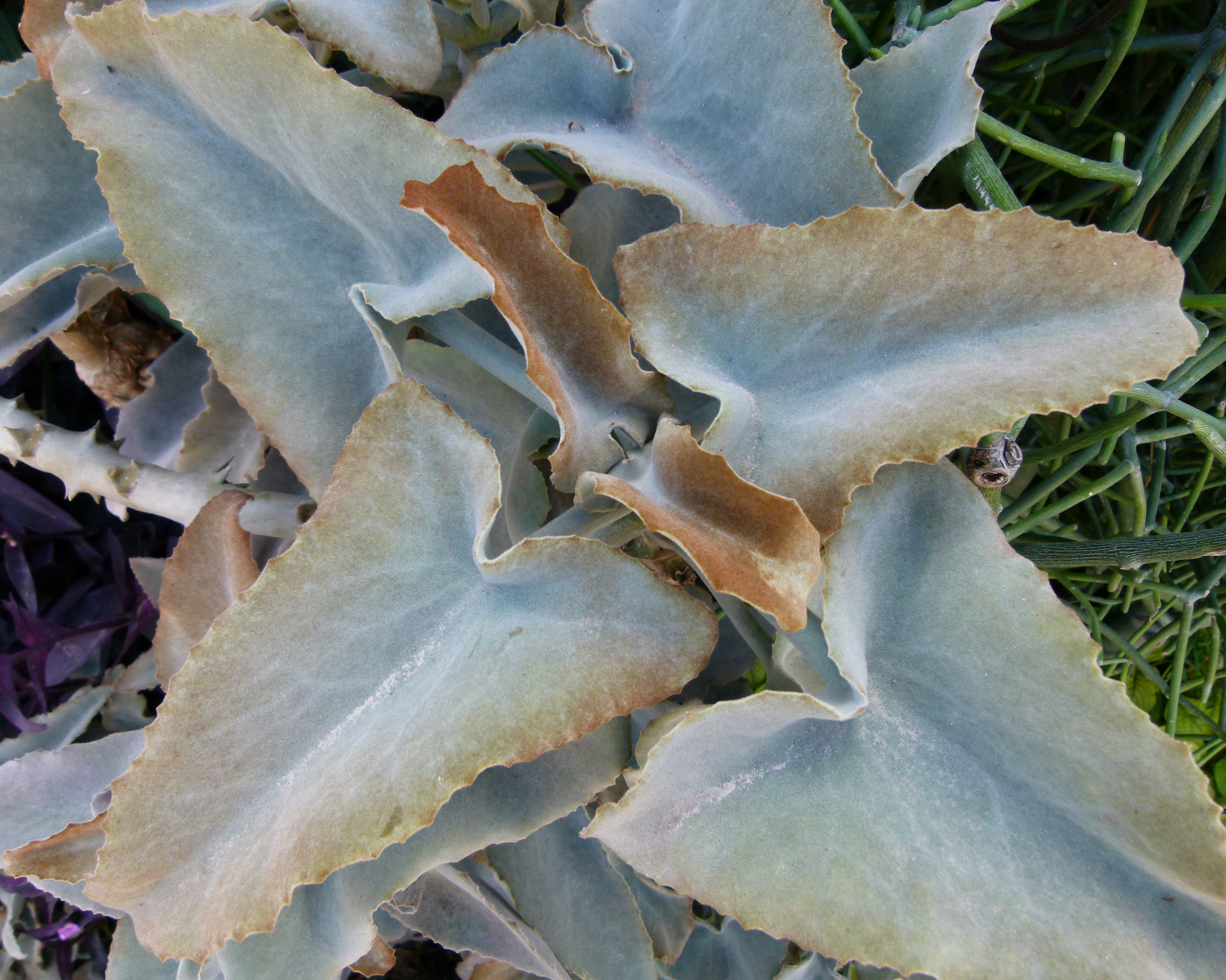
The plant is best known for its triangular, velvety leaves, pale with fine hairs on both surfaces and often blushing reddish-brown under strong sun, with ruffled margins and a growth habit in opposing pairs along slender, knotted stems. In the wild it can become quite large, even tree-like with a woody trunk, though container culture keeps it far smaller. Varieties like 'Fang' show bronze-topped leaves with small protuberances underneath, while dwarf forms such as 'Oak Leaf' and 'Brown Dwarf' offer more compact rosettes in silvery or soft brown tones.
Source: Epic Gardening
Sap-Sucking Visitors
Aphids, mealybugs, and spider mites are the main pests to watch for, since the plant's juicy leaves are appealing to sap-suckers. Aphids leave sticky honeydew and cause leaf curling or yellowing, mealybugs appear as white fuzzy clusters that shrivel leaves and stunt growth, and spider mites leave fine webbing along with pale or yellow speckling on the foliage.
Source: Epic Gardening
Watch the Roots
Root rot is this succulent's most persistent problem, almost always traced back to overwatering or poor drainage that leaves roots sitting in moisture they cannot absorb. Affected roots soften, turn vulnerable to fungus and bacteria, and can show up as blackening at the stem or lower leaves; the remedy is to unpot, let the roots dry out in shade, and replant in fresh, well-draining soil with adjusted watering habits going forward.
Source: Epic Gardening
Little Upkeep Needed
This is a low-maintenance plant that asks for very little pruning beyond shaping or removing dead and unhealthy foliage to redirect energy into new growth. A spindly specimen can be cut back to a large leaf in spring to encourage it to thicken and fill back in.
Source: Epic Gardening
Care recipe
The species record — the baseline every cultivar inherits unless it says otherwise.
Care notes are early — not yet verified
- Light
- ai:claude-opus-4-8
- Water
- ai:claude-opus-4-8 (range 14-28d)
- Humidity
- ai:claude-opus-4-8
- Soil
- ai:claude-fable-5
- Care
- ai:claude-fable-5
Direct sun
≈ every 28 days
Low — average room
10–32 °C
Gritty, fast-draining cactus and succulent mix
Leaf or stem cuttings callused then rooted
Dilute succulent feed once or twice in summer
Slow
Rarely flowers indoors; grown for felted leaves
Toxic to cats & dogs
Crassulaceae of the genus Kalanchoe contain bufadienolide cardiac glycosides. This is where toxicity lives: every cultivar of this species inherits it and none can override it.
Reference images
Every image credited. Licenses link to their deeds.
PrimarySources: ai:claude-opus-4-8 · ai:claude-opus-4-8 (range 14-28d) · ai:claude-fable-5 · ai:claude-opus-4-8 (family inference)
Kept true by its growers
Every fact here carries its source. Grow Velvet Leaf yourself? What you’ve observed — how it drinks, how it holds its color, a name that’s off — and a clear photo of your plant are exactly what keep this page honest. Contributions are reviewed before anything changes.
Sign in to add what you know →