Species · genus Jasminum · Oleaceae
Arabian Jasmine
Jasminum sambac (L.) Aiton
Also known as: Sambac Jasmine · Tuscan-jasmine · Mogra
Cultivars of J. sambac
The named forms growers keep — each with its own page, each honest about how much we know.
No named cultivars catalogued under J. sambac yet. When growers document a stable, named form, it earns its own page here.
Guide
The species-level account. Cultivar pages build on this and say where they differ.
A Fragrant Tropical Shrub
Arabian jasmine, Jasminum sambac, is a broadleaf evergreen prized above all for its intensely fragrant white flowers. It can be grown as a mounding shrub or, given a support, trained as a twining vine, and it holds a place of cultural honor as the national flower of the Philippines.
Source: Missouri Botanical Garden
A Plant Of Many Names
This species likely originates from India or tropical Southeast Asia. It travels under many local names: Sampaguita in the Philippines, Pikake in Hawaii, Mogra in India, and Melati Putih in Indonesia. Its blossoms are woven into Hawaiian leis and dried to scent Chinese jasmine tea, and it stands as one of the national plants of both the Philippines and Indonesia.
Source: Epic Gardening
Warmth, Moisture, Light
Give this plant full sun to partial shade, aiming for six to eight hours of light daily, since strong light is what drives reliable flowering. Keep the soil consistently moist with about an inch of water weekly, checking that the top two inches are dry before watering again, and back off in winter to avoid rot. It favors humid, warm conditions, best between 80 and 90°F by day and 70 to 80°F at night, and appreciates a loose, humus-rich, well-draining soil kept slightly acidic. Skip feeding right after bringing it home, then settle into a rhythm: four seasonal feedings outdoors or a monthly diluted liquid feed indoors, tapering off if temperatures drop below 70°F.
Source: Epic Gardening
Rooting From Cuttings
Arabian jasmine is propagated from semi-hardwood cuttings taken from the previous season's growth, since older, fully hardened wood roots poorly. Cut just below a leaf node, strip away all but the top three leaves and any buds or flowers, then dip the cutting in water and rooting hormone before setting it into potting soil right away. Some growers also propagate by layering in autumn.
Source: Epic Gardening
Waxy Blooms, Twining Habit
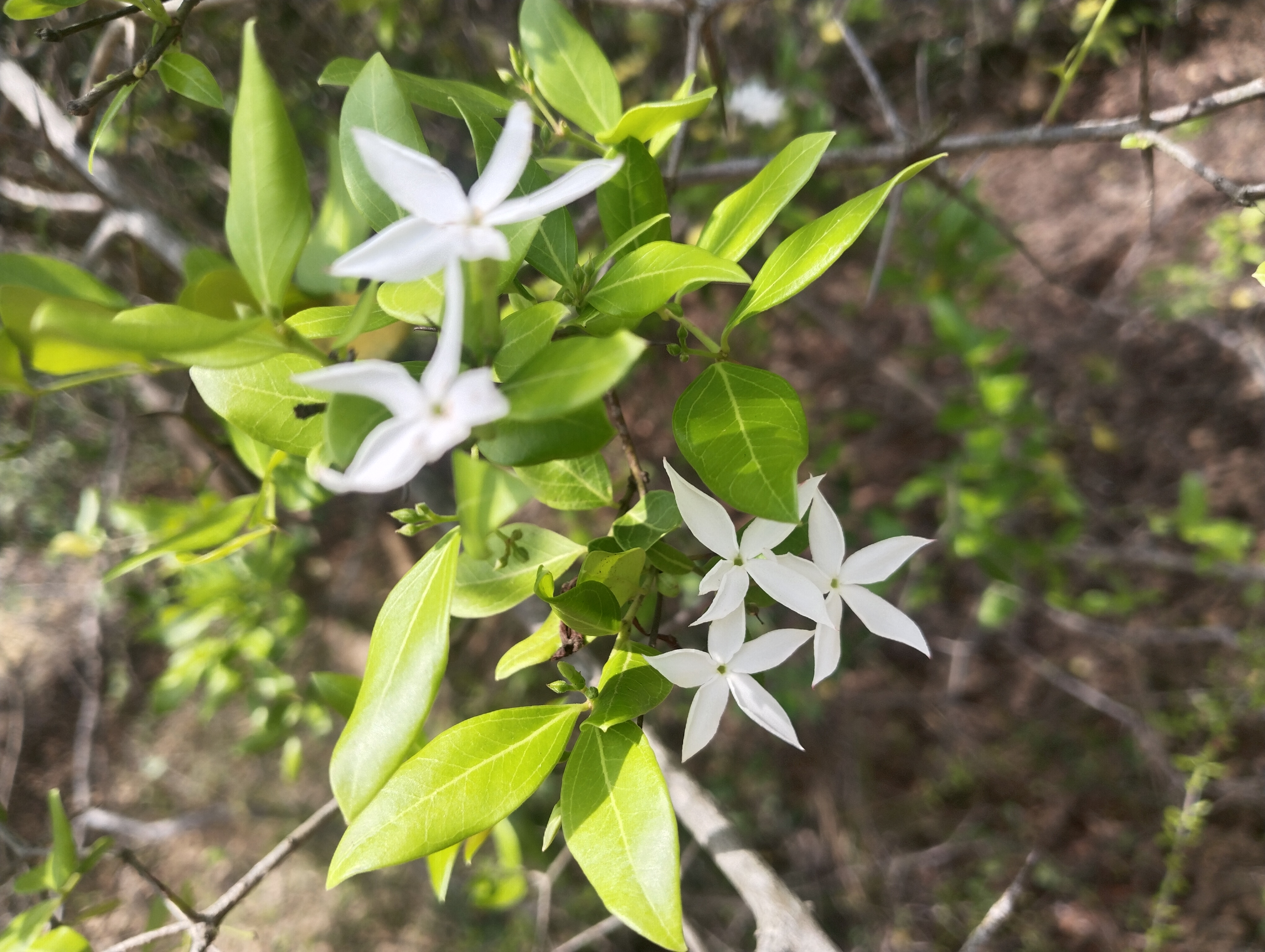
The plant carries softly downy stems and broad, oval, dark green leaves reaching about three inches long. Its waxy white flowers, roughly an inch across, cluster in groups of three to twelve and age from white to pale pink before browning. In its native range it can stretch to 25 feet, though in cultivation it is usually kept far shorter, and left unsupported it sprawls as a shrub rather than climbing.
Source: Missouri Botanical Garden
Sap-Sucking Visitors
Aphids, spider mites, and scale insects are the pests most likely to trouble this plant, all of them sap-suckers that can be caught early by checking stems and leaf undersides. Under glass, mealybugs and glasshouse red spider mite are also worth watching for.
Source: RHS
Reading The Leaves
A lack of flowers usually points to insufficient light, so a brighter spot often solves it. Yellowing leaves are most often a sign of underwatering, since this plant does not tolerate drought and will droop before it yellows, though soggy, waterlogged soil can cause the very same symptom. Poor fertilizing habits can compound the picture too: too much feed burns the roots, too little leaves the plant short on nutrients, and a soil test can help sort out which is at play. Leaf spot and root rot are the main diseases, both tied to overwatering, so water at the base rather than over the foliage and keep the soil from staying soggy.
Source: Epic Gardening
Pruning And Repotting
Prune once blooming ends and winter sets in, cutting away dead growth and spent flowers just above a node to encourage the next flush. Shrub forms need more frequent trimming to stay in bounds, as this plant grows vigorously and is considered invasive in parts of Florida; many gardeners hold it to two to four feet. When repotting, move up only two to three inches in pot size, since oversized containers hold excess moisture, and keep the plant at its original depth without burying the crown.
Source: Epic Gardening
Care recipe
The species record — the baseline every cultivar inherits unless it says otherwise.
Care notes are early — not yet verified
- Light
- ai:claude-opus-4-8
- Water
- ai:claude-opus-4-8 (range 3-7d)
- Humidity
- ai:claude-opus-4-8
- Soil
- ai:claude-fable-5
- Care
- ai:claude-fable-5
Direct sun
≈ every 7 days
Medium
15–30 °C
Fertile, well-draining mix kept evenly moist
Semi-ripe cuttings or layering under warmth
Balanced liquid feed every two to four weeks when growing
Moderate
Intensely fragrant white flowers through warm months
Not yet documented
This is where toxicity lives — every cultivar of this species inherits it and none can override it.
Reference images
Every image credited. Licenses link to their deeds.
PrimarySources: ai:claude-opus-4-8 · ai:claude-opus-4-8 (range 3-7d) · ai:claude-fable-5
Kept true by its growers
Every fact here carries its source. Grow Arabian Jasmine yourself? What you’ve observed — how it drinks, how it holds its color, a name that’s off — and a clear photo of your plant are exactly what keep this page honest. Contributions are reviewed before anything changes.
Sign in to add what you know →