Species · genus Jasminum · Oleaceae
Summer Jasmine
Jasminum officinale L.
Also known as: Poet's Jasmine · Common Jasmine · Jasmine · Jessamine · White Jasmine
Cultivars of J. officinale
The named forms growers keep — each with its own page, each honest about how much we know.
No named cultivars catalogued under J. officinale yet. When growers document a stable, named form, it earns its own page here.
Guide
The species-level account. Cultivar pages build on this and say where they differ.
A Fragrant Climbing Vine
Jasminum officinale, known as common jasmine, is a sprawling, twining climber grown above all for its sweet-smelling flowers. A single vine can perfume a whole room or garden, which is why it has long been a favourite for both outdoor structures and indoor pots.
Source: Missouri Botanical Garden
From Asia's Mountains
This jasmine's native range runs through Asia Minor, the Himalayas, and China, and it belongs to the olive family, Oleaceae. Its genus name traces back to a medieval Latin rendering of the Persian yasmin, and the species name simply notes that it was once sold in shops.
Source: Missouri Botanical Garden
Sun, Support, and Steady Moisture
Common jasmine wants a warm, sheltered spot in full sun to partial shade, ideally south- or west-facing, in fertile, well-drained soil. Newly planted specimens need regular watering until established, after which ground-grown plants generally cope on rainfall alone except in dry spells, while container plants need consistent watering through the growing season. Feed container-grown plants with a high-potassium liquid feed to encourage flowering; those in open ground usually need nothing beyond an annual mulch.
Source: RHS
Layering and Cuttings
New plants are most straightforwardly raised by layering or by taking cuttings. Outdoor jasmines do best from hardwood cuttings taken in winter, while tender or glasshouse types root well from semi-ripe or softwood cuttings taken in spring or summer. Seed propagation is possible but rarely practical, since jasmine seldom sets berries in cultivation.
Source: RHS
Pinnate Leaves, Starry Blooms
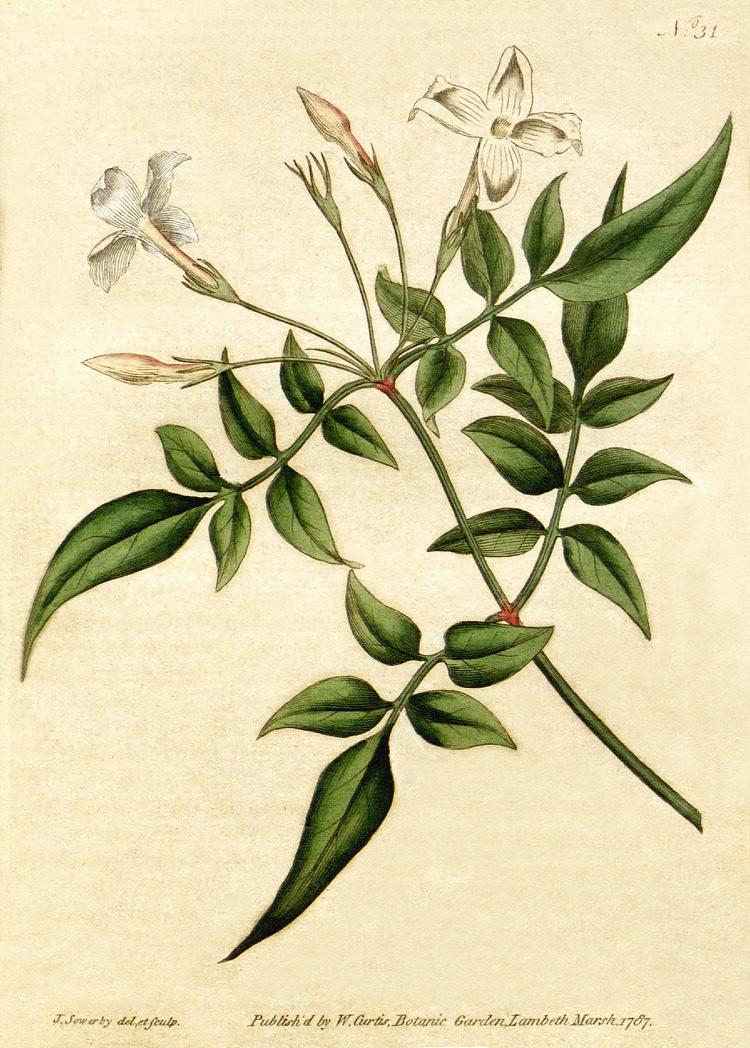
It is a vigorous, usually deciduous climber that can reach up to 12 metres, with green stems carrying mid-green, pinnate leaves made up of seven to nine leaflets. From summer into early autumn it produces clusters of three to ten very fragrant white flowers, each about 2cm across, occasionally followed by blackish-purple fruits.
Source: RHS
Watch for Sap-Feeders
Common jasmine is largely trouble-free outdoors, though aphids can turn up on tender new shoots without usually needing treatment. Grown indoors, it is more prone to sap-feeding pests such as mealybugs and red spider mites, along with scale insects, so it is worth checking plants regularly to catch any outbreak early.
Source: RHS
Prune After Flowering
Give the plant an annual prune just after flowering, in late summer or early autumn, cutting flowered stems back to a strong side-shoot and thinning out crowded, damaged, or weak growth. This timing allows new wood to mature before the following season's flowers. An overgrown plant can be cut back hard to within 60cm of the base, though it will then take two or three years to bloom again. A generous autumn mulch of organic matter over the root area helps retain moisture and insulates roots that aren't fully hardy, leaving a small gap around the stem base to prevent rot.
Source: RHS
Care recipe
The species record — the baseline every cultivar inherits unless it says otherwise.
Care notes are early — not yet verified
- Light
- ai:claude-opus-4-8
- Water
- ai:claude-opus-4-8 (range 5-10d)
- Humidity
- ai:claude-opus-4-8
- Soil
- ai:claude-fable-5
- Care
- ai:claude-fable-5
Bright, indirect
≈ every 10 days
Medium
7–24 °C
Fertile, well-draining mix kept evenly moist
Semi-ripe cuttings or layering
Balanced liquid feed monthly through spring and summer
Fast
Fragrant white summer flowers, pink in bud
Not yet documented
This is where toxicity lives — every cultivar of this species inherits it and none can override it.
Reference images
Every image credited. Licenses link to their deeds.
Sources: ai:claude-opus-4-8 · ai:claude-opus-4-8 (range 5-10d) · ai:claude-fable-5
Kept true by its growers
Every fact here carries its source. Grow Summer Jasmine yourself? What you’ve observed — how it drinks, how it holds its color, a name that’s off — and a clear photo of your plant are exactly what keep this page honest. Contributions are reviewed before anything changes.
Sign in to add what you know →