Species · genus Jasminum · Oleaceae
Winter Jasmine
Jasminum nudiflorum Lindl.
Cultivars of J. nudiflorum
The named forms growers keep — each with its own page, each honest about how much we know.
No named cultivars catalogued under J. nudiflorum yet. When growers document a stable, named form, it earns its own page here.
Guide
The species-level account. Cultivar pages build on this and say where they differ.
Winter jasmine, in brief
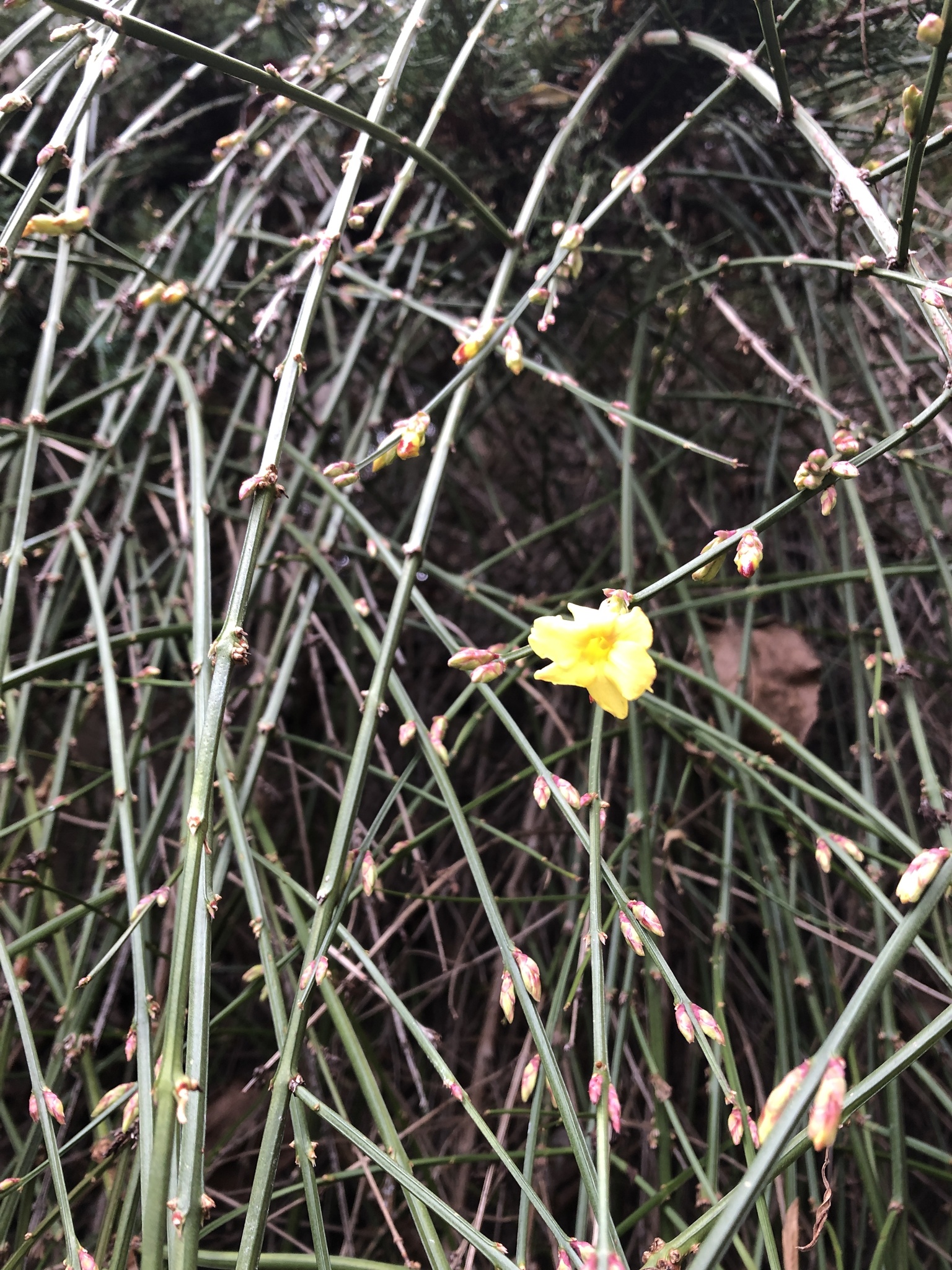
Winter jasmine is a medium-sized deciduous shrub grown for its bright yellow flowers, which open on bare stems through the colder months. It carries small, trifoliate leaves and long, arching branches, and belongs to the olive family, Oleaceae.
Source: RHS
A native of northern China
This species comes originally from northern China, and is not native to Britain or Ireland. It has long been valued in gardens for bringing colour to the garden precisely when little else is in flower.
Source: RHS
An easy, tolerant shrub
Winter jasmine is content in full sun or partial shade, in any reasonably well-drained soil, whether acid, alkaline or neutral, and tolerates chalk, clay, loam or sand. It is fully hardy and asks for a sheltered spot rather than special protection. Newly planted specimens need regular watering until established, but mature plants in the ground generally cope without extra watering except in dry summer spells, and an annual autumn mulch of organic matter takes the place of feeding.
Source: RHS
Layering or cuttings
New plants are raised by layering or by semi-hardwood cuttings. Outdoor jasmines such as this one are best propagated from hardwood cuttings taken in winter.
Source: RHS
Bare stems, bright flowers
The habit is clump-forming, with long arching stems that scramble rather than climb, needing no support of their own though they can be trained against a wall. Small trifoliate leaves accompany flowers up to 2.5cm across, appearing in a bright, unscented yellow across winter and into spring.
Source: RHS
Mostly trouble-free
Winter jasmine is generally untroubled outdoors, though it may occasionally attract aphids, scale insects or mealybugs, and, if grown under glass, glasshouse red spider mite. Checking plants regularly makes any outbreak easier to catch early.
Source: RHS
Few real problems
This is a generally trouble-free plant when grown in suitable conditions, and outdoor specimens suffer few pests or diseases. It is only rarely susceptible to honey fungus.
Source: RHS
Prune after flowering
This shrub falls into pruning group two, so it is best cut back in spring, immediately after flowering, since its blooms form on the previous year's growth. Cut flowered stems back to a strong side-shoot lower down, and thin out any overcrowded, damaged or weak stems. If it has outgrown its space, it tolerates hard renovation, cut back to within 60cm of the base, though it will then take two or three years to flower again.
Source: RHS
Care recipe
The species record — the baseline every cultivar inherits unless it says otherwise.
Care notes are early — not yet verified
- Light
- ai:claude-opus-4-8
- Water
- ai:claude-opus-4-8 (range 5-10d)
- Humidity
- ai:claude-opus-4-8
- Soil
- ai:claude-fable-5
- Care
- ai:claude-fable-5
Direct sun
≈ every 10 days
Medium
5–22 °C
Well-draining loamy mix; tolerates poorer soils
Semi-ripe cuttings or layering
Light balanced feed monthly in growing season
Fast
Cheerful yellow flowers on bare stems in winter
Not yet documented
This is where toxicity lives — every cultivar of this species inherits it and none can override it.
Reference images
Every image credited. Licenses link to their deeds.
PrimarySources: ai:claude-opus-4-8 · ai:claude-opus-4-8 (range 5-10d) · ai:claude-fable-5
Kept true by its growers
Every fact here carries its source. Grow Winter Jasmine yourself? What you’ve observed — how it drinks, how it holds its color, a name that’s off — and a clear photo of your plant are exactly what keep this page honest. Contributions are reviewed before anything changes.
Sign in to add what you know →