Species · genus Jasminum · Oleaceae
Many-Petalled Jasmine
Jasminum multipartitum Hochst.
Also known as: Wild Jasmine · Wild Jessamine
Cultivars of J. multipartitum
The named forms growers keep — each with its own page, each honest about how much we know.
No named cultivars catalogued under J. multipartitum yet. When growers document a stable, named form, it earns its own page here.
Guide
The species-level account. Cultivar pages build on this and say where they differ.
Starry wild jasmine
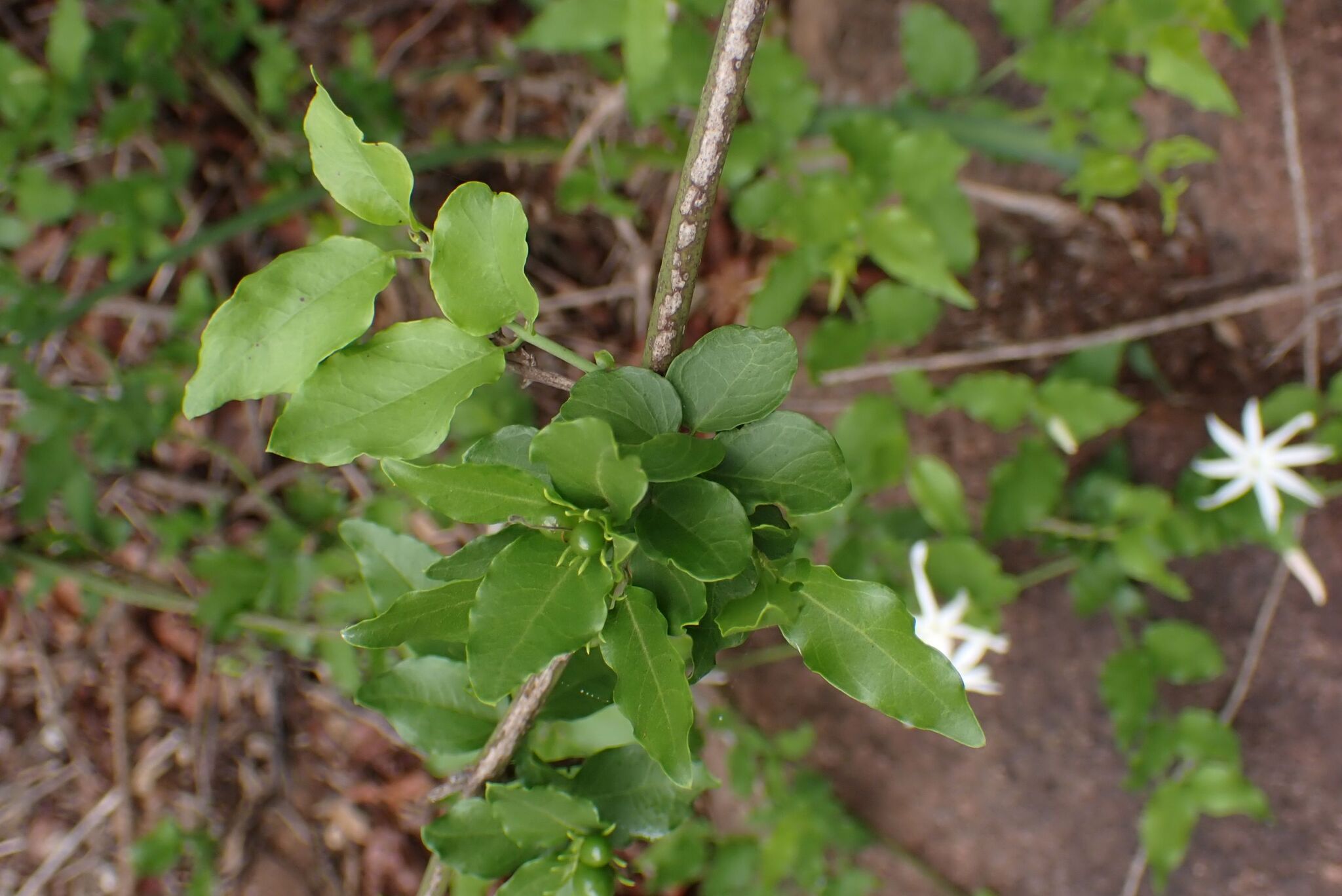
Jasminum multipartitum, known as starry wild jasmine or African jasmine, is an evergreen shrub with glossy dark green leaves and a bushy habit reaching around 1 to 1.5 metres. From late spring into late summer it carries large, eight-petalled, star-shaped white flowers that open from deep pink buds, with a scent that grows more noticeable in the evening.
Source: RHS
A southern African native
This species is native to southern tropical and southern Africa, with a range that takes in the Cape Provinces, Eswatini, KwaZulu-Natal, Mozambique, the Northern Provinces and Zimbabwe. In the wild it grows as a scrambling shrub within the subtropical biome. It was first described by Hochstetter and published in 1844, and belongs to the olive family, Oleaceae.
Source: Kew
Sun, shelter, good drainage
Outdoors this jasmine wants a sheltered, frost-free spot in full sun or partial shade, ideally against a south- or west-facing aspect, in well-drained loam or sandy soil that can be acid, neutral or alkaline. Under glass, grow it in peat-free, loam-based compost and bright filtered light. It is only rated to withstand cool temperatures, not frost, so protection matters through the colder months.
Source: RHS
Seed, cuttings or layering
Propagate by seed, by semi-hardwood cuttings, or by layering carried out in autumn.
Source: RHS
Watch under glass
Grown under glass, this jasmine may be susceptible to aphids, scale insects and mealybugs.
Source: RHS
Honey fungus, rarely
Honey fungus is noted as a possible disease risk for this plant, though the RHS describes it as rare.
Source: RHS
Pruning group nine
This shrub falls into pruning group 9, the guidance used for evergreen shrubs of this type.
Source: RHS
Care recipe
The species record — the baseline every cultivar inherits unless it says otherwise.
Care notes are early — not yet verified
- Light
- ai:claude-opus-4-8
- Water
- ai:claude-opus-4-8 (range 7-12d)
- Humidity
- ai:claude-opus-4-8
- Soil
- ai:claude-fable-5
- Care
- ai:claude-fable-5
Bright, indirect
≈ every 12 days
Medium
10–27 °C
Well-draining loamy mix with organic matter
Semi-ripe cuttings rooted under warmth
Balanced feed monthly during active growth
Moderate
Highly fragrant white flowers, pink-tinged in bud
Not yet documented
This is where toxicity lives — every cultivar of this species inherits it and none can override it.
Reference images
Every image credited. Licenses link to their deeds.
PrimarySources: ai:claude-opus-4-8 · ai:claude-opus-4-8 (range 7-12d) · ai:claude-fable-5
Kept true by its growers
Every fact here carries its source. Grow Many-Petalled Jasmine yourself? What you’ve observed — how it drinks, how it holds its color, a name that’s off — and a clear photo of your plant are exactly what keep this page honest. Contributions are reviewed before anything changes.
Sign in to add what you know →