Species · genus Hoya · Apocynaceae
Hoya
Hoya pubicalyx Merr.
Also known as: Wax Plant · Wax Flower · Porcelain Flower
Cultivars of H. pubicalyx
The named forms growers keep — each with its own page, each honest about how much we know.
No named cultivars catalogued under H. pubicalyx yet. When growers document a stable, named form, it earns its own page here.
Guide
The species-level account. Cultivar pages build on this and say where they differ.
An evergreen climbing hoya
Hoya pubicalyx is an evergreen climbing vine grown both as a houseplant and, given the room, a conservatory or greenhouse climber. Its narrow, glossy dark green leaves and clusters of fragrant star-shaped flowers place it firmly among the wax plants, a genus known for leathery foliage and waxy, five-petalled blooms.
Source: RHS
Philippine wax plant
This species comes from the Philippines, part of a wider Hoya genus that spreads across the Philippines, India, Thailand, Malaysia, Vietnam, Bangladesh, Indonesia, Polynesia, New Guinea, and parts of Australia. Within that family it belongs to the Apocynaceae, alongside several hundred other hoya species and cultivars.
Source: Epic Gardening
Bright light, careful watering
Grow it indoors in a free-draining mix, positioned in bright filtered light with moderate to high humidity. Water freely through the growing season but let it run just moist over winter, since it will not tolerate wet soil. More broadly, hoyas as a group are epiphytic and prefer their soil to dry out between waterings, with feeding shifted from a nitrogen-rich formula for foliage to a phosphorous-rich one shortly before the bloom period to support flowering.
Source: RHS
Cuttings or layering
This hoya is propagated by semi-hardwood cuttings or by layering. More generally, hoya cuttings are best taken from softer, newer growth, four to six inches long with a few leaves, and rooted in water or a lightly dampened medium, where they tend to root readily.
Source: RHS
Foliage that shifts colour
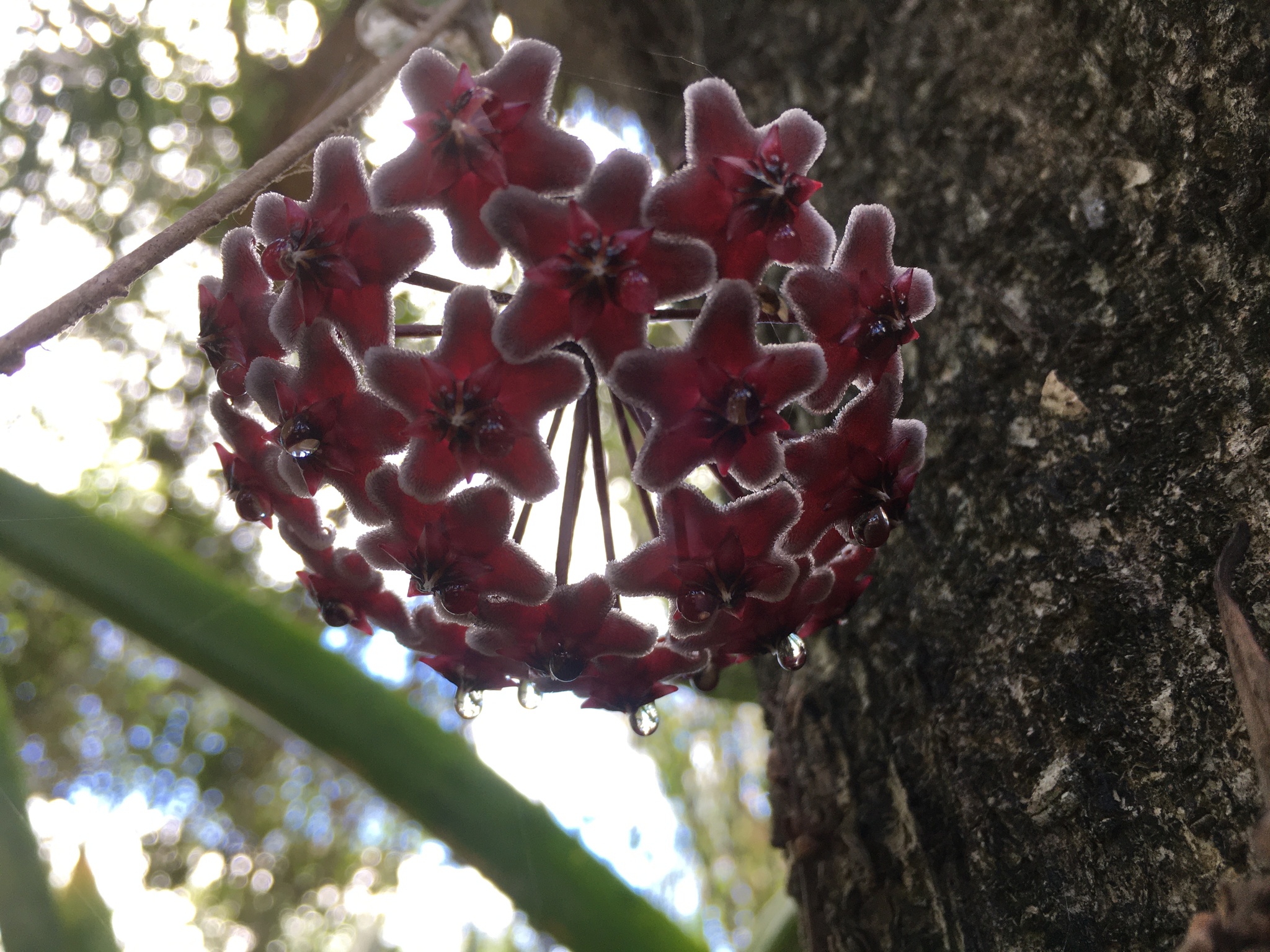
The long, narrow leaves are glossy dark green but take on a silvery-pink cast when given more sun, a trait particular to this species. From late spring into late summer it produces clusters of star-shaped, pale red flowers with pink centres, and these release their fragrance mainly in the evening. Left to its own devices it can climb to 2.5–4 metres with a spread of 1–1.5 metres.
Source: RHS
Sap-suckers to watch
Hoya pubicalyx may be troubled by mealybugs, glasshouse whitefly, and scale insects. It is otherwise generally disease-free.
Source: RHS
Watering is the usual culprit
Most growing troubles in hoyas trace back to watering. Overwatering can bring on rot and kill the plant, while underwatering shows up as wilting and yellowing leaves, so it is safer to lean toward slight underwatering given the plant's epiphytic nature.
Source: Epic Gardening
Prune sparingly, keep spurs
Pruning falls into group 11, and in practice this means removing only wilted, damaged, or dead growth. Flower buds form on older flowering stems called spurs, which bloom again year after year, so those are best left alone, and the trailing stems should not be cut back too hard since the plant needs that length to fill out and flower.
Source: Epic Gardening
Care recipe
The species record — the baseline every cultivar inherits unless it says otherwise.
Care notes are early — not yet verified
- Light
- ai:claude-opus-4-8
- Water
- ai:claude-opus-4-8 (range 7-14d)
- Humidity
- ai:claude-opus-4-8
- Soil
- ai:claude-fable-5
- Care
- ai:claude-fable-5
Bright, indirect
≈ every 14 days
Medium
15–29 °C
Chunky, free-draining epiphyte or orchid-style mix
Stem cuttings with a node, rooted in water or mix
Dilute balanced feed monthly in spring and summer
Fast
Prolific fragrant flower clusters; leave old spurs intact
Toxic to cats & dogs & humans
Apocynaceae family is associated with cardiac glycosides and milky irritant sap This is where toxicity lives: every cultivar of this species inherits it and none can override it.
Reference images
Every image credited. Licenses link to their deeds.
PrimarySources: ai:claude-opus-4-8 · ai:claude-opus-4-8 (range 7-14d) · ai:claude-fable-5 · ai:claude-opus-4-8 (family inference)
Kept true by its growers
Every fact here carries its source. Grow Hoya yourself? What you’ve observed — how it drinks, how it holds its color, a name that’s off — and a clear photo of your plant are exactly what keep this page honest. Contributions are reviewed before anything changes.
Sign in to add what you know →