Species · genus Heptapleurum · Araliaceae
Australian Umbrella Tree
Heptapleurum actinophyllum (Endl.) Lowry & G.M.Plunkett
Also known as: Octopus Tree · Umbrella Tree · Australian Cabbagetree · Queensland Umbrella-tree
Cultivars of H. actinophyllum
The named forms growers keep — each with its own page, each honest about how much we know.
No named cultivars catalogued under H. actinophyllum yet. When growers document a stable, named form, it earns its own page here.
Guide
The species-level account. Cultivar pages build on this and say where they differ.
An Umbrella Tree Indoors
This is Heptapleurum actinophyllum, better known to many by its old name Schefflera actinophylla, or the Queensland umbrella tree. It is a fast-growing, compact evergreen shrub or small tree, valued indoors for its glossy, umbrella-like foliage and its knack for giving a room a tropical feel.
Source: RHS
From Australia's Wet Tropics
Its native ground runs from southern New Guinea into northern Australia, including Queensland and the Northern Territory, where it grows as a scrambling tree in wet tropical forest. From there it has travelled widely, becoming introduced and naturalised in places as far apart as Florida, Hawaii, the Canary Islands, and Bangladesh.
Source: Kew
Light, Water, Feed
Grow it in standard houseplant compost in bright indirect light, in a spot with moist but well-drained soil. During active growth, water moderately and feed monthly with a balanced liquid fertiliser, then cut back to sparing watering once winter sets in.
Source: RHS
Cuttings, Seed, or Layering
This plant can be raised from seed, from semi-ripe or semi-hardwood cuttings, or by air-layering.
Source: RHS
Leathery, Radiating Leaflets
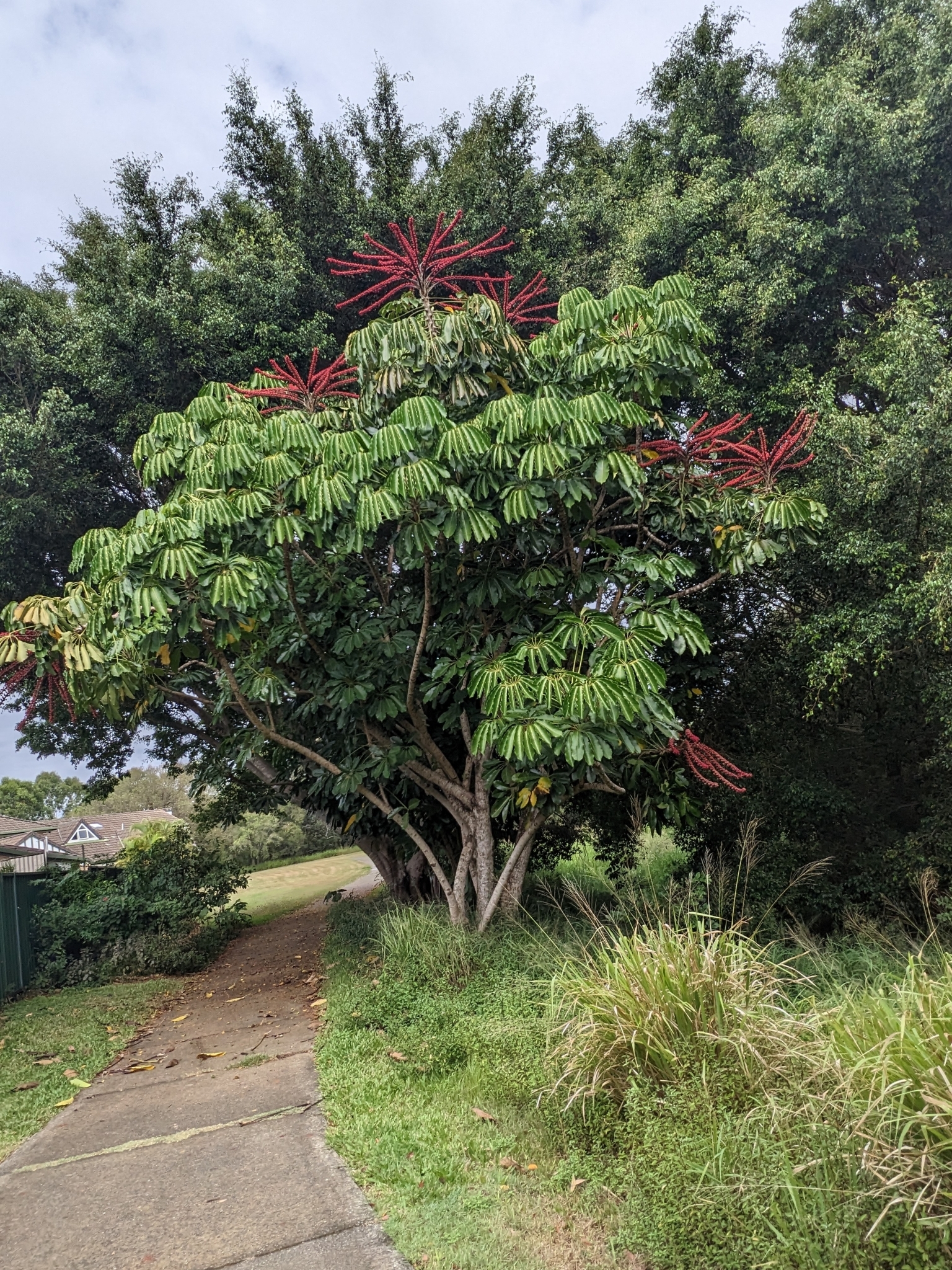
The leaves are leathery and palmately compound, arranged in a spoke-like whorl of five or more oblong leaflets that can reach 30cm long, giving the umbrella-like look the plant is named for. Juvenile plants carry fewer, smaller leaflets than the adult form. In the wild it can produce erect panicles of small dull red flowers followed by black fruit, though as a houseplant it generally stays a foliage plant without flowering.
Source: RHS
Watch for Sap-Suckers
Keep an eye out for glasshouse red spider mite, mealybugs, and scale insects, which are the pests most likely to trouble it. It is otherwise generally free of disease.
Source: RHS
Light Pruning Only
This species falls into the light pruning group, so it asks for only modest trimming to keep its shape rather than any hard cutting back.
Source: RHS
Care recipe
The species record — the baseline every cultivar inherits unless it says otherwise.
Care notes are early — not yet verified
- Light
- ai:claude-opus-4-8
- Water
- ai:claude-opus-4-8 (range 7-14d)
- Humidity
- ai:claude-opus-4-8
- Soil
- ai:claude-fable-5
- Care
- ai:claude-fable-5
Bright, indirect
≈ every 14 days
Medium
13–27 °C
Well-draining, peat-based potting mix
Stem cuttings or air layering
Balanced liquid feed monthly in the growing season
Fast
Does not flower indoors
Toxic to cats & dogs & humans
Araliaceae commonly contain insoluble calcium oxalate crystals and saponins that irritate the mouth and gut. This is where toxicity lives: every cultivar of this species inherits it and none can override it.
Reference images
Every image credited. Licenses link to their deeds.
PrimarySources: ai:claude-opus-4-8 · ai:claude-opus-4-8 (range 7-14d) · ai:claude-fable-5 · ai:claude-opus-4-8 (family inference)
Kept true by its growers
Every fact here carries its source. Grow Australian Umbrella Tree yourself? What you’ve observed — how it drinks, how it holds its color, a name that’s off — and a clear photo of your plant are exactly what keep this page honest. Contributions are reviewed before anything changes.
Sign in to add what you know →