Species · genus Haworthiopsis · Asphodelaceae
Fairy Washboard
Haworthiopsis limifolia (Marloth) G.D.Rowley
Also known as: Swati Haworthia
Cultivars of H. limifolia
The named forms growers keep — each with its own page, each honest about how much we know.
No named cultivars catalogued under H. limifolia yet. When growers document a stable, named form, it earns its own page here.
Guide
The species-level account. Cultivar pages build on this and say where they differ.
A Ridged Little Rosette
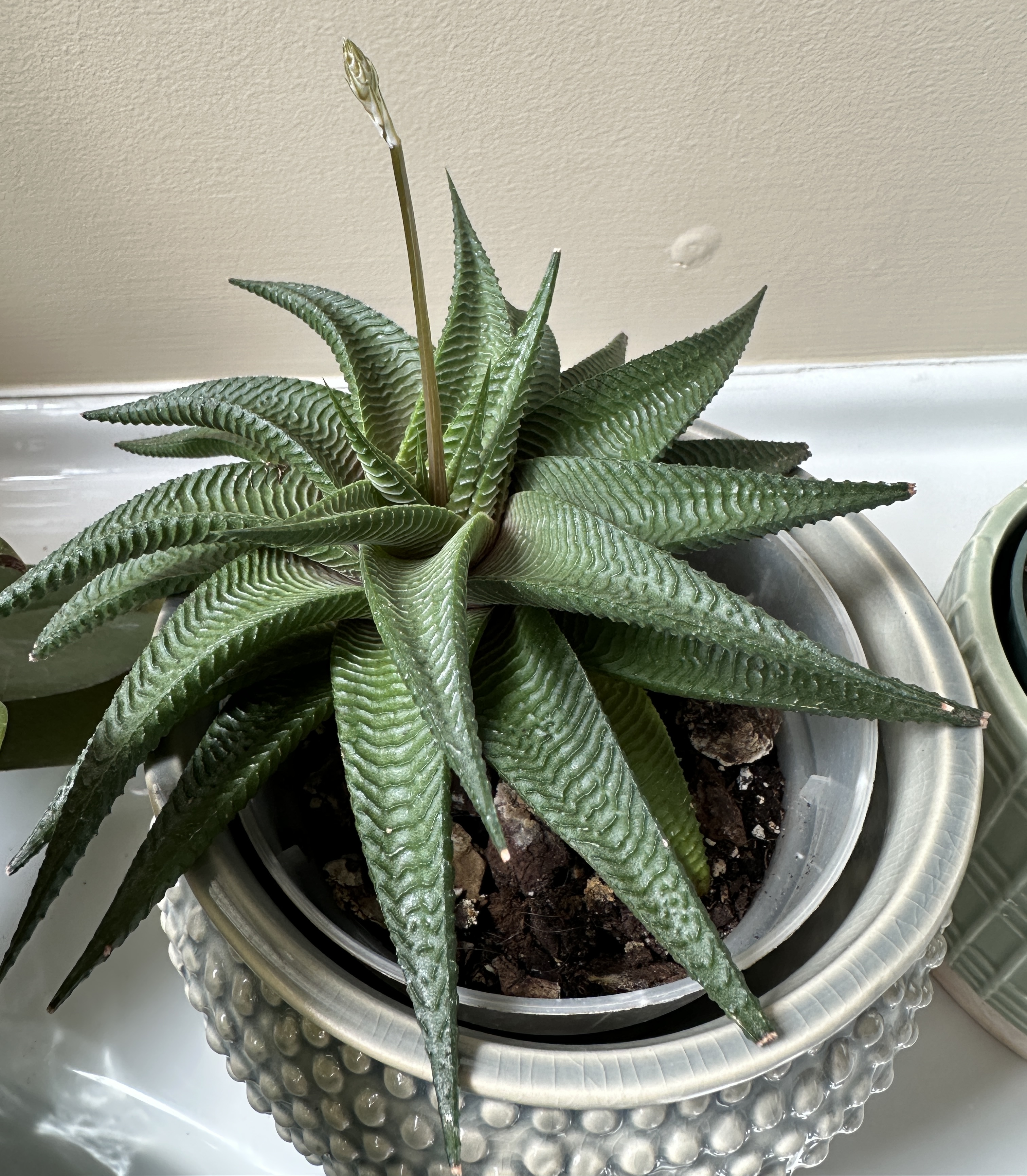
Haworthiopsis limifolia, known as fairy washboard, is a small succulent that builds a spiralling rosette of stiff, triangular leaves. Each leaf carries numerous irregular ridges, giving the whole plant a textured, washboard-like surface. In summer it sends up tall, slender flower stalks bearing small tubular green and white blooms.
Source: RHS
A Southern African Native
This plant belongs to Haworthiopsis, a genus of stemless succulent perennials from southern Africa. Like its relatives, it forms tight rosettes of thick, fleshy leaves, some also marked with raised white tubercles, and produces upright racemes of tubular, two-lipped flowers.
Source: RHS
Sun, Grit, and Restraint
Give it full light but shield it from the hottest sun, and keep humidity low with decent air movement around the leaves. A gritty cactus compost that drains freely suits it best, and during the growing season it wants moderate watering along with a half-strength, low-nitrogen feed once or twice. Come winter, ease off almost entirely and let it sit nearly dry.
Source: RHS
Seed, Offsets, or Leaves
New plants can be started from seed sown at 21–24°C in spring, or you can simply detach the offsets the rosette produces. Leaf cuttings taken in spring and summer are another reliable route.
Source: RHS
Whimsical, Whorled Ridging
The common name nods to tiny woodland creatures, fitting for a plant that stays fast-growing yet compact. Its leaves spiral slightly as they grow, crossed by horizontal ridges running base to tip, and it appears in both plain and variegated forms, the latter striped with bright yellow. On the ordinary green form, yellowing leaves are a sign the plant wants more sunlight.
Source: Epic Gardening
Watch for Mealybugs
This species may draw the occasional mealybug, so it is worth checking leaf axils and the base of the rosette now and then. Beyond that, it is generally free of disease.
Source: RHS
Little Fuss Required
There is no pruning to do here; the rosette simply looks after its own shape. It suits pots, patios, conservatories, or a sunny windowsill as a low-maintenance houseplant, reaching maturity over roughly two to five years.
Source: RHS
Care recipe
The species record — the baseline every cultivar inherits unless it says otherwise.
Care notes are early — not yet verified
- Light
- ai:claude-opus-4-8
- Water
- ai:claude-opus-4-8 (range 14-28d)
- Humidity
- ai:claude-opus-4-8
- Soil
- ai:claude-fable-5
- Care
- ai:claude-fable-5
Bright, indirect
≈ every 28 days
Low — average room
10–27 °C
Gritty, fast-draining cactus and succulent mix
Offsets removed and rooted, or leaf cuttings
Dilute succulent feed once or twice in the growing season
Slow
Small tubular flowers rare indoors
Not yet documented
This is where toxicity lives — every cultivar of this species inherits it and none can override it.
Reference images
Every image credited. Licenses link to their deeds.
PrimarySources: ai:claude-opus-4-8 · ai:claude-opus-4-8 (range 14-28d) · ai:claude-fable-5
Kept true by its growers
Every fact here carries its source. Grow Fairy Washboard yourself? What you’ve observed — how it drinks, how it holds its color, a name that’s off — and a clear photo of your plant are exactly what keep this page honest. Contributions are reviewed before anything changes.
Sign in to add what you know →