Species · genus Haworthiopsis · Asphodelaceae
Albany Haworthia
Haworthiopsis coarctata (Haw.) G.D.Rowley
Also known as: Crowded Haworthia
Cultivars of H. coarctata
The named forms growers keep — each with its own page, each honest about how much we know.
No named cultivars catalogued under H. coarctata yet. When growers document a stable, named form, it earns its own page here.
Guide
The species-level account. Cultivar pages build on this and say where they differ.
A columnar clustering succulent
Haworthiopsis coarctata, once classed as Haworthia coarctata, is a clump-forming evergreen succulent that stacks its fleshy leaves into a dense column rather than the flatter rosette of many relatives. It stays modest in size, reaching only around 20cm tall, which suits it well to pots on a sunny sill.
Source: RHS
A Cape Province native
This species is native to the Cape Provinces of South Africa, growing there as a succulent subshrub within the subtropical biome. It has since been recorded as introduced further afield, into central and southwestern Mexico. Botanically it has travelled under several names, having first been described as Haworthia coarctata before later authors moved it into the genus Haworthiopsis.
Source: Kew
Sun, sparing water, light feeding
Grow this haworthia under glass or on a bright windowsill in standard cactus compost, giving it full light and low humidity. Water freely while it is actively growing, then let it sit just moist through the rest of the year. A dilute, low-nitrogen fertiliser applied fortnightly through late spring and summer supports that growth phase, and the plant appreciates a spell outdoors once summer weather settles.
Source: RHS
Simply from offsets
This species is propagated from the offsets it produces around the base of the clump, rather than from cuttings or seed.
Source: RHS
Stacked, spotted, colour-shifting leaves
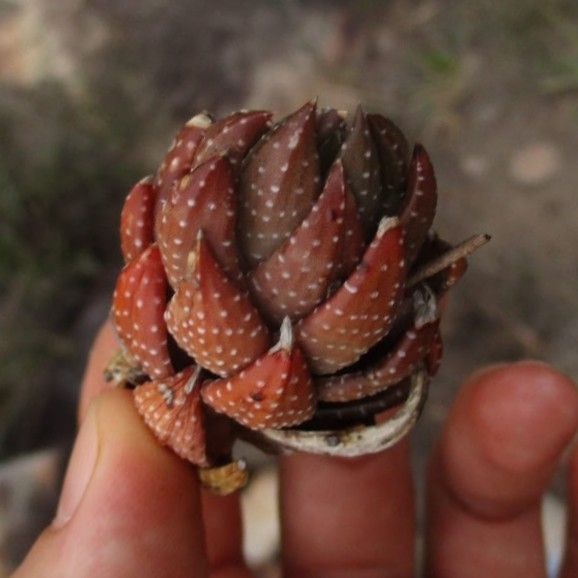
The dark green leaves are densely packed and covered in white spots, building upward into a solid, columnar clump rather than sprawling outward. Long flower stems can rise well above the foliage in spring and summer, carrying small white tubular flowers. Given full sun, the leaves are inclined to flush a rich purple-red, a stress colouring that many keepers find as appealing as the plant's usual green.
Source: RHS
Watch for mealybugs
Mealybugs are the pest most likely to trouble this plant, so it is worth checking the leaf axils and base of the column now and then. Beyond that, it is generally free of disease.
Source: RHS
Little upkeep required
No pruning is needed for this plant, and it is considered low maintenance, making it a good choice for patio containers as well as a windowsill spot. Its slow, steady habit of offsetting means a single plant will gradually thicken into a fuller clump over a couple of years to five.
Source: RHS
Care recipe
The species record — the baseline every cultivar inherits unless it says otherwise.
Care notes are early — not yet verified
- Light
- ai:claude-opus-4-8
- Water
- ai:claude-opus-4-8 (range 14-28d)
- Humidity
- ai:claude-opus-4-8
- Soil
- ai:claude-fable-5
- Care
- ai:claude-fable-5
Bright, indirect
≈ every 28 days
Low — average room
10–27 °C
Sharp, well-draining cactus and succulent mix
Offsets separated and rooted
Dilute feed a couple of times over summer
Slow
Slender stalk of small white flowers; grown for stacked leaves
Not yet documented
This is where toxicity lives — every cultivar of this species inherits it and none can override it.
Reference images
Every image credited. Licenses link to their deeds.
PrimarySources: ai:claude-opus-4-8 · ai:claude-opus-4-8 (range 14-28d) · ai:claude-fable-5
Kept true by its growers
Every fact here carries its source. Grow Albany Haworthia yourself? What you’ve observed — how it drinks, how it holds its color, a name that’s off — and a clear photo of your plant are exactly what keep this page honest. Contributions are reviewed before anything changes.
Sign in to add what you know →