Species · genus Haworthiopsis · Asphodelaceae
Zebra Haworthia
Haworthiopsis attenuata (Haw.) G.D.Rowley
Also known as: Zebra Plant · Zebra Cactus · Zebra Wart
Cultivars of H. attenuata
The named forms growers keep — each with its own page, each honest about how much we know.
No named cultivars catalogued under H. attenuata yet. When growers document a stable, named form, it earns its own page here.
Guide
The species-level account. Cultivar pages build on this and say where they differ.
The Zebra Plant
Haworthiopsis attenuata, still often sold under its old name Haworthia attenuata, is a small rosette-forming succulent known as the zebra plant or zebra cactus for the white banding across its leaves. It is a slow grower, easy enough to keep that it suits both windowsill collections and outdoor succulent beds. Though it resembles a cactus and is sometimes mistaken for an aloe relative, it belongs to the Asphodelaceae family alongside its haworthia cousins.
Source: Epic Gardening
South African Roots
This species comes from the Eastern Cape province of South Africa, part of the wider Cape range the RHS records for the genus. Left to its own pace, it can live for decades, with reports of specimens reaching fifty years old. Its close look-alike, Haworthiopsis fasciata, hails from the same dry corner of South Africa and is often confused with it in cultivation, though true fasciata is actually the rarer of the two to find for sale.
Source: Epic Gardening
Light, Water, Feed
Grow it in cactus compost in full light but shield it from the hottest, most direct sun, and keep humidity low with decent air movement around the pot. Water moderately while it is in active growth, then let it go nearly dry through winter dormancy. During the growing season a half-strength, low-nitrogen feed once or twice is enough, and there is no need to fertilise once growth slows for the colder months.
Source: RHS
Offsets and Leaf Cuttings
The simplest route is dividing offsets, the small pups the mother plant produces at its base, cut away carefully with a sharp knife without disturbing either plant's roots and potted on their own. Leaf cuttings work too: twist a leaf free at the base, let the cut end callus for a few days, then set it into fresh, well-draining potting mix, where it should root within a couple of weeks. The RHS notes seed can also be sown at 21-24°C in spring, alongside offset division or leaf cuttings taken through spring and summer.
Source: Epic Gardening
Striped, Fleshy Rosettes
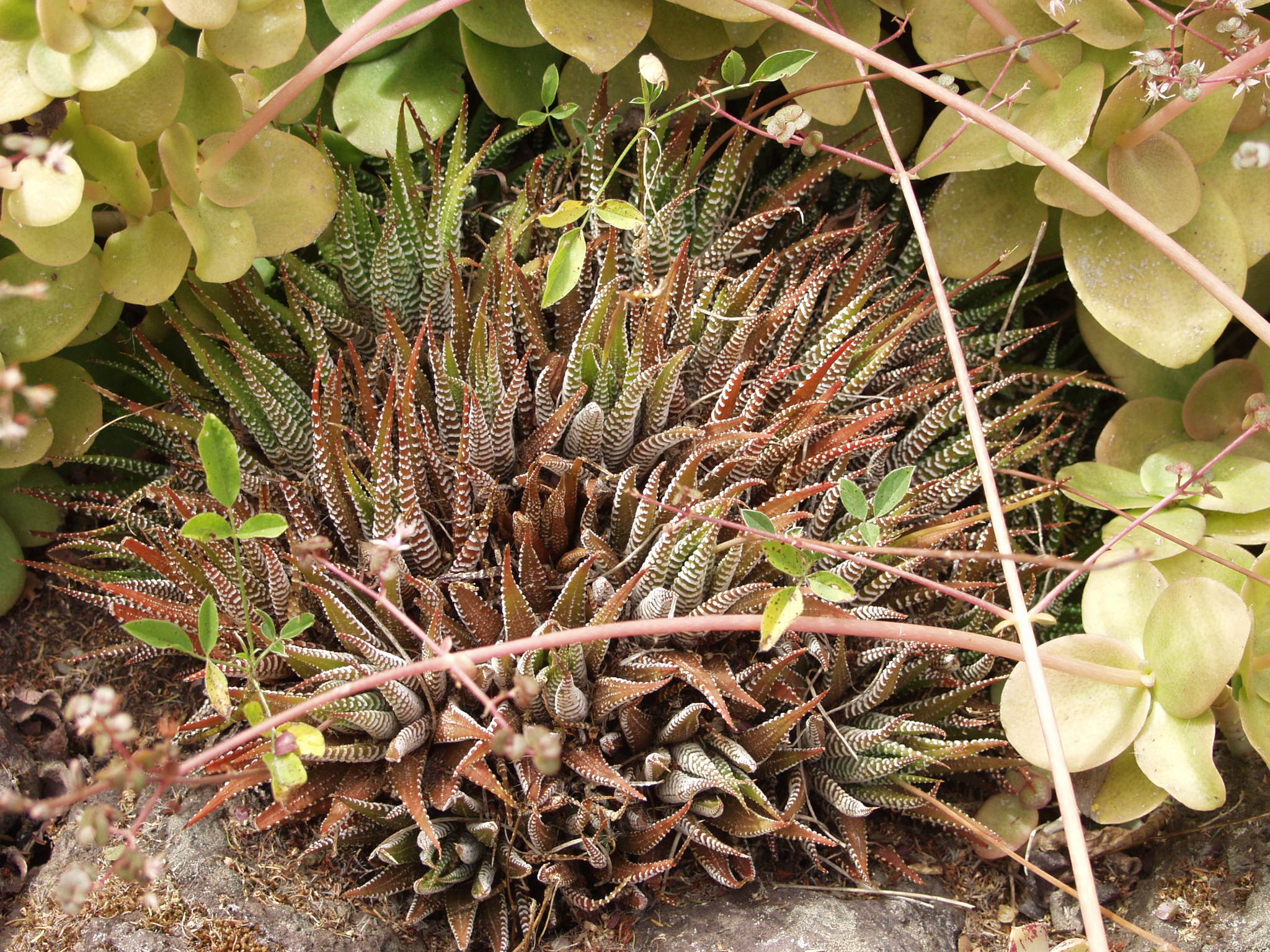
The plant forms a clump of stiff, narrowly triangular, dark green leaves banded with raised white tubercles, giving the zebra-stripe effect on the outer leaf surface and scattered patches on top as well. In summer it can send up wiry flowering stems to around 40cm, tipped with small tubular white flowers. It is distinguished from Haworthiopsis fasciata by carrying its warty white tubercles on both the top and undersides of the leaves, rather than just underneath, and named varieties exist with darker, more compact leaves, cream variegation, or an especially dense scattering of tubercles.
Source: RHS
Mealybugs and Scale
This is not a plant plagued by pests, but mealybugs and other scale insects can turn up on occasion, both sources agree on this. A wipe with a rubbing-alcohol-soaked swab at 70% concentration or lower, or a treatment of insecticidal soap, will usually deal with them.
Source: Epic Gardening
Browning and Rot
Brown, crisping tips usually point to underwatering paired with too much heat, since a thirsty plant is more prone to scorching in intense sun; a good soak and a spot with some midday shade generally reverses it. The opposite problem, mushy and drooping leaves with stalled growth, signals overwatering and root rot, best answered by withholding water, trimming away damaged tissue, and repotting into a freer-draining mix if soggy soil is to blame. The RHS, by contrast, notes the plant is generally disease-free when its basic growing conditions are met.
Source: Epic Gardening
Repotting and Pruning
No pruning is required for this species. It suits wide, shallow pots rather than tall ones given its clumping habit, and only needs sizing up by an inch or two, or dividing into fresh clusters, once offsets have filled the container.
Source: RHS
Care recipe
The species record — the baseline every cultivar inherits unless it says otherwise.
Care notes are early — not yet verified
- Light
- ai:claude-opus-4-8
- Water
- ai:claude-opus-4-8 (range 14-28d)
- Humidity
- ai:claude-opus-4-8
- Soil
- ai:claude-fable-5
- Care
- ai:claude-fable-5
Bright, indirect
≈ every 28 days
Low — average room
10–27 °C
Sharp, well-draining cactus and succulent mix
Offsets separated at repotting
Dilute feed a couple of times over summer
Slow
Tall stalk of tiny white tubular flowers
Not yet documented
This is where toxicity lives — every cultivar of this species inherits it and none can override it.
Reference images
Every image credited. Licenses link to their deeds.
PrimarySources: ai:claude-opus-4-8 · ai:claude-opus-4-8 (range 14-28d) · ai:claude-fable-5
Kept true by its growers
Every fact here carries its source. Grow Zebra Haworthia yourself? What you’ve observed — how it drinks, how it holds its color, a name that’s off — and a clear photo of your plant are exactly what keep this page honest. Contributions are reviewed before anything changes.
Sign in to add what you know →