Species · genus Gynura · Asteraceae
Red-vegetable
Gynura bicolor (Roxb. ex Willd.) DC.
Also known as: Velvetplant · Okinawa Spinach
Cultivars of G. bicolor
The named forms growers keep — each with its own page, each honest about how much we know.
No named cultivars catalogued under G. bicolor yet. When growers document a stable, named form, it earns its own page here.
Guide
The species-level account. Cultivar pages build on this and say where they differ.
A Subshrub Called Gynura
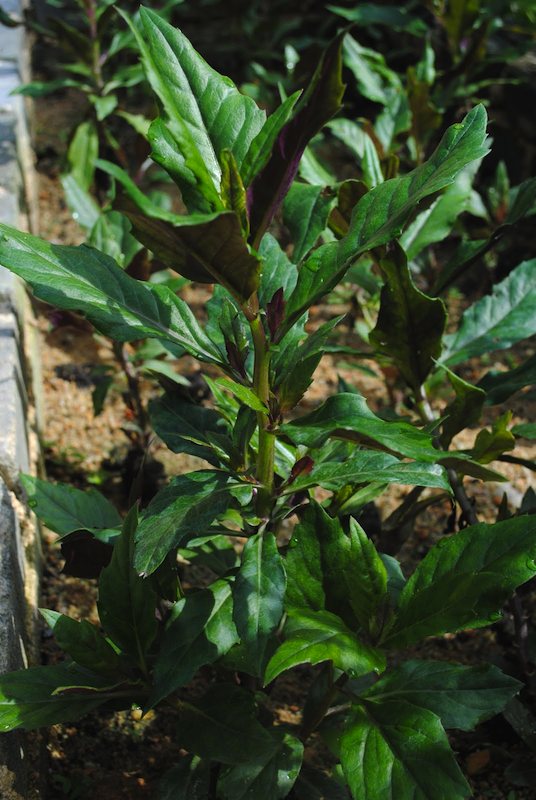
Gynura bicolor is a subshrub in the daisy family, Asteraceae, known in cultivation as Okinawa spinach. It sits in the genus Gynura, whose members are evergreen perennials and sub-shrubs, some trailing or scrambling, with toothed leaves.
Source: RHS
Rooted Across Asia
This plant's native range runs from the Indian Subcontinent across to South China and Taiwan, and out to the Caroline Islands, taking in Assam, the East and West Himalaya, Hainan, India, Myanmar, Nepal, Thailand and southeast and south-central China. It has also become established, as an introduction, in Japan and the Nansei-shoto islands. It grows primarily within the subtropical biome, and was first formally published under this name in 1838.
Source: Kew
Toothed Leaves, Modest Flowers
As a member of Gynura, it shares the genus habit of toothed leaves on a scrambling or trailing to sub-shrubby frame. Its flowers are orange or yellow, and notably lack ray florets, giving the blooms a more tufted, button-like look than a typical daisy.
Source: RHS
Care recipe
The species record — the baseline every cultivar inherits unless it says otherwise.
Care notes are early — not yet verified
- Light
- ai:claude-opus-4-8
- Water
- ai:claude-opus-4-8 (range 5-10d)
- Humidity
- ai:claude-opus-4-8
- Soil
- ai:claude-fable-5
- Care
- ai:claude-fable-5
Bright, indirect
≈ every 10 days
Medium
16–28 °C
Rich, moisture-retentive but draining mix
Stem cuttings root easily in water or soil
Balanced feed monthly through the growing season
Fast
Small orange blooms; grown for its purple-backed leaves
Not yet documented
This is where toxicity lives — every cultivar of this species inherits it and none can override it.
Reference images
Every image credited. Licenses link to their deeds.
PrimarySources: ai:claude-opus-4-8 · ai:claude-opus-4-8 (range 5-10d) · ai:claude-fable-5
Kept true by its growers
Every fact here carries its source. Grow Red-vegetable yourself? What you’ve observed — how it drinks, how it holds its color, a name that’s off — and a clear photo of your plant are exactly what keep this page honest. Contributions are reviewed before anything changes.
Sign in to add what you know →