Species · genus Gynura · Asteraceae
Velvetplant
Gynura aurantiaca (Blume) DC.
Also known as: Purple Velvetplant · Purple-passionvine · Royal Velvetplant · Purple Velvet Plant · Velvet Plant
Cultivars of G. aurantiaca
The named forms growers keep — each with its own page, each honest about how much we know.
No named cultivars catalogued under G. aurantiaca yet. When growers document a stable, named form, it earns its own page here.
Guide
The species-level account. Cultivar pages build on this and say where they differ.
A Velvet-Leaved Houseplant
Gynura aurantiaca, commonly called the purple passion plant or velvet plant, is a woody-based evergreen perennial grown for its ovate leaves and stems clothed in fine purple hairs. It can be kept low and bushy or trained to climb, and it works equally well trailing from a hanging basket or supported against a wall.
Source: Epic Gardening
From Southeast Asian Understories
This species comes from Southeast Asia, with a native range spanning Java, Sumatra, and Sulawesi. In the wild it grows as an understory plant in tropical forests, where warmth and humidity are constant, which explains why it settles so readily into a similar niche indoors.
Source: Epic Gardening
Light, Water, and Warmth
Give this plant bright, filtered or indirect light rather than direct sun, which fades the purple coloring and can scorch leaf tips. Keep the soil evenly moist through the growing season and let it dry out somewhat in fall and winter, watering only once roughly a quarter of the potting mix has dried, and avoid wetting the fuzzy leaves directly. It appreciates humidity in the 40–60% range and warmth between 75–85°F (24–29°C), coming indoors whenever temperatures fall near 60°F (16°C); feed with a balanced fertilizer diluted to half strength every two weeks in spring and summer, and withhold feeding once it goes dormant in fall and winter.
Source: Epic Gardening
Easy From Stem Cuttings
Propagation is straightforward: take a stem cutting during active growth in spring or summer, remove the lower leaves, and root it in fresh potting mix, optionally with rooting hormone, kept evenly moist under a plastic cover until new growth appears. RHS notes this can also be done as softwood cuttings in late spring or semi-ripe cuttings in summer, both rooting best with bottom heat. Because the plant tends to decline after flowering and typically lives only two to three years, keeping a rooted cutting on hand ensures continuity.
Source: Epic Gardening
Purple Hairs, Orange Flowers
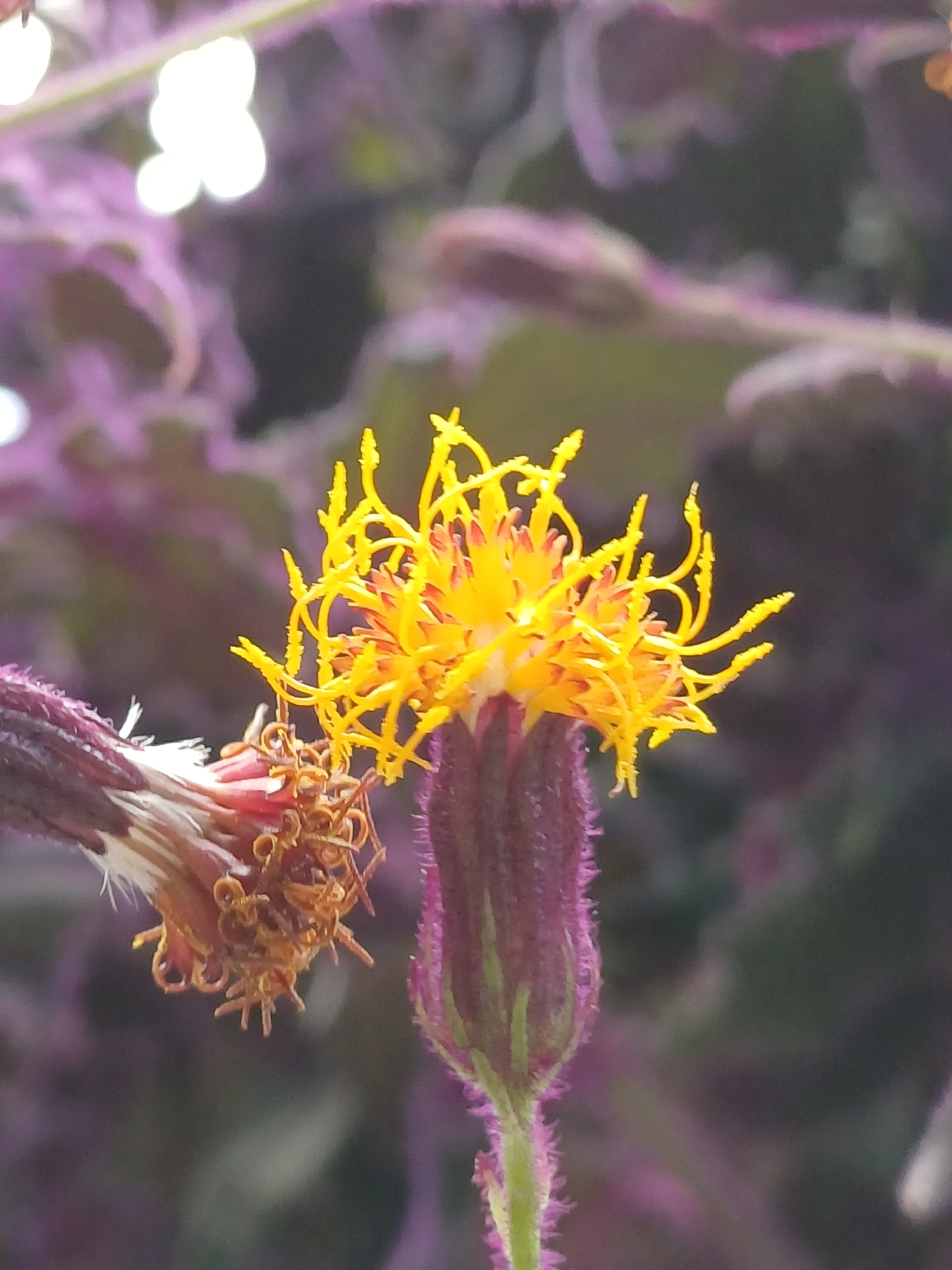
The plant's signature trait is the coat of purple to reddish hairs covering its serrated, ovate leaves, most vivid while foliage is young, with plain green undersides. At maturity it produces small, strongly scented flowers, described by RHS as thistle-like with yellow, orange, or red discs and no ray florets, appearing mostly in winter. In cultivation it usually stays compact, though when given a support to lean or climb on it can stretch several feet tall.
Source: RHS
Sap-Suckers to Watch
Aphids, spider mites, and mealybugs are the main pests, each piercing leaves or stems to feed on sap and leaving behind curling foliage, webbing, or cottony white residue, along with sticky honeydew that can invite rot if left untreated. The plant's velvety leaf hairs offer some natural deterrence against pests. RHS likewise flags aphids and glasshouse red spider mite as the chief concerns, treatable with a strong water spray, insecticidal soap, or neem oil.
Source: Epic Gardening
Reading the Warning Signs
Faded purple color and crisp, dry leaf tips point to too much direct sun, while mushy stems or a rotten root ball usually trace back to overwatering or fertilizing outside the active growing season. Botrytis blight and fusarium wilt can also take hold under poor conditions, showing up as wilting, brown leaf spots, and soft stems, and are best headed off with adequate light and restrained feeding. If root rot has set in, unpotting to check for white, healthy roots versus brown, dead ones determines whether the plant can be saved by repotting into fresh mix.
Source: Epic Gardening
Pinching and Deadheading
This plant needs little formal pruning, but pinching back growing tips encourages a bushier habit rather than a single leggy stem, and it can be trained upright against a support or left unpruned to trail. RHS advises no routine pruning is required beyond cutting the plant back in spring or summer if it outgrows its space. Removing the flowers before they open fully is also common practice, since they carry an unpleasant, strong odor and their appearance signals the plant is nearing the end of its natural cycle.
Source: Epic Gardening
Care recipe
The species record — the baseline every cultivar inherits unless it says otherwise.
Care notes are early — not yet verified
- Light
- ai:claude-opus-4-8
- Water
- ai:claude-opus-4-8 (range 5-9d)
- Humidity
- ai:claude-opus-4-8
- Soil
- ai:claude-fable-5
- Care
- ai:claude-fable-5
Bright, indirect
≈ every 9 days
Medium
16–27 °C
Well-draining, fertile potting mix
Stem cuttings root quickly in water or soil
Balanced liquid feed monthly while actively growing
Fast
Small orange flowers with an unpleasant scent, usually pinched off
Not yet documented
This is where toxicity lives — every cultivar of this species inherits it and none can override it.
Reference images
Every image credited. Licenses link to their deeds.
PrimarySources: ai:claude-opus-4-8 · ai:claude-opus-4-8 (range 5-9d) · ai:claude-fable-5
Kept true by its growers
Every fact here carries its source. Grow Velvetplant yourself? What you’ve observed — how it drinks, how it holds its color, a name that’s off — and a clear photo of your plant are exactly what keep this page honest. Contributions are reviewed before anything changes.
Sign in to add what you know →