Species · genus Graptopetalum · Crassulaceae
Ghostplant
Graptopetalum paraguayense (N.E.Br.) Walther
Also known as: Mother-of-pearl-plant · Ghost-plant
Cultivars of G. paraguayense
The named forms growers keep — each with its own page, each honest about how much we know.
No named cultivars catalogued under G. paraguayense yet. When growers document a stable, named form, it earns its own page here.
Guide
The species-level account. Cultivar pages build on this and say where they differ.
The Ghost Plant
The ghost plant, Graptopetalum paraguayense, is a medium-sized flowering succulent in the Crassulaceae family, related to jade plants, kalanchoe, and sedum. Its rosettes of thick, fleshy leaves stay modest in size, but the trailing stems can stretch on considerably, and the plant is forgiving enough to suit both first-time growers and seasoned collectors.
Source: Epic Gardening
A Mexican Desert Native
This succulent comes from central and eastern Mexico, where it grew accustomed to bright light and warm days paired with cool, dry nights. That desert upbringing explains its comfort with both intense sun and surprisingly wide temperature swings once it comes indoors.
Source: Epic Gardening
A Simple Rhythm
Give this plant full sun where possible, at least six hours a day, in a well-draining succulent mix, and check the soil weekly with a fingertip rather than watering on a fixed schedule. Water thoroughly when the mix is dry, letting it run through the pot, and hold back rather than overdo it, since underwatering is far easier to recover from than rot. Warm conditions suit it, feeding is only needed lightly during spring and summer growth, and a porous pot with drainage holes helps keep the roots on the dry side of happy.
Source: Epic Gardening
Easy Vegetative Increase
Ghost plants multiply readily from leaf cuttings, stem cuttings, or the small offshoots that form at the base of a mature plant. In each case the cut or detached piece is allowed to callus over for a few days before being pressed into damp cactus mix and kept out of drafts until roots and new leaves appear.
Source: Epic Gardening
Color That Shifts With Light
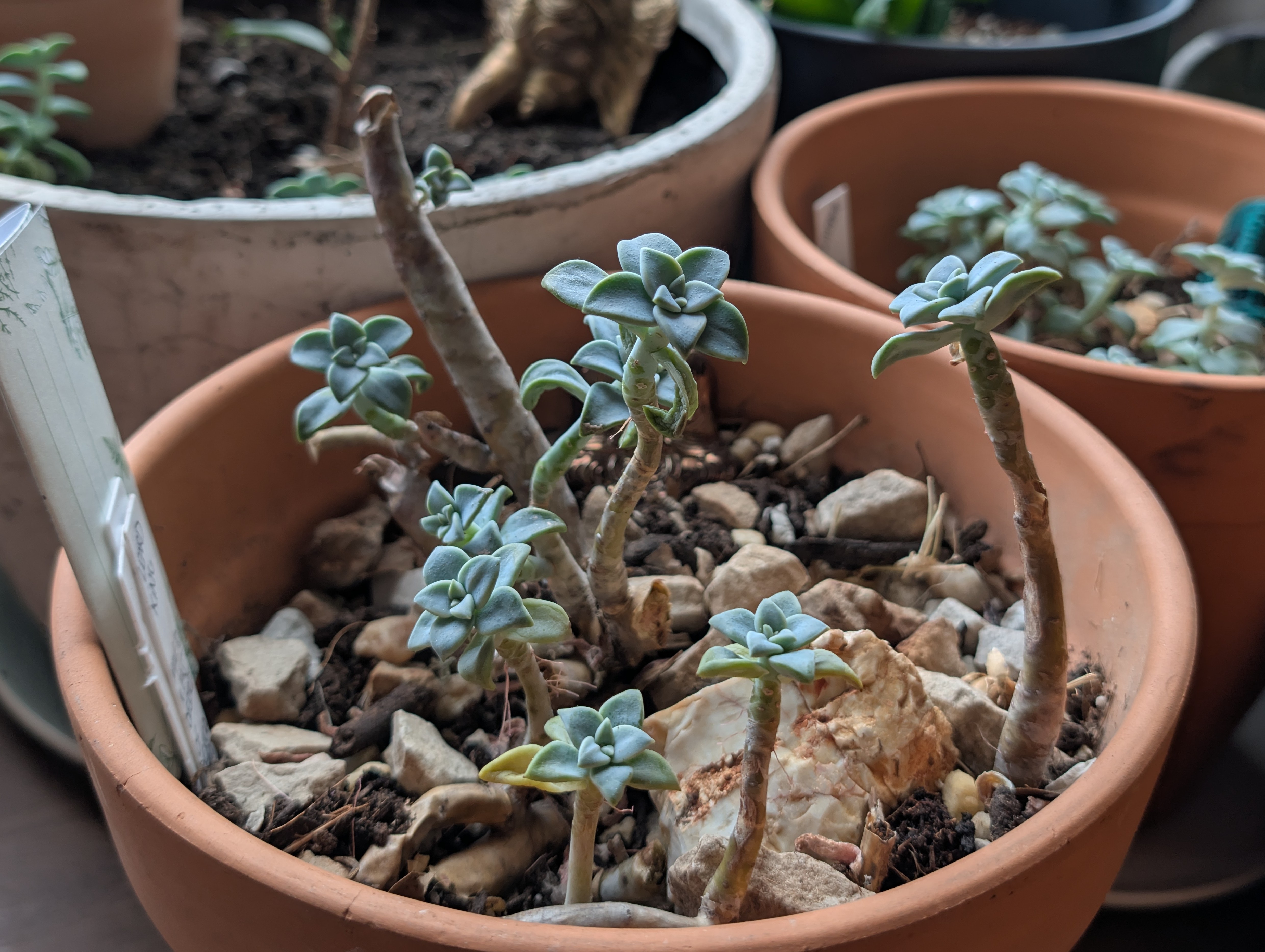
Grey-green leaves, often tinged pink, form basal rosettes to about 10cm wide on trailing stems, occasionally topped in summer with short sprays of star-shaped yellow and red flowers. The exact leaf color is not fixed: strong light pushes the foliage toward reddish-yellow tones, while lower light lets a blue-gray cast take over, sometimes alongside a looser, more open habit as the stems stretch toward the light.
Source: RHS
Sap-Suckers to Watch
The main pests are aphids, mealybugs, and spider mites, all of which feed by piercing leaf tissue and drawing out sap. Aphids and mealybugs multiply quickly, mealybugs often hiding as white cottony clusters or a sticky residue on leaf undersides, while spider mites announce themselves through fine webbing and leaf discoloration. Dish soap solutions or diluted rubbing alcohol, applied repeatedly, are the usual remedies.
Source: Epic Gardening
Reading the Leaves
Wrinkly, thin, or leathery leaves signal underwatering and are fixed with a thorough soak, while soft, oozing leaves or blackened stems point to overwatering and the onset of root rot, the single biggest killer of this succulent. Stretched, elongated stems mean the plant is reaching for more light, and straw-colored patches after a sudden move outdoors are simply leaf scorch from too-fast a transition. Flowering is not guaranteed and tends to wait until the plant is around three years old, sometimes nudged along by being a little root-bound.
Source: Epic Gardening
Light Touch Upkeep
This is a low-maintenance plant that mostly asks for weekly water checks, decent light, and a pot sized to match its growth rather than one it can swim in. Repotting is only needed every few years, ideally in late winter or early spring stepping up just one pot size, and pruning follows the same seasonal timing, with no more than a third of the top growth removed at once, cutting just above a node.
Source: Epic Gardening
Care recipe
The species record — the baseline every cultivar inherits unless it says otherwise.
Care notes are early — not yet verified
- Light
- ai:claude-opus-4-8
- Water
- ai:claude-opus-4-8 (range 14-28d)
- Humidity
- ai:claude-opus-4-8
- Soil
- ai:claude-fable-5
- Care
- ai:claude-fable-5
Direct sun
≈ every 28 days
Low — average room
10–27 °C
Gritty, fast-draining cactus and succulent mix
Leaf or stem cuttings, callused then rooted
Light balanced feed once or twice in the growing season
Moderate
Small star-shaped yellow blooms in spring with good light
Not yet documented
This is where toxicity lives — every cultivar of this species inherits it and none can override it.
Reference images
Every image credited. Licenses link to their deeds.
PrimarySources: ai:claude-opus-4-8 · ai:claude-opus-4-8 (range 14-28d) · ai:claude-fable-5
Kept true by its growers
Every fact here carries its source. Grow Ghostplant yourself? What you’ve observed — how it drinks, how it holds its color, a name that’s off — and a clear photo of your plant are exactly what keep this page honest. Contributions are reviewed before anything changes.
Sign in to add what you know →