Species · genus Gardenia · Rubiaceae
Cape Jessamine
Gardenia thunbergia Thunb.
Also known as: Forest Gardenia · Starry Gardenia · Wild Gardenia
Cultivars of G. thunbergia
The named forms growers keep — each with its own page, each honest about how much we know.
No named cultivars catalogued under G. thunbergia yet. When growers document a stable, named form, it earns its own page here.
Guide
The species-level account. Cultivar pages build on this and say where they differ.
White Gardenia, Introduced
Gardenia thunbergia is an evergreen shrub or small tree known as white gardenia, prized for its large, creamy-white, heavily scented flowers. It is one of only six Gardenia species native to South Africa.
Source: Kew
Southern African Roots
This species grows along the eastern coast of South Africa, from the Eastern Cape north into KwaZulu-Natal, and into southern Mozambique, generally within evergreen forest and along forest margins, though it is occasionally found in woodland and veld. It is named for Carl Peter Thunberg, the Swedish physician and botanist who studied the flora of the Cape extensively. The genus itself honours Dr Alexander Garden, a Scottish physician and amateur botanist. The species is considered of least concern overall, though it has been noted as rare within the Cape.
Source: Kew
Warmth, Sun, Moisture
White gardenia needs a frost-free climate and ample water, either through generous summer rain or year-round watering. It does best in slightly acid soil rich in humus, and will grow in either full sun or part shade.
Source: Kew
Grown From Cuttings
Beyond seed, which must be freed from the plant's hard woody fruit, this gardenia can be propagated by cuttings.
Source: Kew
Scent, Flower, Fruit
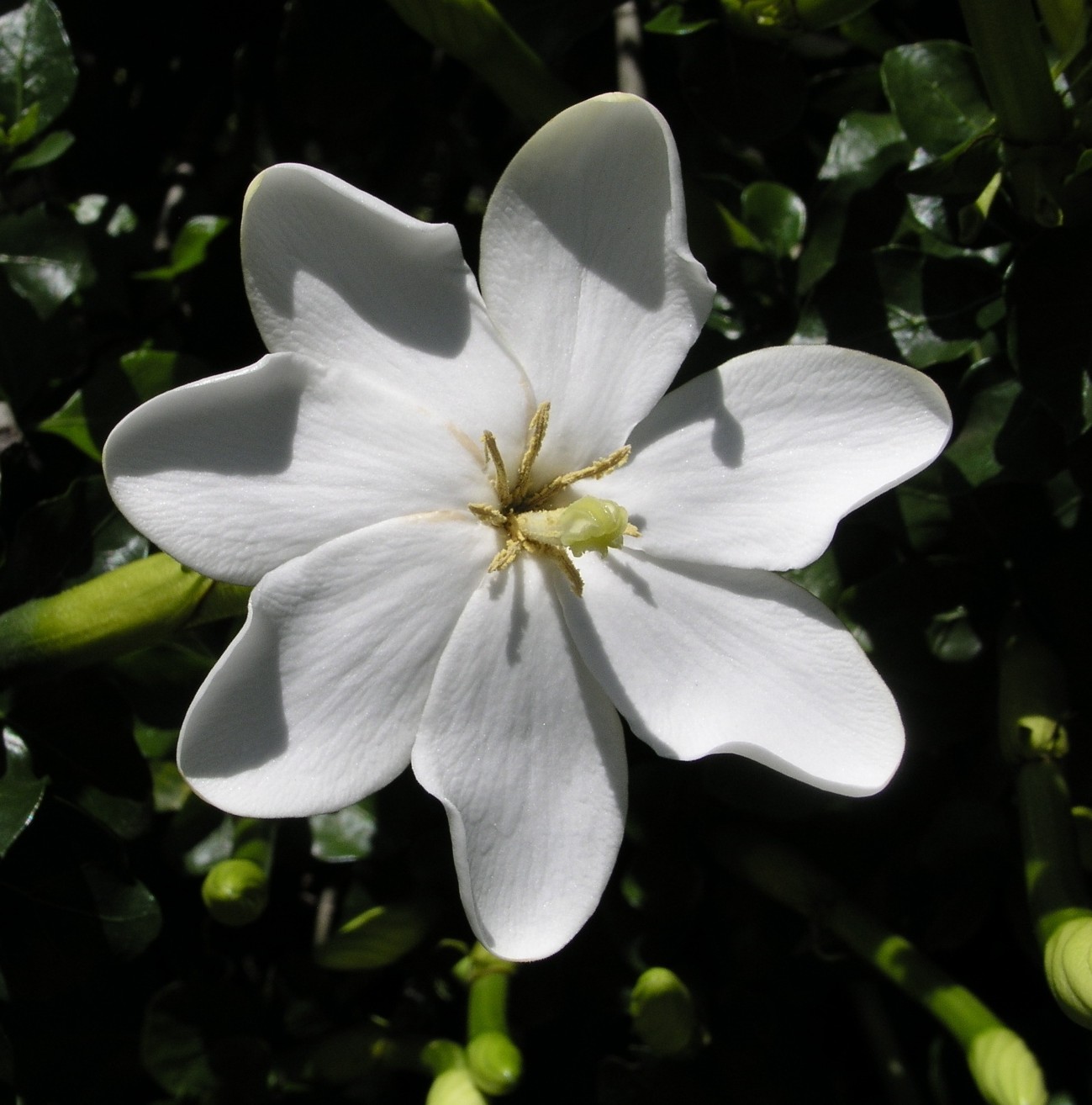
The plant reaches up to 5 metres, with a smooth whitish main stem and clusters of glossy green leaves gathered at the ends of short branches. Its flowers are large, eight-petalled, and creamy white, carrying an overpowering scent most noticeable at night, a trait typical of moth-pollinated flowers; they appear from October to March. These give way to hard, woody, greyish, egg-shaped fruits whose seed must be extracted by smashing or sawing through the shell.
Source: Kew
Prune After Flowering
Any pruning this plant needs is best carried out soon after it finishes flowering.
Source: Kew
Care recipe
The species record — the baseline every cultivar inherits unless it says otherwise.
Care notes are early — not yet verified
- Light
- ai:claude-opus-4-8
- Water
- ai:claude-opus-4-8 (range 5-10d)
- Humidity
- ai:claude-opus-4-8
- Soil
- ai:claude-fable-5
- Care
- ai:claude-fable-5
Bright, indirect
≈ every 10 days
Medium
13–27 °C
Acidic, well-draining loamy mix
Semi-hardwood cuttings or seed
Acid-formula feed monthly while growing
Slow
Fragrant white flowers in bright light
Not yet documented
This is where toxicity lives — every cultivar of this species inherits it and none can override it.
Reference images
Every image credited. Licenses link to their deeds.
PrimarySources: ai:claude-opus-4-8 · ai:claude-opus-4-8 (range 5-10d) · ai:claude-fable-5
Kept true by its growers
Every fact here carries its source. Grow Cape Jessamine yourself? What you’ve observed — how it drinks, how it holds its color, a name that’s off — and a clear photo of your plant are exactly what keep this page honest. Contributions are reviewed before anything changes.
Sign in to add what you know →