Species · genus Ferocactus · Cactaceae
Devil's-tongue Cactus
Ferocactus latispinus (Haw.) Britton & Rose
Also known as: Devil's Tongue Barrel Cactus
Cultivars of F. latispinus
The named forms growers keep — each with its own page, each honest about how much we know.
No named cultivars catalogued under F. latispinus yet. When growers document a stable, named form, it earns its own page here.
Guide
The species-level account. Cultivar pages build on this and say where they differ.
A Barrel of Character
Ferocactus latispinus is a globular barrel cactus known also as the devil's tongue or candy cactus, prized for its stout ribbed form and fierce, colourful spines. It stays relatively compact for the genus, reaching about 25cm across, and belongs to the Cactaceae family.
Source: RHS
Rooted in Mexico
This cactus is native to central, southwestern and northeastern Mexico, from Durango down to Puebla, where it grows in desert and dry shrubland. It has accumulated a long tangle of botanical names over the centuries, evidence of how often collectors and taxonomists have puzzled over it since it first entered horticultural literature.
Source: Kew
Sun, Soil, Restraint
Give this cactus full sun and a well-drained loam or sandy compost formulated for cacti, in a sheltered spot with an east, south or west aspect. Water moderately through the growing season and keep it nearly dry once winter sets in, matching its tolerance for low temperatures but not frost. No pruning is needed to keep it tidy.
Source: RHS
Starting From Seed
Propagation is by seed, sown at around 21°C in spring.
Source: RHS
Ribs, Spines, Flowers
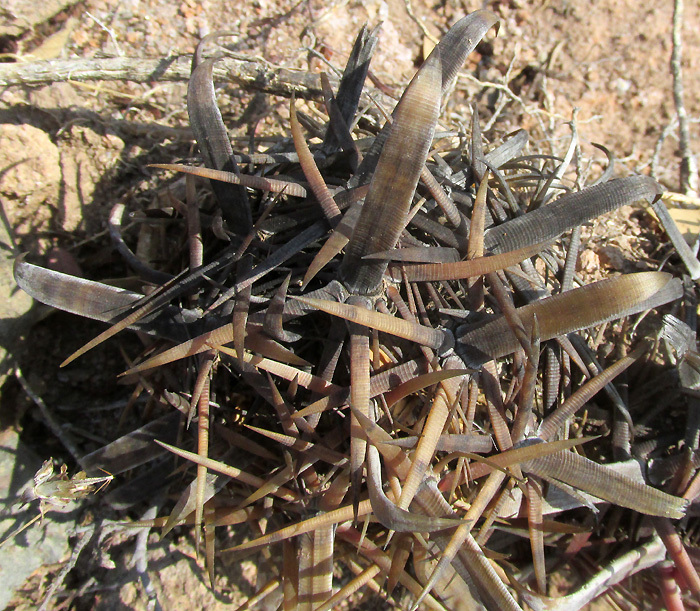
The plant carries twenty-one well-defined ribs studded with areoles bearing fine white radial spines alongside thick, flattened central spines in red or brown, the feature that gives it its common names. In winter it sends up pink, funnel-shaped flowers, a contrast to the more usual summer flowering of its relatives in the genus.
Source: RHS
Watch for Mealybugs
Mealybugs are the pest most likely to trouble this cactus, so it is worth checking the ribs and areoles for their telltale waxy clusters.
Source: RHS
The Overwatering Risk
Stem and root rots are the main hazard, and they arise from overwatering rather than any inherent weakness in the plant. Keeping to the moderate summer, near-dry winter rhythm is the best safeguard.
Source: RHS
Care recipe
The species record — the baseline every cultivar inherits unless it says otherwise.
Care notes are early — not yet verified
- Light
- ai:claude-opus-4-8
- Water
- ai:claude-opus-4-8 (range 14-30d)
- Humidity
- ai:claude-opus-4-8
- Soil
- ai:claude-fable-5
- Care
- ai:claude-fable-5
Direct sun
≈ every 30 days
Low — average room
8–32 °C
Gritty, fast-draining cactus mix with extra pumice
From seed
Dilute cactus feed once or twice in spring and summer
Slow
Pink to purple flowers on mature plants in strong light
Not yet documented
This is where toxicity lives — every cultivar of this species inherits it and none can override it.
Reference images
Every image credited. Licenses link to their deeds.
PrimarySources: ai:claude-opus-4-8 · ai:claude-opus-4-8 (range 14-30d) · ai:claude-fable-5
Kept true by its growers
Every fact here carries its source. Grow Devil's-tongue Cactus yourself? What you’ve observed — how it drinks, how it holds its color, a name that’s off — and a clear photo of your plant are exactly what keep this page honest. Contributions are reviewed before anything changes.
Sign in to add what you know →