Species · genus Euphorbia · Euphorbiaceae
Upright Myrtle Spurge
Euphorbia rigida M.Bieb.
Cultivars of E. rigida
The named forms growers keep — each with its own page, each honest about how much we know.
No named cultivars catalogued under E. rigida yet. When growers document a stable, named form, it earns its own page here.
Guide
The species-level account. Cultivar pages build on this and say where they differ.
An upright blue-leaved spurge
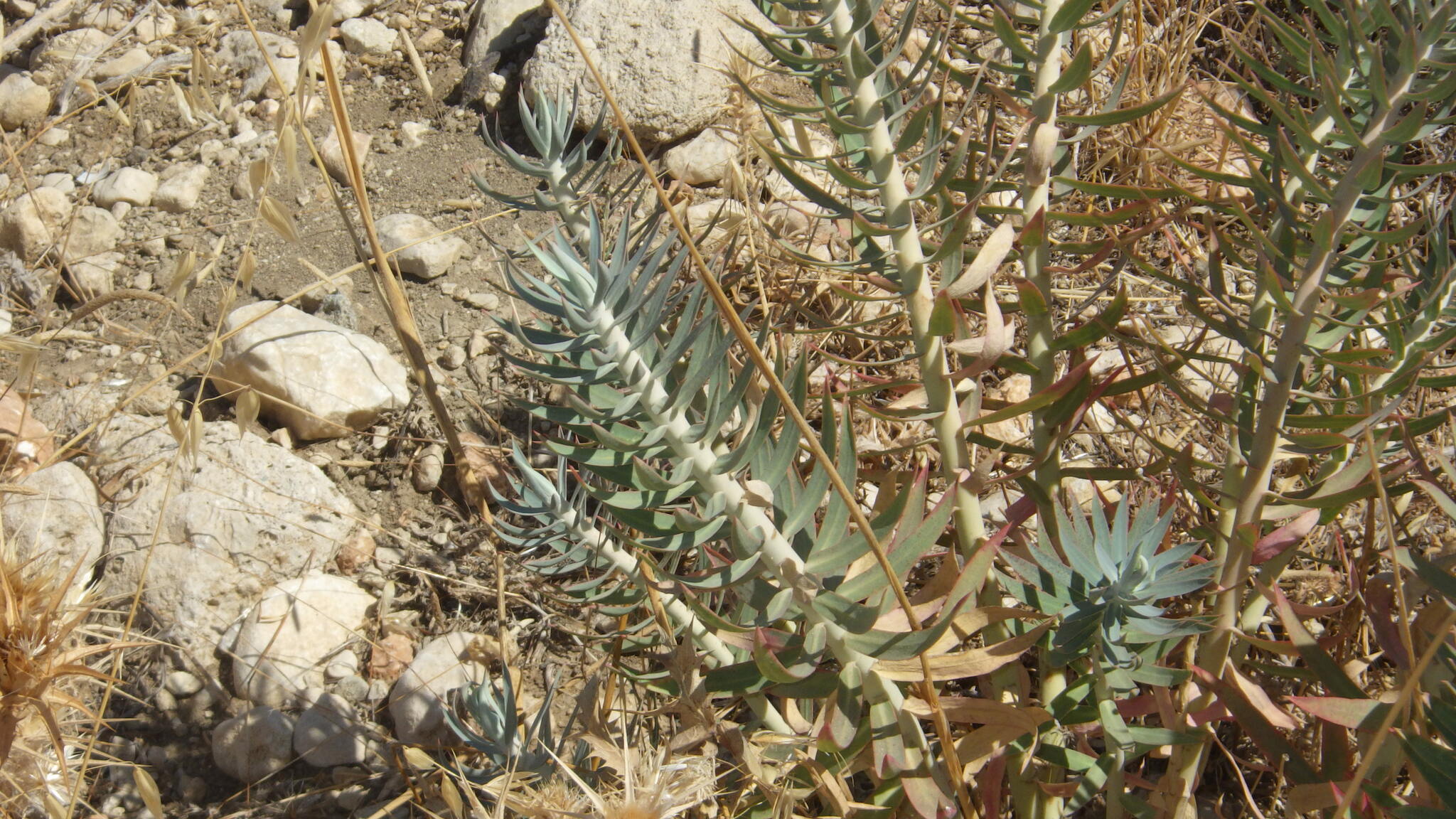
Euphorbia rigida, known as upright myrtle spurge, is an evergreen perennial that starts upright and later sprawls, reaching around 60cm tall. Its fleshy, blue-green leaves spiral around the stems, topped in late spring and early summer by small clusters of bright yellow flowers.
Source: RHS
A Mediterranean native
This spurge hails from southern Europe, southwest Asia, and northwest Africa, which explains its comfort with sun-baked, well-drained ground. It carries the synonym Euphorbia biglandulosa and has earned the RHS Award of Garden Merit.
Source: RHS
Sun, drainage, and restraint
Give this plant full sun to partial shade and well-drained soil, whether chalk, clay, loam, or sand, and it will settle into most garden situations. Water well through the first couple of growing seasons to help it establish, but afterward keep feeding to a minimum, since rich soil or generous feeding tends to make euphorbias lush and leggy rather than sturdy. A gravel mulch suits this silvery species particularly well if grown in a Mediterranean-style planting.
Source: RHS
Divide, don't cut
Propagate this one by division, the standard method for clump-forming, herbaceous euphorbias, carried out as the plant comes into growth in spring.
Source: RHS
Blue foliage, bushy habit
What sets this euphorbia apart among its relatives is its blue-grey foliage, a trait shared with only a few others in the genus. It grows as a bushy, evergreen perennial, and it is rated fully hardy, tolerating cold down to H6 UK conditions, with good drought resistance.
Source: RHS
Largely trouble-free
This species is generally pest-free and disease-free. Do bear in mind, though, that the sap common to euphorbias is irritant to skin and eyes and harmful if eaten, so gloves and care are worthwhile when handling it.
Source: RHS
Watch the drainage
Across the euphorbia genus, the main troubles are powdery mildew, aphids causing distorted growth, occasional rust, and root rot where soil stays too wet. Since this species prefers sharp drainage, waterlogged ground is the likeliest source of trouble for it.
Source: RHS
Little pruning needed
No pruning is required for this species. Any general tidying of euphorbias is usually folded into deadheading or the removal of old, dead stems once herbaceous growth dies back for winter.
Source: RHS
Care recipe
The species record — the baseline every cultivar inherits unless it says otherwise.
Care notes are early — not yet verified
- Light
- ai:claude-opus-4-8
- Water
- ai:claude-opus-4-8 (range 14-30d)
- Humidity
- ai:claude-opus-4-8
- Soil
- ai:claude-fable-5
- Care
- ai:claude-fable-5
Direct sun
≈ every 30 days
Low — average room
5–27 °C
Sharp, gritty, fast-draining mix
Seed or division of clumps
Light feed once in spring
Slow
Bright chartreuse-yellow bracts in late winter to spring
Toxic to cats & dogs & humans
Euphorbiaceae exude a milky latex that is a skin, eye, and mucous-membrane irritant and is harmful if ingested. This is where toxicity lives: every cultivar of this species inherits it and none can override it.
Reference images
Every image credited. Licenses link to their deeds.
PrimarySources: ai:claude-opus-4-8 · ai:claude-opus-4-8 (range 14-30d) · ai:claude-fable-5 · ai:claude-opus-4-8 (family inference)
Kept true by its growers
Every fact here carries its source. Grow Upright Myrtle Spurge yourself? What you’ve observed — how it drinks, how it holds its color, a name that’s off — and a clear photo of your plant are exactly what keep this page honest. Contributions are reviewed before anything changes.
Sign in to add what you know →