Species · genus Euphorbia · Euphorbiaceae
Balkan Spurge
Euphorbia oblongata Griseb.
Also known as: Egg-leaf Spurge · Eggleaf Spurge · Oblong Spurge
Cultivars of E. oblongata
The named forms growers keep — each with its own page, each honest about how much we know.
No named cultivars catalogued under E. oblongata yet. When growers document a stable, named form, it earns its own page here.
Guide
The species-level account. Cultivar pages build on this and say where they differ.
Balkan Spurge, Briefly
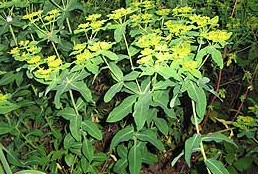
Euphorbia oblongata, known as Balkan spurge, is a clump-forming herbaceous perennial in the spurge family, though gardeners commonly treat it as an annual because it is short-lived. It carries dark green stem leaves and flat, chartreuse-yellow flowerheads that stay in bloom for months.
Source: RHS
A Balkan Native
This species was first described by Grisebach in 1843 and comes from the Balkan Peninsula through to northwest Türkiye, including Albania, Bulgaria, Greece, Kriti and the East Aegean Islands. It has since been introduced well beyond that native range, turning up in Great Britain, Ireland, France, Japan, New Zealand, Palestine, and parts of the United States such as California, Oregon and Washington.
Source: Kew
Light Shade, Even Moisture
Balkan spurge does best in moist, humus-rich soil that still drains well, and it prefers light dappled shade with some direct sun during part of the day. It tolerates clay or loam, copes with acid, alkaline or neutral pH, and is rated drought resistant once established. It is also hardy through most of the UK, even in severe winters.
Source: RHS
Sowing Fresh Seed
Propagation is by seed, sown into pots and placed in a cold frame as soon as it ripens, or sown directly outdoors in spring. Left to its own devices the plant self-sows readily, which is worth watching so it does not spread further than wanted.
Source: RHS
Neat Habit, Bright Bracts
The plant grows as a bushy, deciduous perennial reaching half a metre to a metre in height, with a fairly narrow spread. Its stem leaves are small, dark green, and no more than 5cm long, while the real display comes from flat heads of chartreuse-yellow bracts up to 15cm wide that persist from spring into autumn.
Source: RHS
Largely Trouble-Free
Balkan spurge is generally free of both pests and disease, which is part of what makes it an easy border plant. Handling still calls for care, since the sap is irritant to skin and eyes and harmful if eaten, so gloves and protective equipment are advised.
Source: RHS
Cutting Back After Flowering
Once flowering finishes, cut the flowered shoots back to the base, or gather the stems for flower arranging as they are cut. Because the plant self-sows freely, it can become a nuisance if spent flowerheads are left to seed unchecked.
Source: RHS
Care recipe
The species record — the baseline every cultivar inherits unless it says otherwise.
Care notes are early — not yet verified
- Light
- ai:claude-opus-4-8
- Water
- ai:claude-opus-4-8 (range 10-18d)
- Humidity
- ai:claude-opus-4-8
- Soil
- ai:claude-fable-5
- Care
- ai:claude-fable-5
Bright, indirect
≈ every 18 days
Low — average room
10–27 °C
Well-draining loamy or sandy mix
Seed, sown in spring
Light feed in spring; undemanding
Moderate
Clusters of small yellow-green bracts in late spring and summer
Toxic to cats & dogs & humans
Euphorbiaceae produce an irritant milky latex that can harm skin, eyes, and mucous membranes if broken This is where toxicity lives: every cultivar of this species inherits it and none can override it.
Reference images
Every image credited. Licenses link to their deeds.
Sources: ai:claude-opus-4-8 · ai:claude-opus-4-8 (range 10-18d) · ai:claude-fable-5 · ai:claude-opus-4-8 (family inference)
Kept true by its growers
Every fact here carries its source. Grow Balkan Spurge yourself? What you’ve observed — how it drinks, how it holds its color, a name that’s off — and a clear photo of your plant are exactly what keep this page honest. Contributions are reviewed before anything changes.
Sign in to add what you know →