Species · genus Euphorbia · Euphorbiaceae
Broad-leaved Glaucous-spurge
Euphorbia myrsinites L.
Also known as: Myrtle Spurge · Blue Spurge · Creeping Spurge · Myrtle Euphorbia · Broadleaf Glaucous Spurge
Cultivars of E. myrsinites
The named forms growers keep — each with its own page, each honest about how much we know.
No named cultivars catalogued under E. myrsinites yet. When growers document a stable, named form, it earns its own page here.
Guide
The species-level account. Cultivar pages build on this and say where they differ.
A Spiraling Spurge
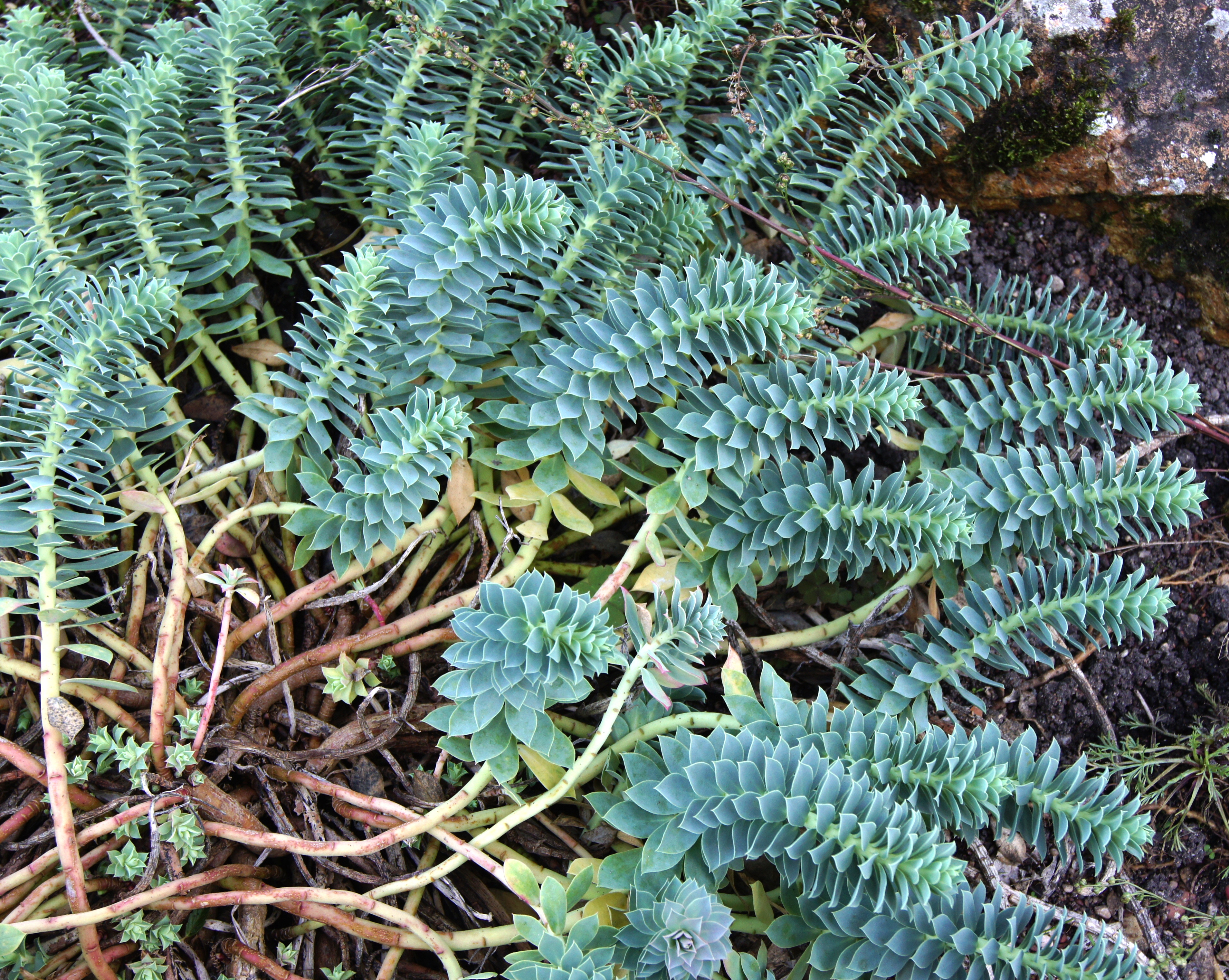
Euphorbia myrsinites, called myrtle spurge or donkey tail, is a low, trailing succulent perennial in the Euphorbiaceae family, grown for its spiraled blue-green leaves and chartreuse spring bracts. It has earned the Royal Horticultural Society's Award of Garden Merit, though it is also flagged as invasive in parts of the United States.
Source: Epic Gardening
From Southeastern Europe
This plant is native to southeastern Europe and Asia Minor, found across Italy, the Balkans, Crimea, and Turkey. The RHS likewise places its natural range across southern Europe and Asia Minor.
Source: Epic Gardening
Sun, Grit, and Neglect
Grow this succulent in full sun and well-drained, sandy or gravelly soil; it tolerates chalk, clay, loam, and sand alike, and asks for very little water once established. It withstands a wide temperature range, from triple-digit heat down to about -20°F, and rarely needs fertilizer since it is bred by circumstance to perform in poor soils. Feeding is best skipped altogether where the plant is considered invasive.
Source: Epic Gardening
Seed, Cuttings, or Division
Myrtle spurge spreads readily by seed, but it can also be propagated from cuttings taken in late spring or early summer, the active growing season. Wear gloves and eye protection, strip the lower two-thirds of leaves, dip the cut end in rooting hormone, and set it in coarse potting mix; rooting typically takes four to six weeks. The RHS notes it can also be propagated by seed or by division.
Source: Epic Gardening
Spiraled Blue Foliage
Light gray-green, slightly fleshy leaves spiral along trailing evergreen stems that can reach up to 35 centimeters long. Come spring, small greenish buds open into sulfur-yellow flowers held in terminal clusters, with most of the visual appeal coming from the showy yellow bracts surrounding the true blooms.
Source: RHS
Aphids and Mealybugs
Aphids and mealybugs are the pests most likely to trouble this plant. A strong stream of water can dislodge either; mealybugs respond to a wipe with rubbing alcohol followed by a neem oil spray, while aphids are best discouraged by keeping the soil well-drained and letting it dry between waterings.
Source: Epic Gardening
Rot from Too Much Care
Overwatering is the main threat to this drought-tolerant plant, since soggy, rich soil invites bacterial or fungal rot, especially where the plant sits in shade with wet feet. If the base of a stem turns brown and mushy the plant may be beyond saving, but a firm base can often be recovered by withholding water or repotting into fresh, dry mix. Left unpruned, the plant can also spread aggressively and take over garden beds.
Source: Epic Gardening
Deadhead to Contain It
Cut back the sprawling stems after spring and summer bloom, and at minimum remove spent flowers before they set seed, since this is how the plant spreads. A stem that begins turning yellow can simply be clipped at its base. Repot only once the plant outgrows its container, moving up to a slightly larger pot with ample drainage and coarse mix. The RHS notes that in garden settings it generally needs no pruning at all.
Source: Epic Gardening
Care recipe
The species record — the baseline every cultivar inherits unless it says otherwise.
Care notes are early — not yet verified
- Light
- ai:claude-opus-4-8
- Water
- ai:claude-opus-4-8 (range 14-28d)
- Humidity
- ai:claude-opus-4-8
- Soil
- ai:claude-fable-5
- Care
- ai:claude-fable-5
Direct sun
≈ every 28 days
Low — average room
7–27 °C
Gritty, very fast-draining mix
Seed or cuttings, callused before potting
Little to none; a light spring feed suffices
Moderate
Chartreuse-yellow bracts in early spring
Toxic to cats & dogs & humans
Euphorbiaceae produce an irritant milky latex that can harm skin, eyes, and mucous membranes if ingested. This is where toxicity lives: every cultivar of this species inherits it and none can override it.
Reference images
Every image credited. Licenses link to their deeds.
PrimarySources: ai:claude-opus-4-8 · ai:claude-opus-4-8 (range 14-28d) · ai:claude-fable-5 · ai:claude-opus-4-8 (family inference)
Kept true by its growers
Every fact here carries its source. Grow Broad-leaved Glaucous-spurge yourself? What you’ve observed — how it drinks, how it holds its color, a name that’s off — and a clear photo of your plant are exactly what keep this page honest. Contributions are reviewed before anything changes.
Sign in to add what you know →