Species · genus Euphorbia · Euphorbiaceae
Slipper Plant
Euphorbia lomelii V.W.Steinm.
Cultivars of E. lomelii
The named forms growers keep — each with its own page, each honest about how much we know.
No named cultivars catalogued under E. lomelii yet. When growers document a stable, named form, it earns its own page here.
Guide
The species-level account. Cultivar pages build on this and say where they differ.
A Sonoran Succulent Shrub
Euphorbia lomelii is a succulent shrub known also under its older name, Pedilanthus macrocarpus. It belongs to the sprawling Euphorbia genus and is built for arid, sun-baked ground rather than a windowsill.
Source: Kew
Native to Northwest Mexico
This plant's native range sits in northwest Mexico, where it grows as part of desert and dry shrubland communities. It was formally described as Euphorbia lomelii in 2003, though it had long circulated under the synonym Pedilanthus macrocarpus.
Source: Kew
Desert Habits, Cold Limits
As a desert shrub, this species is accustomed to bright exposure and dry ground rather than regular watering. Its main vulnerability is cold: ordinary plants of this species take damage between 25 and 28°F, with severe injury or death below 20°F, so in the ground it needs a frost-free or only lightly frosty spot.
Source: Google Patents
Rooting from Stem Cuttings
Propagation is done from stem cuttings roughly three inches long, each including at least one node set below the soil line. Cuttings root into a peat-based substrate without need of rooting hormone, given warm greenhouse conditions with nighttime temperatures no lower than about 50°F. Rooting is typically complete within about eight weeks.
Source: Google Patents
Leafless Stems, Slipper Flowers
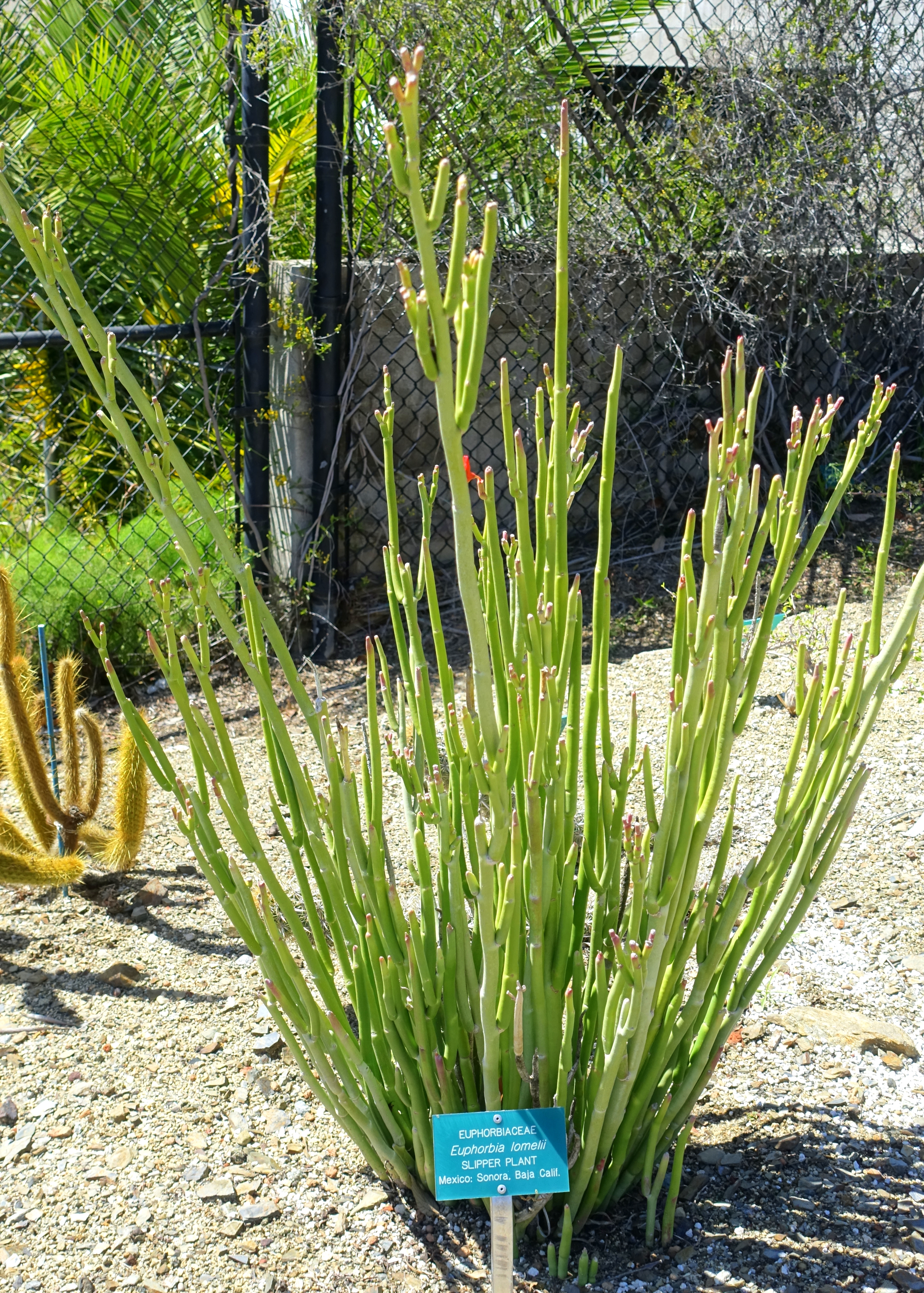
In the wild this species grows as a mostly leafless, succulent shrub with clustered upright stems that ooze milky sap when cut. What leaves it does produce are small, semi-succulent, and quick to drop as stems mature or drought sets in. Its flowers are borne in an odd, shark- or slipper-shaped structure typical of the old Pedilanthus group, usually appearing in spring into early summer. Wild clones range from short, tightly clustered mounds to rangy, arching shrubs reaching six feet or more.
Source: Google Patents
Care recipe
The species record — the baseline every cultivar inherits unless it says otherwise.
Care notes are early — not yet verified
- Light
- ai:claude-opus-4-8
- Water
- ai:claude-opus-4-8 (range 14-28d)
- Humidity
- ai:claude-opus-4-8
- Soil
- ai:claude-fable-5
- Care
- ai:claude-fable-5
Direct sun
≈ every 28 days
Low — average room
13–32 °C
Gritty, fast-draining cactus and succulent mix
Stem cuttings, callused before potting
Light succulent feed once or twice in the warm months
Slow
Small red flowers along the stems in bright light
Toxic to cats & dogs & humans
Euphorbiaceae produce an irritant milky latex that can harm skin, eyes, and mucous membranes if broken. This is where toxicity lives: every cultivar of this species inherits it and none can override it.
Reference images
Every image credited. Licenses link to their deeds.
PrimarySources: ai:claude-opus-4-8 · ai:claude-opus-4-8 (range 14-28d) · ai:claude-fable-5 · ai:claude-opus-4-8 (family inference)
Kept true by its growers
Every fact here carries its source. Grow Slipper Plant yourself? What you’ve observed — how it drinks, how it holds its color, a name that’s off — and a clear photo of your plant are exactly what keep this page honest. Contributions are reviewed before anything changes.
Sign in to add what you know →