Species · genus Euphorbia · Euphorbiaceae
Madagascar Jewel
Euphorbia leuconeura Boiss.
Cultivars of E. leuconeura
The named forms growers keep — each with its own page, each honest about how much we know.
No named cultivars catalogued under E. leuconeura yet. When growers document a stable, named form, it earns its own page here.
Guide
The species-level account. Cultivar pages build on this and say where they differ.
A Madagascan Spurge
Euphorbia leuconeura, known as white-veined spurge, is a tropical succulent shrub grown both as a feature houseplant and in warm greenhouses or conservatories. It belongs to the Euphorbiaceae family, a group typified by milky sap and small flowers held within cupped bracts.
Source: RHS
Native to Madagascar
This species comes from the north of Madagascar, where it grows as a semisucculent subshrub or shrub in a seasonally dry tropical setting. It was first formally described by Boissier in 1862.
Source: Kew
Sun, Drainage, Warmth
This spurge does best in well-drained, loamy or sandy soil, given full sun to partial shade, and it dislikes temperatures dropping below 15°C. It is drought resistant and tolerates acid, alkaline, or neutral pH, but appreciates a sheltered spot with a south, west, or east aspect.
Source: RHS
Seed Or Spring Cuttings
Propagate by seed, or by taking cuttings in spring or early summer. Dip the cut surfaces in charcoal or lukewarm water afterwards, since this helps stop the milky sap from bleeding.
Source: RHS
Herringbone Veins, Bristled Stems
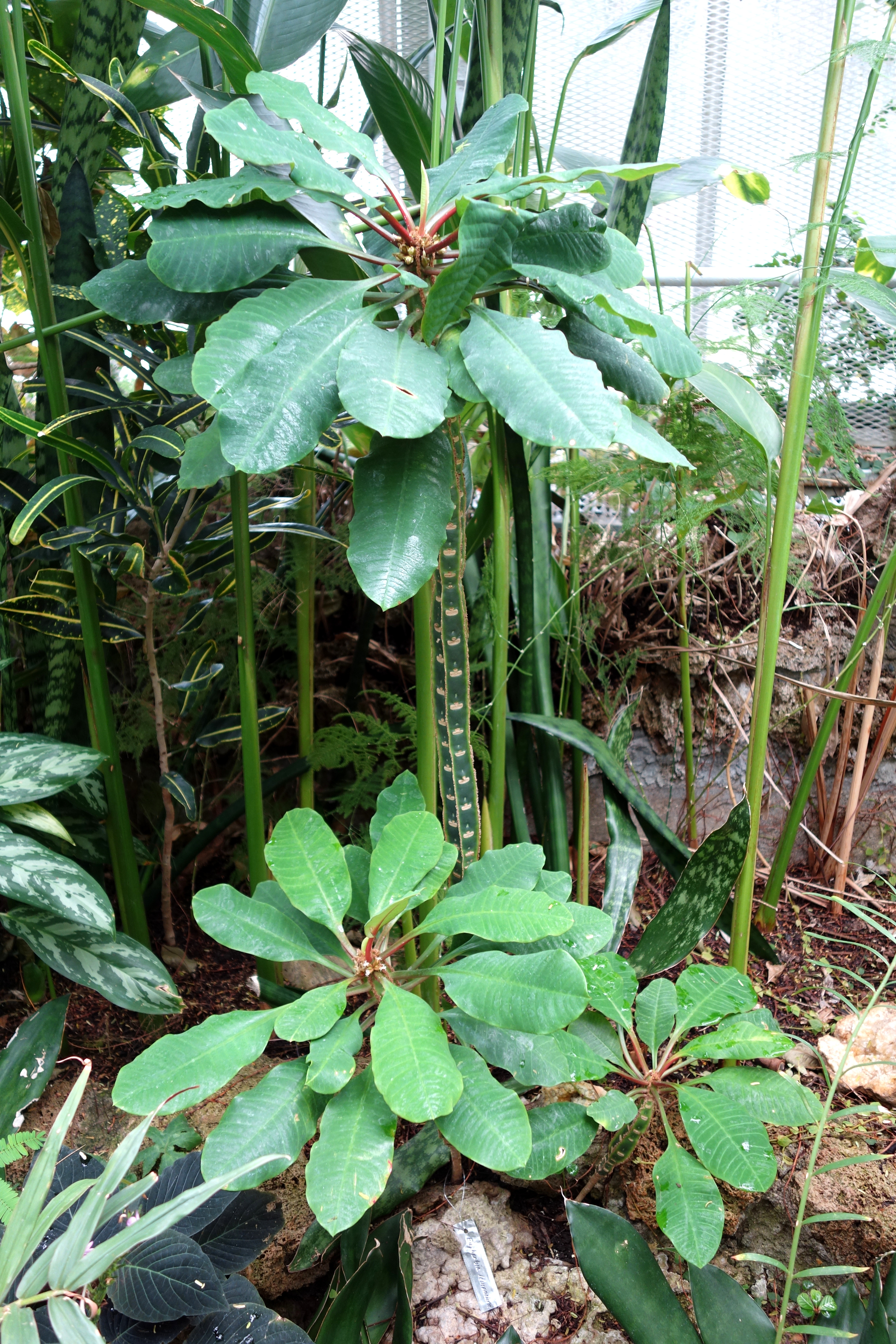
Young stems start out cylindrical and mature into four or five sided columns edged with dense brown bristles. The newer leaves are dark green with striking white veins arranged in a herringbone pattern, though this fades to plain green as the foliage ages. In strong light the leaf stalks and margins can flush reddish, and mature plants send up clusters of small, petal-less white flowers from red buds at the stem tips in spring. Left to itself it can become a substantial shrub, reaching around 1.8m tall and 1m across.
Source: RHS
Watch For Mealybugs
This plant may be susceptible to mealybugs, so it is worth checking leaf axils and stem joints where they tend to hide. Otherwise it is generally free of disease.
Source: RHS
Occasional Size Pruning
Prune in early spring, and only when needed to bring the size back under control. Given its eventual reach of nearly two metres, this is mainly a matter of managing an indoor specimen's bulk over time.
Source: RHS
Care recipe
The species record — the baseline every cultivar inherits unless it says otherwise.
Care notes are early — not yet verified
- Light
- ai:claude-opus-4-8
- Water
- ai:claude-opus-4-8 (range 10-21d)
- Humidity
- ai:claude-opus-4-8
- Soil
- ai:claude-fable-5
- Care
- ai:claude-fable-5
Bright, indirect
≈ every 21 days
Low — average room
15–29 °C
Well-draining sandy potting mix
Seed, which it ejects and self-sows freely
Dilute feed once or twice during the growing season
Slow
Small greenish-white flowers on and off through the year
Toxic to cats & dogs & humans
Euphorbiaceae produce an irritant milky latex that can harm skin, eyes, and mucous membranes. This is where toxicity lives: every cultivar of this species inherits it and none can override it.
Reference images
Every image credited. Licenses link to their deeds.
PrimarySources: ai:claude-opus-4-8 · ai:claude-opus-4-8 (range 10-21d) · ai:claude-fable-5 · ai:claude-opus-4-8 (family inference)
Kept true by its growers
Every fact here carries its source. Grow Madagascar Jewel yourself? What you’ve observed — how it drinks, how it holds its color, a name that’s off — and a clear photo of your plant are exactly what keep this page honest. Contributions are reviewed before anything changes.
Sign in to add what you know →