Species · genus Euphorbia · Euphorbiaceae
Caper Spurge
Euphorbia lathyris L.
Also known as: Gopher Plant · Moleplant · Mole Plant · Gopherplant
Cultivars of E. lathyris
The named forms growers keep — each with its own page, each honest about how much we know.
No named cultivars catalogued under E. lathyris yet. When growers document a stable, named form, it earns its own page here.
Guide
The species-level account. Cultivar pages build on this and say where they differ.
Caper Spurge, Briefly
Euphorbia lathyris, known as caper spurge or mole plant, is an upright biennial in the spurge family, grown as much for its architectural stems as for its folklore reputation. It carries the typical euphorbia trait of milky sap beneath a rather orderly, geometric leaf arrangement.
Source: RHS
From Central Asia Outward
This species is native to Central Asia through to Pakistan, with Kew narrowing its true home ground to Kyrgyzstan, Pakistan, and Xinjiang. From there it has been introduced very widely, turning up from Great Britain and much of Europe to North and South America, New Zealand, and beyond, a spread that speaks to how readily it seeds itself into new ground.
Source: Kew
Sun, Soil, Self-Sufficiency
Caper spurge prefers well-drained soil in full sun, though it will tolerate moist soil and partial shade without complaint. It suits clay, loam or sandy ground across a range of pH, and its drought resistance and hardiness rating of H5 mean it copes with most UK winters unassisted.
Source: RHS
Grown From Seed
Propagation is by seed, sown in spring. Left to its own devices the plant self-seeds readily, which is worth remembering before letting flowers run their course.
Source: RHS
Regimented Leaves, Caper-Like Seed
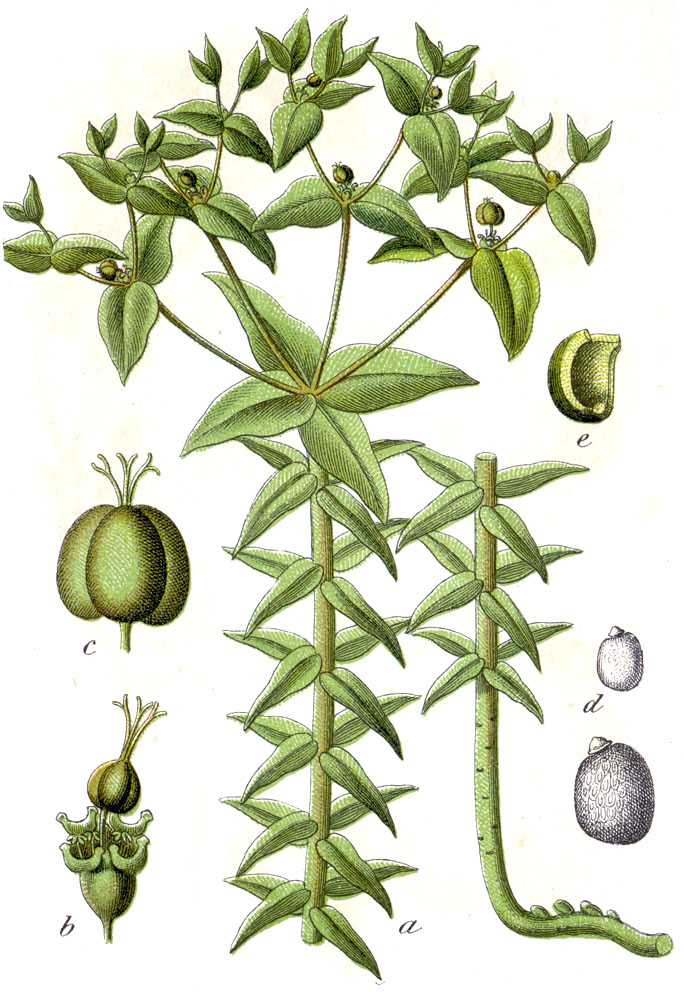
The plant grows upright to about 1.2 metres on unbranched stems, its narrow, lance-shaped dark green leaves held in neat horizontal pairs, an arrangement that gives it a distinctly regimented look. In late spring into summer it bears small yellow-green flowers only a few millimetres across, followed by green, caper-like seed capsules held in threes that ripen to brown.
Source: RHS
Largely Untroubled
This is a plant generally free of both pests and disease, one of the quieter entries in a troubleshooting list.
Source: RHS
Deadhead to Contain It
No pruning is required for caper spurge, but because it self-seeds so readily it can become a nuisance in the garden. Removing the flowers as they fade is the recommended way to keep its spread in check.
Source: RHS
Care recipe
The species record — the baseline every cultivar inherits unless it says otherwise.
Care notes are early — not yet verified
- Light
- ai:claude-opus-4-8
- Water
- ai:claude-opus-4-8 (range 10-21d)
- Humidity
- ai:claude-opus-4-8
- Soil
- ai:claude-fable-5
- Care
- ai:claude-fable-5
Bright, indirect
≈ every 21 days
Low — average room
10–27 °C
Well-draining sandy or gritty mix
Seed, self-sows readily
Minimal feeding; a light dose in spring is plenty
Fast
Small green-yellow blooms; biennial, flowers in its second year
Toxic to cats & dogs & humans
Euphorbiaceae produce an irritant milky latex that is caustic to skin, eyes, and mucous membranes if contacted or ingested. This is where toxicity lives: every cultivar of this species inherits it and none can override it.
Reference images
Every image credited. Licenses link to their deeds.
Sources: ai:claude-opus-4-8 · ai:claude-opus-4-8 (range 10-21d) · ai:claude-fable-5 · ai:claude-opus-4-8 (family inference)
Kept true by its growers
Every fact here carries its source. Grow Caper Spurge yourself? What you’ve observed — how it drinks, how it holds its color, a name that’s off — and a clear photo of your plant are exactly what keep this page honest. Contributions are reviewed before anything changes.
Sign in to add what you know →