Species · genus Euphorbia · Euphorbiaceae
Mottled Spurge
Euphorbia lactea Haw.
Also known as: Candelabra Spurge · Candelabra Cactus · Devil's Walking Stick · Dragon Bones · False Cactus · Milkstripe Euphorbia · Mottled Candlestick
Cultivars of E. lactea
The named forms growers keep — each with its own page, each honest about how much we know.
Guide
The species-level account. Cultivar pages build on this and say where they differ.
A Wobbly, Wonderful Succulent
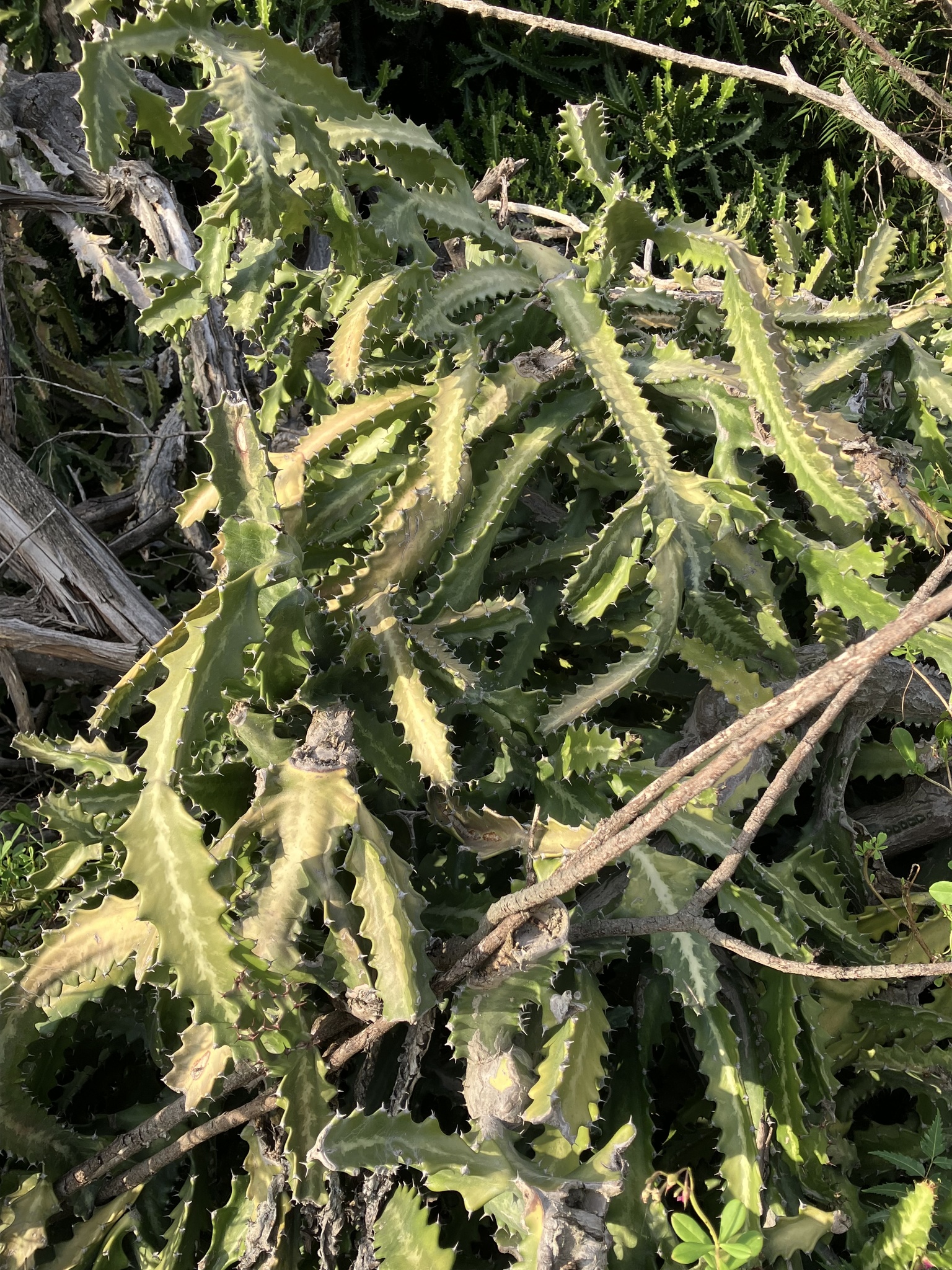
Euphorbia lactea is a leafless, cactus-like shrub prized for its three-sided, candelabra arms and mottled green-and-white stems. Despite its cactus look, it is a euphorbia through and through, marked out by milky sap and small, inconspicuous flowers rather than showy blooms.
Source: Epic Gardening
Tropical Asian Roots
This plant is believed to hail from India, and it also occurs naturally across Sri Lanka and Thailand. It is a tropical species, not a desert one, which sets it apart from the true cacti it resembles. The genus name likely honors Euphorbus, physician to the King of Mauretania, while the species name lactea nods to its milky sap.
Source: Missouri Botanical Garden
Sun, Sparing Water, Light Feed
Give this plant full to partial sun, but ease it into brighter light gradually, since direct summer sun and heat can scorch it, especially the paler variegated forms. Water only once the soil has dried out completely, watering at least weekly through summer and cutting back to once or not at all in winter; overwatered plants turn yellow, brown, and mushy, while underwatered ones simply wrinkle and recover faster. Plant it in sandy, well-draining cactus or succulent soil, keep it away from temperatures below 40°F, and feed monthly from spring through fall with a diluted, low-nitrogen fertilizer, withholding food entirely in winter.
Source: Epic Gardening
Cuttings or Careful Grafting
The standard, un-crested Euphorbia lactea roots reasonably well from stem cuttings taken in spring or summer, sliced cleanly at the arm's connection to the main stem and left to callous over for one to two weeks before being set upright in soil. Crested and variegated forms, by contrast, rarely root well on their own, so growers typically propagate them by grafting a cutting onto a healthy Euphorbia neriifolia base. Whichever method is used, the milky sap calls for gloves and caution throughout.
Source: Epic Gardening
Candelabra Form and Curious Cultivars
In its ordinary form, mottled spurge grows as an upright, columnar shrub with four-angled, spiny stems, paired black thorns, and green stems striped with white. Small teardrop leaves sometimes appear briefly at the growing tips before dropping. The 'Cristata' form mutates its growing point into a wavy, ridged crest resembling brain coral, and this crested type is usually grafted onto the stem of another euphorbia rather than grown on its own roots.
Source: RHS
Mealybugs and Company
Mealybugs are the pest most drawn to this plant's sap, appearing as small, cottony white clusters and, left unchecked, causing yellowing and wilting. Missouri Botanical Garden also notes aphids and nematodes may turn up, along with mites worth watching for. The RHS likewise flags mealybugs as the main pest risk, while describing the plant as otherwise generally disease-free.
Source: Missouri Botanical Garden
Rot, Mildew, and Toxic Sap
Root rot is the most serious threat, arising when the plant sits too wet from overwatering or poor drainage, and it turns affected tissue brownish-black and mushy, calling for prompt trimming of the damaged parts and a dry-out period before replanting. Powdery mildew can develop where air circulation and humidity are poor, showing as a white, moldy coating. Every part of this euphorbia is toxic, and its latex sap is a significant irritant to skin, eyes, and mucous membranes, so contact should always be avoided or handled with gloves.
Source: Epic Gardening
Repotting a Shallow-Rooted Plant
Despite its height, this euphorbia keeps a modest root system and rarely becomes rootbound, so repotting is mostly about sizing up into a heavier container that won't tip under the plant's weight, using dry, well-draining cactus soil and holding off on watering for a couple of weeks afterward to let any root damage heal. The crested cultivar is slow-growing and, per the RHS, needs no routine pruning at all. Gloves, covered arms and legs, and eye protection are worth the trouble whenever handling this spiny, sap-oozing plant.
Source: Epic Gardening
Care recipe
The species record — the baseline every cultivar inherits unless it says otherwise.
Care notes are early — not yet verified
- Light
- ai:claude-opus-4-8
- Water
- ai:claude-opus-4-8 (range 14-28d)
- Humidity
- ai:claude-opus-4-8
- Soil
- ai:claude-fable-5
- Care
- ai:claude-fable-5
Bright, indirect
≈ every 28 days
Low — average room
13–29 °C
Gritty, fast-draining cactus and succulent mix
Stem or crest cuttings, callused before potting
Light succulent feed once or twice during the growing season
Slow
Rarely flowers indoors
Toxic to cats & dogs & humans
Milky latex in every part of the plant contains diterpene esters. Skin contact can cause dermatitis, eye contact can damage the cornea, and ingestion blisters the mouth and lips. Toxic to cats, dogs, and people — keep sap off skin and the plant out of reach. This is where toxicity lives: every cultivar of this species inherits it and none can override it.
Reference images
Every image credited. Licenses link to their deeds.
PrimarySources: ai:claude-opus-4-8 · ai:claude-opus-4-8 (range 14-28d) · ai:claude-fable-5 · NC State Extension Plant Toolbox — Euphorbia lactea (species entry; poison characteristics)
Kept true by its growers
Every fact here carries its source. Grow Mottled Spurge yourself? What you’ve observed — how it drinks, how it holds its color, a name that’s off — and a clear photo of your plant are exactly what keep this page honest. Contributions are reviewed before anything changes.
Sign in to add what you know →