Species · genus Euphorbia · Euphorbiaceae
Wood Spurge
Euphorbia amygdaloides L.
Cultivars of E. amygdaloides
The named forms growers keep — each with its own page, each honest about how much we know.
No named cultivars catalogued under E. amygdaloides yet. When growers document a stable, named form, it earns its own page here.
Guide
The species-level account. Cultivar pages build on this and say where they differ.
A Woodland Spurge
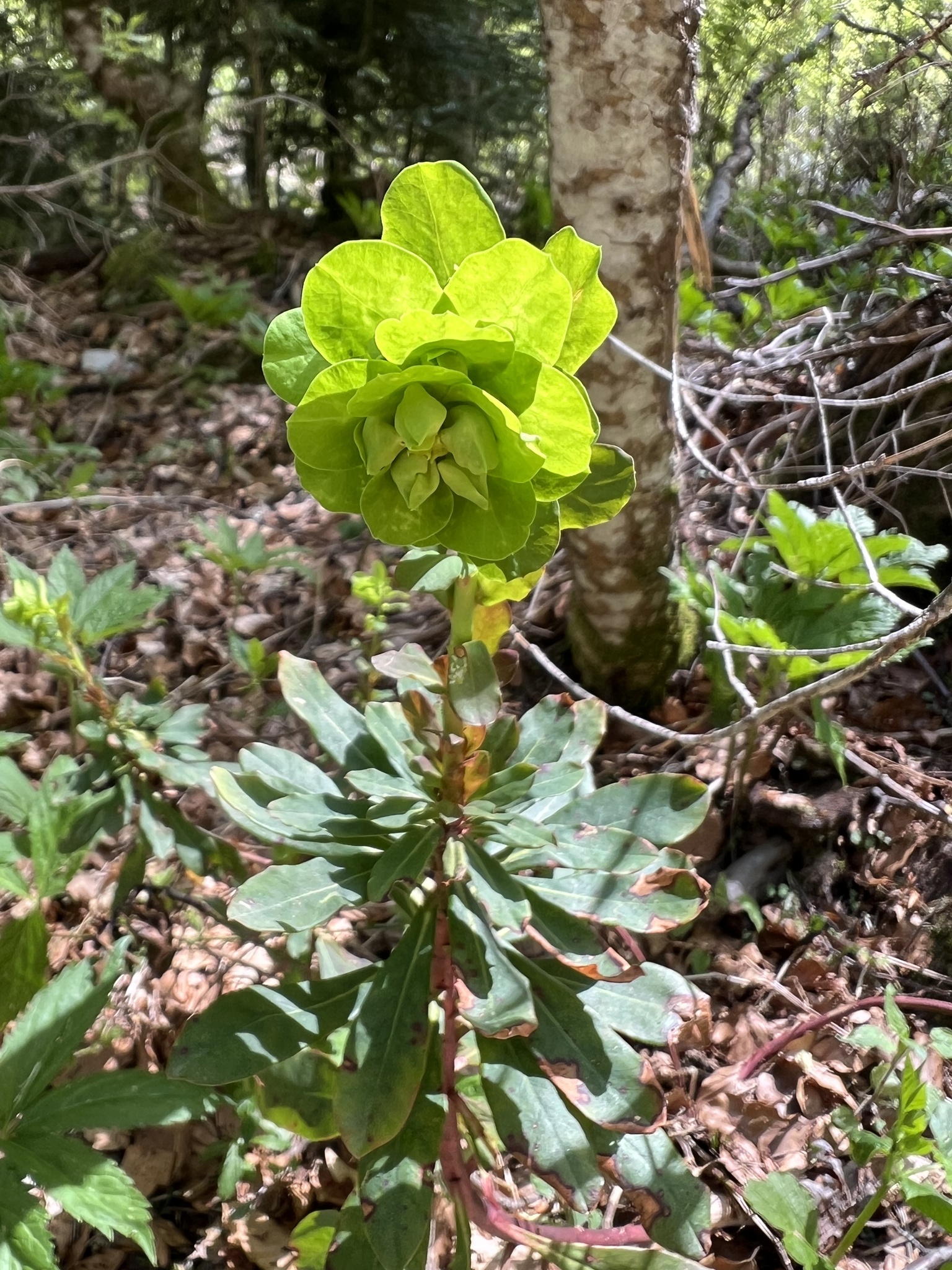
Wood spurge is a bushy, evergreen perennial in the Euphorbiaceae family, grown for its reddish-green stems, matt foliage, and clusters of yellow-green flowers held in spring and summer. It stays low and mounded, generally reaching no more than half a metre in height and spread.
Source: RHS
Native Woodland Margins
This species comes from woodland margins across Europe, western Asia, and the Mediterranean, with a native range extending into northern Africa. It is also counted among the native flora of Britain and Ireland. The genus name is thought to honour Euphorbus, physician to the King of Mauretania, while the species name refers to a resemblance to almond.
Source: Missouri Botanical Garden
Light, Soil, and Position
In the garden it takes best to partial shade, though it will grow in full sun to part shade and tolerates dry shade without complaint. It prefers moist but well-drained soil across clay, loam, or sandy ground, and is unfussy about pH. It is worth noting that wet soil, especially through winter, can be fatal, so drainage matters more than feeding here.
Source: RHS
Dividing and Cuttings
Increase it by division in spring, by basal cuttings in early summer, or by sowing seed. Left alone, it will also self-seed readily unless spent flowers are removed before they set seed.
Source: RHS
Foliage and Flower Bracts
The leaves are spatulate to obovate, matte green, and purple-tinted beneath, arranged alternately lower on the stem and in whorls higher up; they take on purple-burgundy tones as autumn cools. In spring the stems carry showy yellow-green bracts surrounding small, inconspicuous true flowers, and broken stems release a milky sap that can irritate skin badly and is poisonous if eaten.
Source: Missouri Botanical Garden
Aphids and Grey Mould
Wood spurge may draw aphids, and can be susceptible to botrytis, or grey mould.
Source: RHS
Spreading and Skin Irritation
This plant spreads by rhizomes and can turn into a nuisance if left unmanaged, so it is worth keeping an eye on its boundaries. The sap is an irritant to skin and eyes and harmful if eaten, so gloves and other protection are sensible when handling or pruning it.
Source: RHS
Cutting Back After Flowering
Remove flowering stems immediately after they finish, which encourages fresh basal growth to take their place.
Source: RHS
Care recipe
The species record — the baseline every cultivar inherits unless it says otherwise.
Care notes are early — not yet verified
- Light
- ai:claude-opus-4-8
- Water
- ai:claude-opus-4-8 (range 7-14d)
- Humidity
- ai:claude-opus-4-8
- Soil
- ai:claude-fable-5
- Care
- ai:claude-fable-5
Bright, indirect
≈ every 14 days
Medium
5–24 °C
Well-draining, moderately fertile loam
Division or stem cuttings
Light balanced feed monthly in the growing season
Moderate
Chartreuse-green flower bracts in spring
Toxic to cats & dogs & humans
Euphorbiaceae produce an irritant milky latex that can burn skin, eyes and mucous membranes. This is where toxicity lives: every cultivar of this species inherits it and none can override it.
Reference images
Every image credited. Licenses link to their deeds.
PrimarySources: ai:claude-opus-4-8 · ai:claude-opus-4-8 (range 7-14d) · ai:claude-fable-5 · ai:claude-opus-4-8 (family inference)
Kept true by its growers
Every fact here carries its source. Grow Wood Spurge yourself? What you’ve observed — how it drinks, how it holds its color, a name that’s off — and a clear photo of your plant are exactly what keep this page honest. Contributions are reviewed before anything changes.
Sign in to add what you know →