Species · genus Echeveria · Crassulaceae
Blue Echeveria
Echeveria secunda Booth ex Lindl.
Also known as: Hen-and-chickens Echeveria
Cultivars of E. secunda
The named forms growers keep — each with its own page, each honest about how much we know.
No named cultivars catalogued under E. secunda yet. When growers document a stable, named form, it earns its own page here.
Guide
The species-level account. Cultivar pages build on this and say where they differ.
A Mexican rosette succulent
Echeveria secunda, the glaucous echeveria, is a clump-forming succulent perennial that builds clusters of rosettes rather than a single specimen. Its narrow, wedge-shaped leaves carry a pale glaucous-grey bloom, and in summer it sends up one-sided sprays of nodding, urn-shaped red and yellow flowers on stems up to 30cm tall.
Source: RHS
Native to Mexico
This species comes from Mexico and belongs to the Crassulaceae family. It is an evergreen, clump-forming succulent, and its many synonyms, including Echeveria secunda var. glauca and Echeveria glauca, reflect a long history of botanical reclassification.
Source: RHS
Sun, sparing water, dry winters
Grow this echeveria under glass in a standard cactus compost, set in full light with low humidity, as it comes from a dry, sun-drenched habitat. Water freely while it is in active growth, but keep it just moist the rest of the time, and let it run almost dry through winter. Feed fortnightly with a dilute, low-nitrogen fertiliser during late spring and summer, and stand the pots outside for the summer months if you can.
Source: RHS
Cuttings or offsets
Increase this plant by taking stem or leaf cuttings in spring or early summer, or by separating the offsets it naturally produces around the base of the rosettes, also in spring.
Source: RHS
Rosettes, glaucous leaves, one-sided blooms
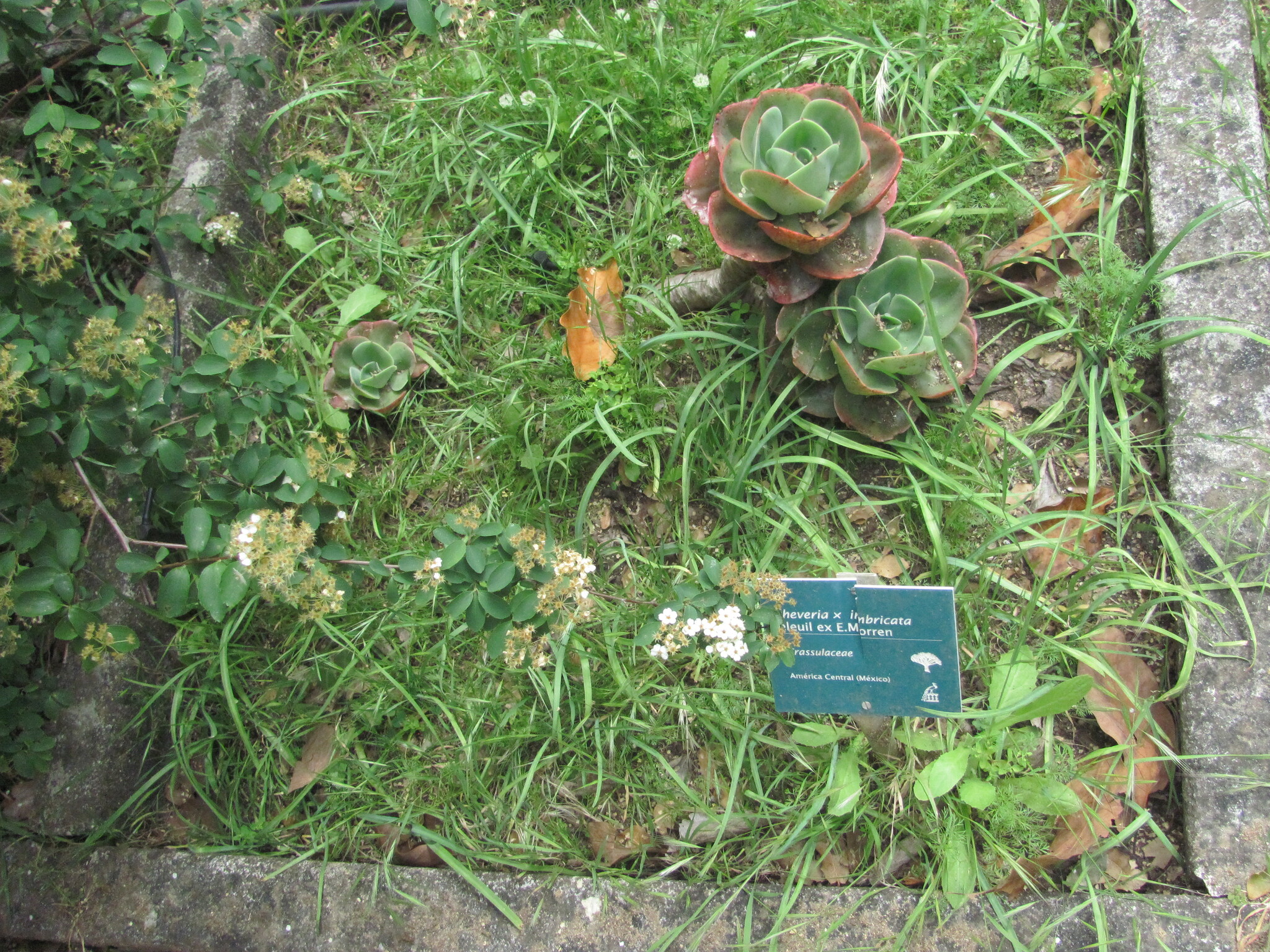
The defining trait is the tight cluster of rosettes, each made up of narrowly wedge-shaped, pale grey-blue leaves. The flower stems are distinctive too, arranging their nodding, urn-shaped red-and-yellow blooms all to one side rather than around the stem. A variegated form, 'Compton Carousel', carries the same habit but with blue-green leaves edged in cream, and has earned the RHS Award of Garden Merit.
Source: RHS
Mealybugs, weevils, aphids
Watch for mealybugs, vine weevil, and aphids, the pests most likely to trouble this echeveria. It is otherwise generally free of disease.
Source: RHS
Little upkeep needed
No pruning is required for this plant, which suits its billing as a low-maintenance patio or container succulent. It reaches maturity over two to five years, staying compact at 0.1 to 0.5 metres in height and spread.
Source: RHS
Care recipe
The species record — the baseline every cultivar inherits unless it says otherwise.
Care notes are early — not yet verified
- Light
- ai:claude-opus-4-8
- Water
- ai:claude-opus-4-8 (range 10-21d)
- Humidity
- ai:claude-opus-4-8
- Soil
- ai:claude-fable-5
- Care
- ai:claude-fable-5
Direct sun
≈ every 21 days
Low — average room
10–27 °C
Gritty, fast-draining cactus and succulent mix
Prolific offsets; leaf cuttings also root readily
Dilute succulent feed once or twice in spring and summer
Moderate
Red-and-yellow bells on slender stalks in spring and summer
Not yet documented
This is where toxicity lives — every cultivar of this species inherits it and none can override it.
Reference images
Every image credited. Licenses link to their deeds.
Sources: ai:claude-opus-4-8 · ai:claude-opus-4-8 (range 10-21d) · ai:claude-fable-5
Kept true by its growers
Every fact here carries its source. Grow Blue Echeveria yourself? What you’ve observed — how it drinks, how it holds its color, a name that’s off — and a clear photo of your plant are exactly what keep this page honest. Contributions are reviewed before anything changes.
Sign in to add what you know →