Species · genus Echeveria · Crassulaceae
Pulido's Echeveria
Echeveria pulidonis E.Walther
Cultivars of E. pulidonis
The named forms growers keep — each with its own page, each honest about how much we know.
No named cultivars catalogued under E. pulidonis yet. When growers document a stable, named form, it earns its own page here.
Guide
The species-level account. Cultivar pages build on this and say where they differ.
A Compact Mexican Rosette
Echeveria pulidonis, commonly called Pulido's echeveria, is an evergreen succulent forming neat mat-shaped rosettes of fleshy leaves. It stays modest in scale, generally reaching no more than half a metre in height or spread.
Source: RHS
Rooted in Mexico's Dry Hills
This species comes from central Mexico, found in the states of Hidalgo, Veracruz and Puebla. It grows there as a succulent subshrub in desert and dry shrubland settings, and was first formally described by Walther in 1972.
Source: Kew
Sun, Sparse Water, Light Feeding
Grow this echeveria under glass in a standard cactus compost, in full light and low humidity, ideally on a south- or west-facing spot. Water freely while it is in active growth but keep the compost just moist the rest of the time, and feed fortnightly with a dilute, low-nitrogen fertiliser through late spring and summer. It can be moved outdoors for the summer months, though it should be sheltered and is only hardy to about 1 to 5°C.
Source: RHS
Cuttings or Offsets
Propagate by taking stem or leaf cuttings in spring or early summer, or by separating offsets in spring.
Source: RHS
Grey Leaves, Red Edges
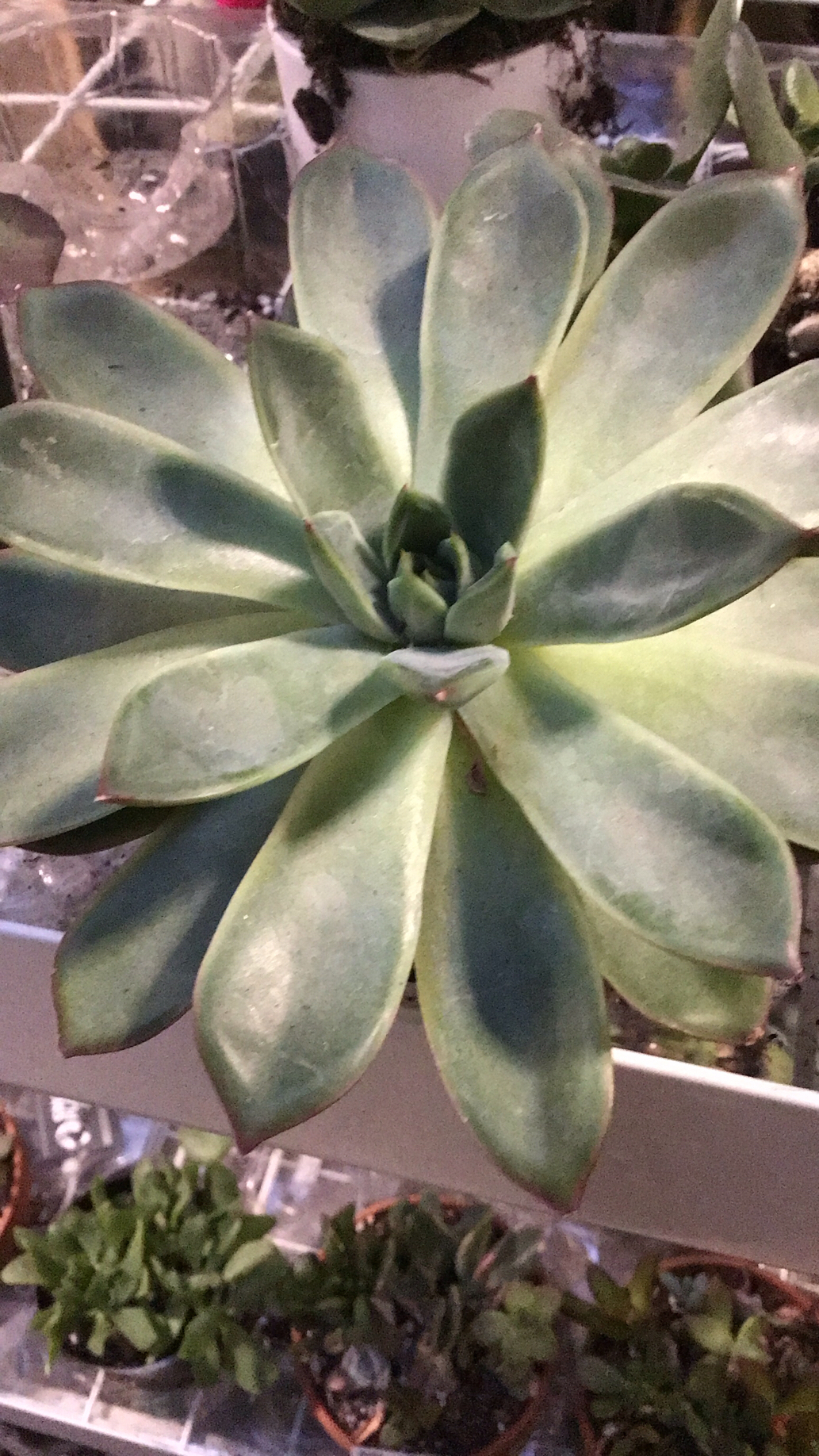
The rosettes reach up to 12cm across, made of fleshy, grey-green leaves rimmed in dark red, a margin that deepens under strong light. In summer, arched stems rise above the foliage carrying small clusters of bright yellow, hanging, urn-shaped flowers.
Source: RHS
Watch for Sap-Suckers
Mealybugs, vine weevil and aphids are the pests most likely to trouble this echeveria. Otherwise, it is generally free of disease.
Source: RHS
Tidy Spent Flower Stems
Once flowering has finished, remove the dead flower stems at their base to keep the rosette tidy.
Source: RHS
Care recipe
The species record — the baseline every cultivar inherits unless it says otherwise.
Care notes are early — not yet verified
- Light
- ai:claude-opus-4-8
- Water
- ai:claude-opus-4-8 (range 10-21d)
- Humidity
- ai:claude-opus-4-8
- Soil
- ai:claude-fable-5
- Care
- ai:claude-fable-5
Direct sun
≈ every 21 days
Low — average room
10–27 °C
Gritty, fast-draining cactus and succulent mix
Leaf or offset cuttings, callused then rooted in dry mix
Dilute succulent feed once or twice in spring and summer
Slow
Bright yellow bells on short stalks in spring
Not yet documented
This is where toxicity lives — every cultivar of this species inherits it and none can override it.
Reference images
Every image credited. Licenses link to their deeds.
PrimarySources: ai:claude-opus-4-8 · ai:claude-opus-4-8 (range 10-21d) · ai:claude-fable-5
Kept true by its growers
Every fact here carries its source. Grow Pulido's Echeveria yourself? What you’ve observed — how it drinks, how it holds its color, a name that’s off — and a clear photo of your plant are exactly what keep this page honest. Contributions are reviewed before anything changes.
Sign in to add what you know →