Species · genus Echeveria · Crassulaceae
Mexican Snowball
Echeveria elegans Rose
Also known as: Mexican-gem · Pearl Echeveria · White Mexican-rose
Cultivars of E. elegans
The named forms growers keep — each with its own page, each honest about how much we know.
No named cultivars catalogued under E. elegans yet. When growers document a stable, named form, it earns its own page here.
Guide
The species-level account. Cultivar pages build on this and say where they differ.
A Classic Rosette Succulent
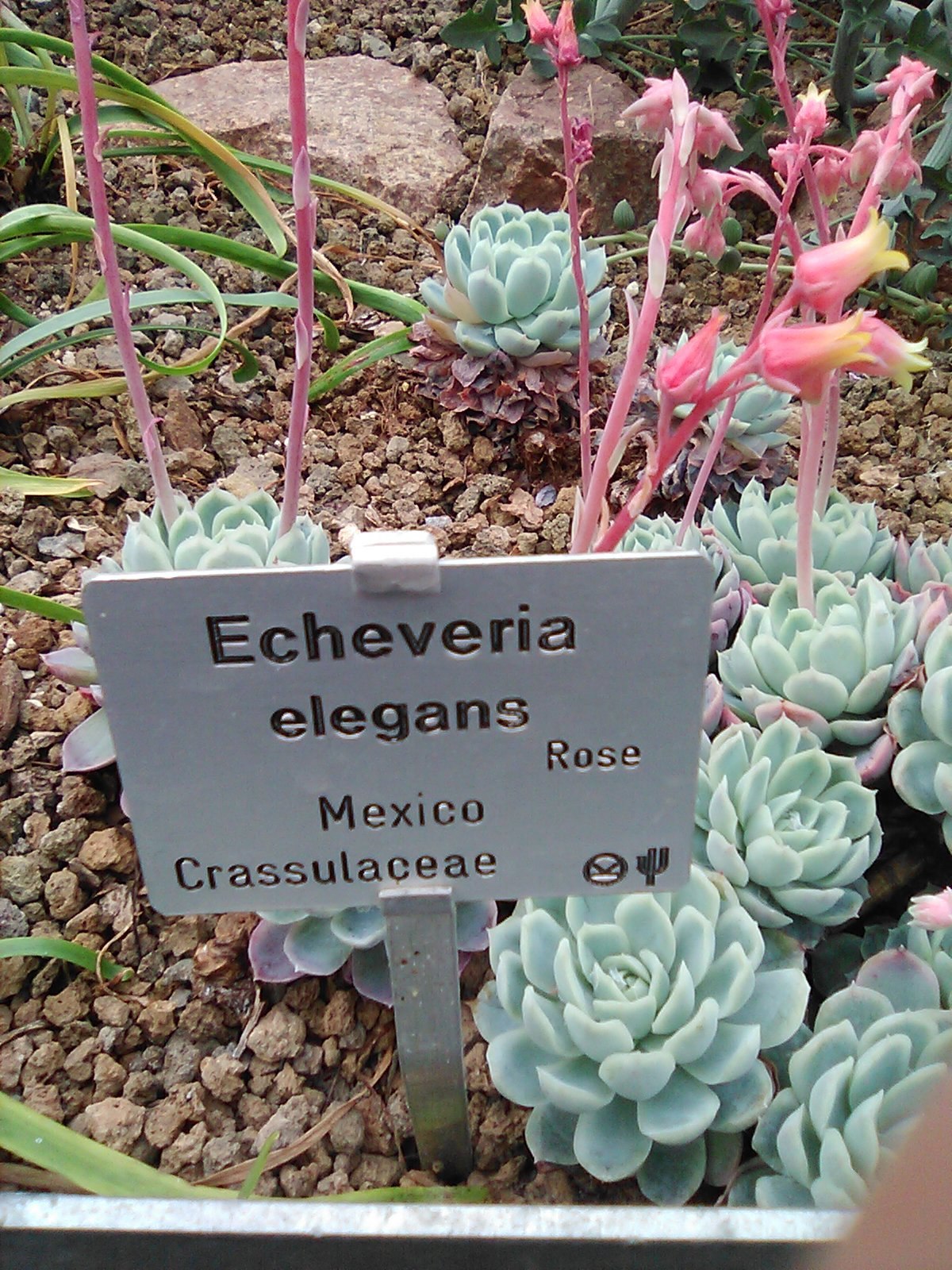
Echeveria elegans, the Mexican snowball, is about as archetypal as succulents get: tight rosettes of plump, blue-green-grey leaves dusted with a powdery farina. It's one of the most widely grown succulents around, equally at home in a garden bed, a rock garden, or a simple pot on a sill.
Source: Epic Gardening
A Mexican Native
This plant hails from central Mexico, where it evolved as a drought-tolerant desert dweller. Its name, elegans, is simply Latin for elegant, a fitting label for a plant that has gone on to earn the Royal Horticultural Society's Award of Garden Merit.
Source: Epic Gardening
Light, Water, and Rest
Give this echeveria at least six hours of sun a day, with full sun to partial shade suiting it best, and let the soil dry out completely between waterings before soaking it through. Winter brings a natural dormancy, so watering should taper off then, picking back up once new growth appears in late winter. Feeding is optional; a little balanced, slow-release fertilizer is only needed if growth has stalled for a long while.
Source: Epic Gardening
Leaves, Stems, and Offsets
Echeveria elegans propagates readily from leaf cuttings, stem cuttings, or the offsets it naturally produces. For leaves, twist one off cleanly at the node, let the wound callus for a few days, then rest it on well-draining soil and mist regularly until a small rosette forms at the base. Stem cuttings follow the same principle: let the cut end callus before setting it in soil, and once roots develop, watering can shift to a normal succulent routine.
Source: Epic Gardening
Spiraled Leaves, Lantern Flowers
Each triangular, water-plump leaf spirals into a rosette that folds into a sphere or lies flatter like a disk, and some cultivated forms carry up to 100 leaves per rosette. In late winter through summer it can send up slender stalks topped with lantern-shaped pink flowers tipped in yellow, a striking contrast to the pale foliage below. The plant also produces small offsets as it matures, giving it a clumping habit reminiscent of hens and chicks, though the two are unrelated.
Source: Epic Gardening
Sap-Seeking Insects
This succulent isn't often troubled by pests, but aphids, mealybugs, and spider mites will occasionally show up drawn to the moisture stored in its leaves. Early signs include yellowing leaves and stunted growth, with spider mites also bringing shriveling and eventual leaf drop before their fine webbing becomes obvious. Insecticidal soap, diatomaceous earth, or neem oil can help, alongside routinely clearing debris from the plant.
Source: Epic Gardening
Stretching, Scorch, and Rot
Insufficient light causes the rosette to stretch toward the source, a condition called etiolation that can't be reversed short of cutting back the stem and replanting the compact top. Too much sun, on the other hand, can scar the leaves, so a shift to partial shade is the usual fix. The single fastest way to lose this plant is overwatering, which invites the fungi and bacteria behind root rot; keeping foliage dry and giving the plant good air circulation is the best prevention.
Source: Epic Gardening
Self-Cleaning Rosettes
Echeveria elegans is largely self-pruning, shedding its older, lower leaves as they brown and wrinkle to make room for new growth. These spent leaves can simply be pulled away by hand to keep the rosette tidy. Beyond this, the plant asks for very little upkeep.
Source: Epic Gardening
Care recipe
The species record — the baseline every cultivar inherits unless it says otherwise.
Care notes are early — not yet verified
- Light
- ai:claude-opus-4-8
- Water
- ai:claude-opus-4-8 (range 10-21d)
- Humidity
- ai:claude-opus-4-8
- Soil
- ai:claude-fable-5
- Care
- ai:claude-fable-5
Direct sun
≈ every 21 days
Low — average room
10–27 °C
Gritty, fast-draining cactus and succulent mix
Leaf or offset cuttings, callused then rooted in dry mix
Dilute succulent feed once or twice in spring and summer
Slow
Arching pink-and-yellow bells in spring when given strong light
Not yet documented
This is where toxicity lives — every cultivar of this species inherits it and none can override it.
Reference images
Every image credited. Licenses link to their deeds.
PrimarySources: ai:claude-opus-4-8 · ai:claude-opus-4-8 (range 10-21d) · ai:claude-fable-5
Kept true by its growers
Every fact here carries its source. Grow Mexican Snowball yourself? What you’ve observed — how it drinks, how it holds its color, a name that’s off — and a clear photo of your plant are exactly what keep this page honest. Contributions are reviewed before anything changes.
Sign in to add what you know →