Species · genus Echeveria · Crassulaceae
Molded-wax
Echeveria agavoides Lem.
Also known as: Lipstick · Lipstick Echeveria
Cultivars of E. agavoides
The named forms growers keep — each with its own page, each honest about how much we know.
No named cultivars catalogued under E. agavoides yet. When growers document a stable, named form, it earns its own page here.
Guide
The species-level account. Cultivar pages build on this and say where they differ.
A small, colorful rosette
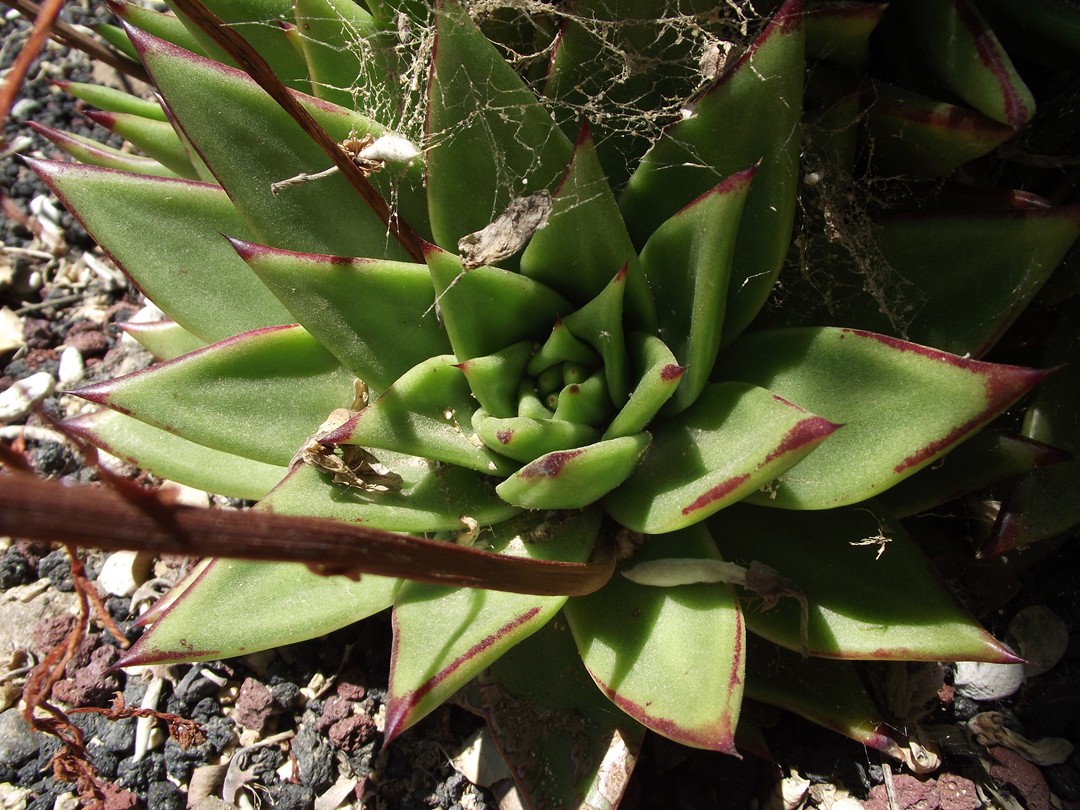
Echeveria agavoides, sometimes called moulded wax succulent or wax agave, is a compact rosette-forming succulent with triangular, pale green leaves edged in red. Its agave-like form gave rise to its species name, and despite its small stature it draws attention wherever it sits.
Source: Epic Gardening
A Mexican native
This echeveria is native to Mexico, where it grows in warm, dry conditions suited to USDA zones 10 to 11. It is usually solitary, rarely producing offsets on its own, and its popularity as a hybrid parent has given rise to many named forms.
Source: Epic Gardening
Light, water, and feeding
Give this plant full sun to bring out its strongest color, though it tolerates as little as four hours of direct light a day; indoors, a south or west-facing window suits it well. Water using the soak-and-dry method, wetting the roots rather than the leaves and letting the soil dry out between drinks, watering even less through winter. Fertilizer isn't a necessity given its native low-nutrient habitat, but a half-strength balanced or low-nitrogen liquid feed occasionally in spring and summer, or a top-dressing of worm castings, can help a dull-looking plant.
Source: Epic Gardening
Propagating by leaf
The simplest method is leaf cuttings: twist off a healthy leaf whole, let it callous over for a few days, then lay it on well-draining soil and mist until it roots. RHS notes seed can also be sown at 15 to 18°C in early spring, or offsets separated in spring, alongside stem or leaf cuttings taken in spring or early summer.
Source: Epic Gardening
Rosette, leaves, and flowers
The plant forms an evergreen, clump-forming rosette of triangular-ovate leaves, pale green and margined with red. In summer it sends up lantern-shaped flowers, red with yellow tips, arranged in one-sided racemes that can reach up to 40cm tall on stems well above the foliage.
Source: RHS
Aphids and mealybugs
Aphids are drawn to the sap and can be discouraged by keeping the plant dry, dusting the soil with diatomaceous earth, or treating leaves with neem oil or insecticidal soap. Mealybugs tend to settle in where dead leaves have been left on the soil, showing up as white, cottony nests with sticky honeydew that attracts ants; clearing debris and wiping pests away with alcohol-dipped cotton swabs keeps them in check. RHS also flags vine weevil as a possible pest of this species.
Source: Epic Gardening
Sunburn and root rot
Sudden moves into bright light can scorch leaves, so acclimate the plant gradually or start it outdoors on a cloudy day, watering it well beforehand. Root rot is the main disease risk and shows as black, mushy sections; cutting away the rot, letting the plant dry, and repotting into fresh soil is the usual fix. Otherwise, RHS notes the species is generally disease-free.
Source: Epic Gardening
Repotting and tidying
Repot in spring or summer once the plant has outgrown its pot, letting the soil dry out first and holding off watering for a few days afterward so roots can settle. The only pruning needed is removing dead leaves by hand, which should be discarded rather than left in the pot where they can attract pests. RHS confirms no pruning is required for this species.
Source: Epic Gardening
Care recipe
The species record — the baseline every cultivar inherits unless it says otherwise.
Care notes are early — not yet verified
- Light
- ai:claude-opus-4-8
- Water
- ai:claude-opus-4-8 (range 14-28d)
- Humidity
- ai:claude-opus-4-8
Direct sun
≈ every 28 days
Low — average room
Not documented
Not documented
Not documented
Not documented
Not documented
Not documented
Not yet documented
This is where toxicity lives — every cultivar of this species inherits it and none can override it.
Reference images
Every image credited. Licenses link to their deeds.
PrimarySources: ai:claude-opus-4-8 · ai:claude-opus-4-8 (range 14-28d)
Kept true by its growers
Every fact here carries its source. Grow Molded-wax yourself? What you’ve observed — how it drinks, how it holds its color, a name that’s off — and a clear photo of your plant are exactly what keep this page honest. Contributions are reviewed before anything changes.
Sign in to add what you know →