Species · genus Drosera · Droseraceae
Cape Sundew
Drosera capensis L.
Cultivars of D. capensis
The named forms growers keep — each with its own page, each honest about how much we know.
No named cultivars catalogued under D. capensis yet. When growers document a stable, named form, it earns its own page here.
Guide
The species-level account. Cultivar pages build on this and say where they differ.
The Cape Sundew
This is Drosera capensis, the Cape sundew, an evergreen carnivorous perennial from the Droseraceae family. It grows in clumping rosettes of narrow, spoon-shaped leaves whose surfaces are set with sticky, glandular hairs for catching and digesting insects.
Source: RHS
Wet Feet, Bright Light
Give this plant full light, with shading from the harshest midday sun under glass, and never let the growing medium dry out. Stand the pot in a tray of rainwater or reverse osmosis water through the growing season, easing off to just moist in winter, and skip fertiliser entirely. In frost-prone regions it wants glasshouse protection, while in warmer climates it can sit in a wet, acidic bog garden in full sun.
Source: RHS
Seed, Leaf, and Root
Propagate from seed sown as soon as it ripens, since stored seed loses viability quickly. Leaf cuttings can be taken during active growth, and root cuttings when the plant is dormant.
Source: RHS
Sticky Traps and Blooms
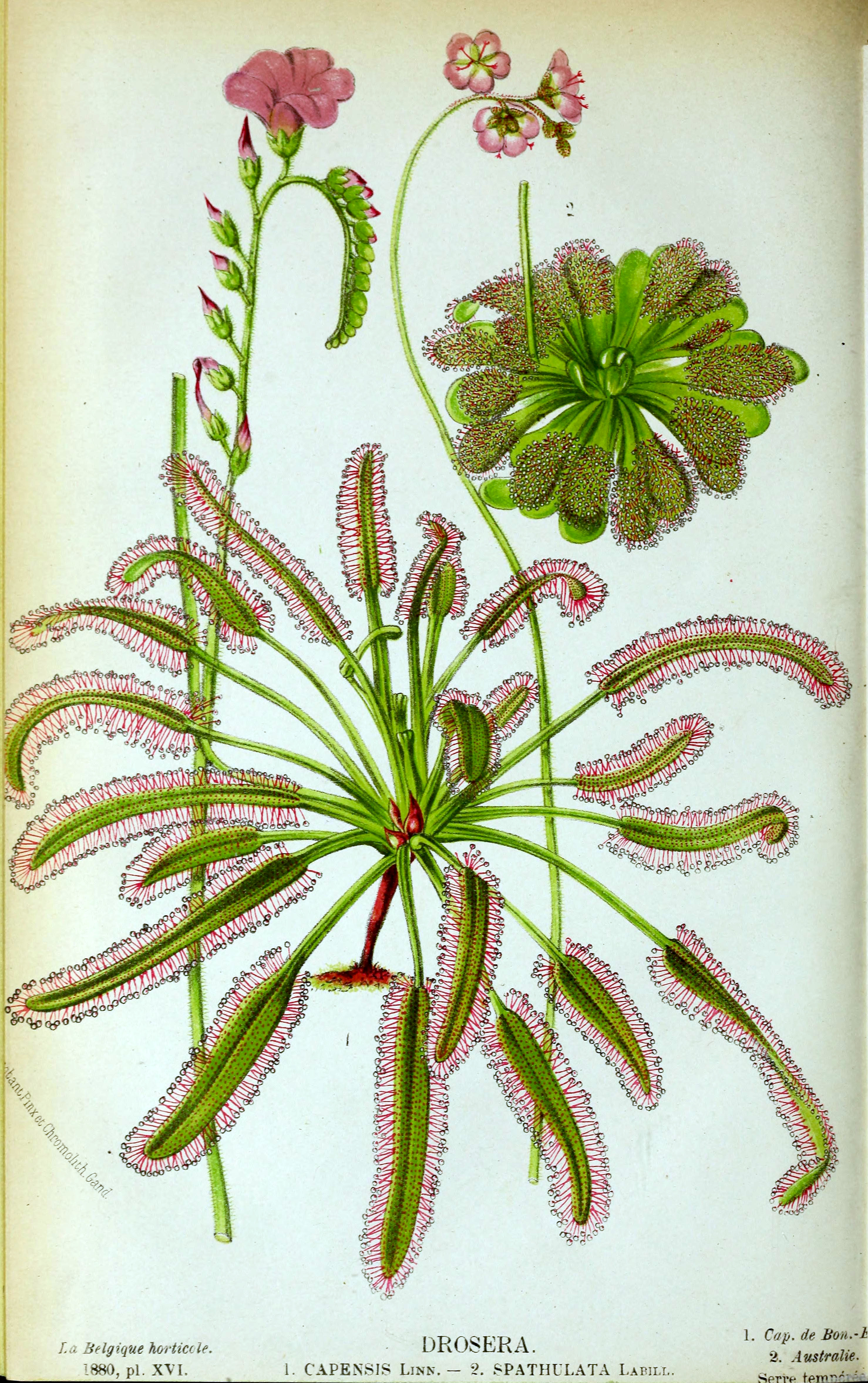
The leaves are linear to spoon-shaped, some six centimetres long, clothed in red or pink glandular hairs that glisten and snare prey. A red-leaved form exists alongside the typical green one. From spring to autumn, and sometimes into winter, it sends up racemes of rose-pink flowers, each about two centimetres across, in clusters of six to twenty.
Source: RHS
Largely Untroubled
This sundew is generally free of both pests and disease.
Source: RHS
Dormancy and Die-Back
No pruning is needed. Where winter temperatures drop consistently below 5C, the plant forms overwintering buds called hibernacula at the stem tip while its foliage dies back, then regenerates from the roots as temperatures rise in spring.
Source: RHS
Care recipe
The species record — the baseline every cultivar inherits unless it says otherwise.
Care notes are early — not yet verified
- Light
- ai:claude-opus-4-8
- Water
- ai:claude-opus-4-8 (range 1-3d)
- Humidity
- ai:claude-opus-4-8
- Soil
- ai:claude-fable-5
- Care
- ai:claude-fable-5
Bright, indirect
≈ every 3 days
High
5–30 °C
Nutrient-poor mix of sphagnum peat and sand, no fertilizer
Seed, leaf cuttings, or root cuttings
Never fertilize; feeds by catching insects
Fast
Freely produces tall pink flower spikes
Not yet documented
This is where toxicity lives — every cultivar of this species inherits it and none can override it.
Reference images
Every image credited. Licenses link to their deeds.
PrimarySources: ai:claude-opus-4-8 · ai:claude-opus-4-8 (range 1-3d) · ai:claude-fable-5
Kept true by its growers
Every fact here carries its source. Grow Cape Sundew yourself? What you’ve observed — how it drinks, how it holds its color, a name that’s off — and a clear photo of your plant are exactly what keep this page honest. Contributions are reviewed before anything changes.
Sign in to add what you know →