Species · genus Dracaena · Asparagaceae
Lucky Bamboo
Dracaena sanderiana Mast.
Also known as: Belgian Evergreen · Chinese Water Bamboo · Curly Bamboo · Goddess Of Mercy's Plant · Ribbon Dracaena
Cultivars of D. sanderiana
The named forms growers keep — each with its own page, each honest about how much we know.
No named cultivars catalogued under D. sanderiana yet. When growers document a stable, named form, it earns its own page here.
Guide
The species-level account. Cultivar pages build on this and say where they differ.
Not Actually Bamboo
Lucky bamboo is a Dracaena, not a true bamboo, and for over 4,000 years it has been kept as a symbol of good fortune in Asian households. It has become a widely available houseplant that can be grown either in soil or simply in water and rocks, which is part of why it suits beginners as well as experienced growers.
Source: Epic Gardening
African Roots, Asian Symbolism
Despite its association with Asian tradition, lucky bamboo actually originates in western Africa, in areas including the Congo, Gabon, Cameroon, and Angola. It became a common gift between friends and coworkers and, in Feng Shui, is placed in the southern and eastern parts of a home to represent prosperity and good fortune.
Source: Epic Gardening
Bright Shade, Steady Moisture
Lucky bamboo prefers bright but indirect light, since direct sun scorches its leaves while too little light slows growth; the RHS likewise places it in partial shade, sheltered from hot direct sun. Grown in water, it simply needs the container topped up with clean, chlorine-free water, refreshed if it turns stagnant; grown in soil, it wants sandy loam kept consistently moist, in a pH range of about 6.0 to 6.5. It is a tropical plant, so temperatures should stay above 60°F (16°C), and soil-grown specimens benefit from a very dilute liquid fertilizer roughly every two months, while water-grown ones can go without feeding altogether.
Source: Epic Gardening
Rooting Cuttings in Water
Lucky bamboo propagates readily from stem cuttings of four to six inches, taken with sterilized shears, left to dry overnight, and then set in distilled water for a few days before misting begins to coax new growth. Once roots form, the cutting can be moved into water, rocks, or soil, with soil rooting taking about a month. The RHS notes that this Dracaena can also be propagated from semi-ripe or hardwood cuttings.
Source: Epic Gardening
Cane Stems, Curling Leaves
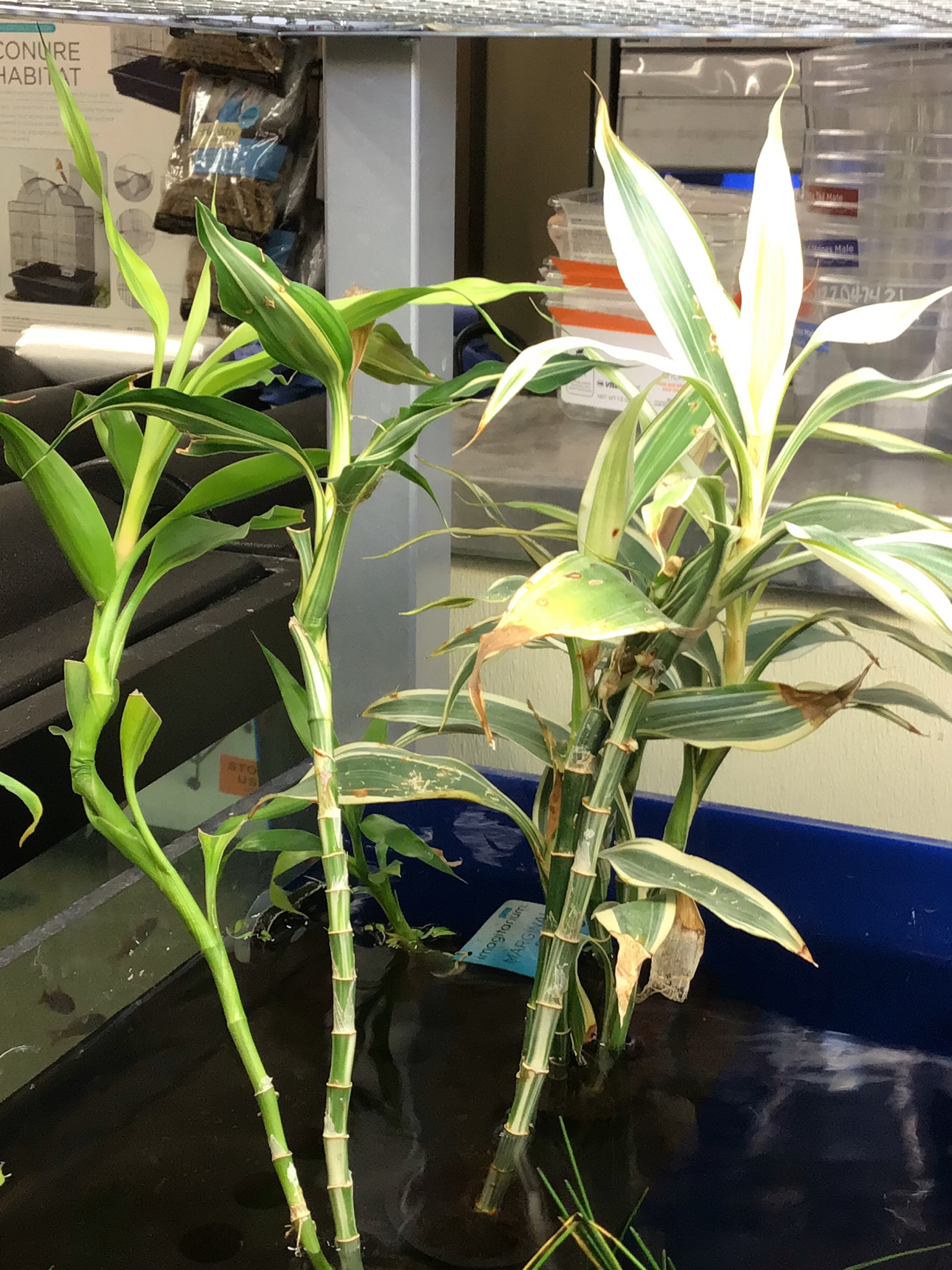
This is a short-lived perennial in the Asparagaceae family, with segmented, fleshy stalks that can reach up to three feet indoors, topped with small clusters of curling leaves. Unlike true bamboo, its stems are solid rather than hollow and woody. The RHS describes it as a slender, erect shrub with cane-like stems and glossy green leaves marked with longitudinal white stripes.
Source: Epic Gardening
Occasional Mites and Scale
Pest trouble is uncommon on lucky bamboo, but spider mites and scale insects can turn up; wiping them away with an isopropyl-soaked cotton swab and following up with a light neem oil misting usually clears and prevents further infestation. The RHS similarly flags mealybugs and scale insects as the pests to watch for on this Dracaena.
Source: Epic Gardening
Yellowing and Stagnant Water
Yellow leaves are most often traced to chlorine buildup in the water, over-fertilizing, or too much direct sun; switching to distilled or rested tap water and diluting feed usually resolves it. Because so many specimens are grown in water and rocks, algae can also develop where light and nutrients are high, so keeping the water clean and out of direct sun helps. Yellowing stalks and tips can signal early root rot, generally from stagnant water rather than classic overwatering, and calls for fresh water and a rinse of the roots and rocks; a foul smell means the plant is past saving.
Source: Epic Gardening
Untangling Roots and Wire
After about a year, roots often knot up in their container, at which point moving to a larger pot with fresh rocks and room-temperature spring water, or up-potting soil-grown plants, keeps growth steady. Any binding string or wire from purchase should be removed before it cuts into the stalks and invites disease. Overly tall growth can be topped an inch above a growth node with a sterilized blade to encourage bushier growth, though the central stem should never be cut; the RHS adds that pruning is otherwise unnecessary except to cut back hard in spring if growth turns weak.
Source: Epic Gardening
Care recipe
The species record — the baseline every cultivar inherits unless it says otherwise.
Care notes are early — not yet verified
- Light
- ai:claude-opus-4-8
- Water
- ai:claude-opus-4-8 (range 7-14d)
- Humidity
- ai:claude-opus-4-8
- Soil
- ai:claude-fable-5
- Care
- ai:claude-fable-5
Bright, indirect
≈ every 14 days
Medium
16–28 °C
Well-draining mix; grows readily in water culture too
Stem sections rooted in water or moist mix
Dilute balanced feed monthly during active growth
Moderate
Rarely flowers indoors
Toxic to cats & dogs
Saponins — vomiting (occasionally with blood), depression, anorexia, drooling. This is where toxicity lives: every cultivar of this species inherits it and none can override it.
Reference images
Every image credited. Licenses link to their deeds.
PrimarySources: ai:claude-opus-4-8 · ai:claude-opus-4-8 (range 7-14d) · ai:claude-fable-5 · ASPCA
Kept true by its growers
Every fact here carries its source. Grow Lucky Bamboo yourself? What you’ve observed — how it drinks, how it holds its color, a name that’s off — and a clear photo of your plant are exactly what keep this page honest. Contributions are reviewed before anything changes.
Sign in to add what you know →