Species · genus Dracaena · Asparagaceae
Dragon's Blood Tree
Dracaena cochinchinensis (Lour.) S.C.Chen
Also known as: Dragon Blood Tree · Chinese Dragon's Blood Tree
Cultivars of D. cochinchinensis
The named forms growers keep — each with its own page, each honest about how much we know.
No named cultivars catalogued under D. cochinchinensis yet. When growers document a stable, named form, it earns its own page here.
Guide
The species-level account. Cultivar pages build on this and say where they differ.
A slow, storied dragon tree
Dracaena cochinchinensis is an evergreen tree in the Asparagaceae family, part of the broader Dracaena group prized for its architectural, tree-like habit. It is treated by some botanical authorities as a distinct species, though Kew's Plants of the World Online now places its name as a synonym of Dracaena angustifolia.
Source: Kew
A medicine tree from the karst
This dragon tree, long known in China as jian ye long xue shu, is the source of the traditional resin dragon's blood, used in Chinese medicine for well over a thousand years. Before 1972 China relied on imported dragon's blood from Southeast Asia and Africa, until a botanist located a substantial wild population on limestone hills in Yunnan's Menglian county, giving rise to a domestic supply. The tree is notoriously slow-growing, thickening its trunk by less than a centimetre a year, and because the resin is only produced when the trunk is wounded, yield has always been limited. Rising demand pushed wild harvesting to unsustainable levels, and the species is now recognised internationally as rare and threatened.
Source: Google Patents
Seed, cutting, or lab-grown
In the wild and in cultivation this tree is conventionally propagated from seed, by cuttings, or by division of tillers, though these methods are slow and yield only modest numbers of plants. To meet demand without further depleting wild stock, researchers have developed a tissue-culture protocol starting from seed-derived explants, which are sterilised, germinated on a basic culture medium, then multiplied into clustered buds and grown into strong plantlets before rooting. This laboratory method reportedly achieves a bud multiplication rate of ten to fifteen times, a rooting success above ninety-five percent, and a seedling survival rate after transplanting above ninety percent.
Source: Google Patents
Tree form, sparse flowers, berries
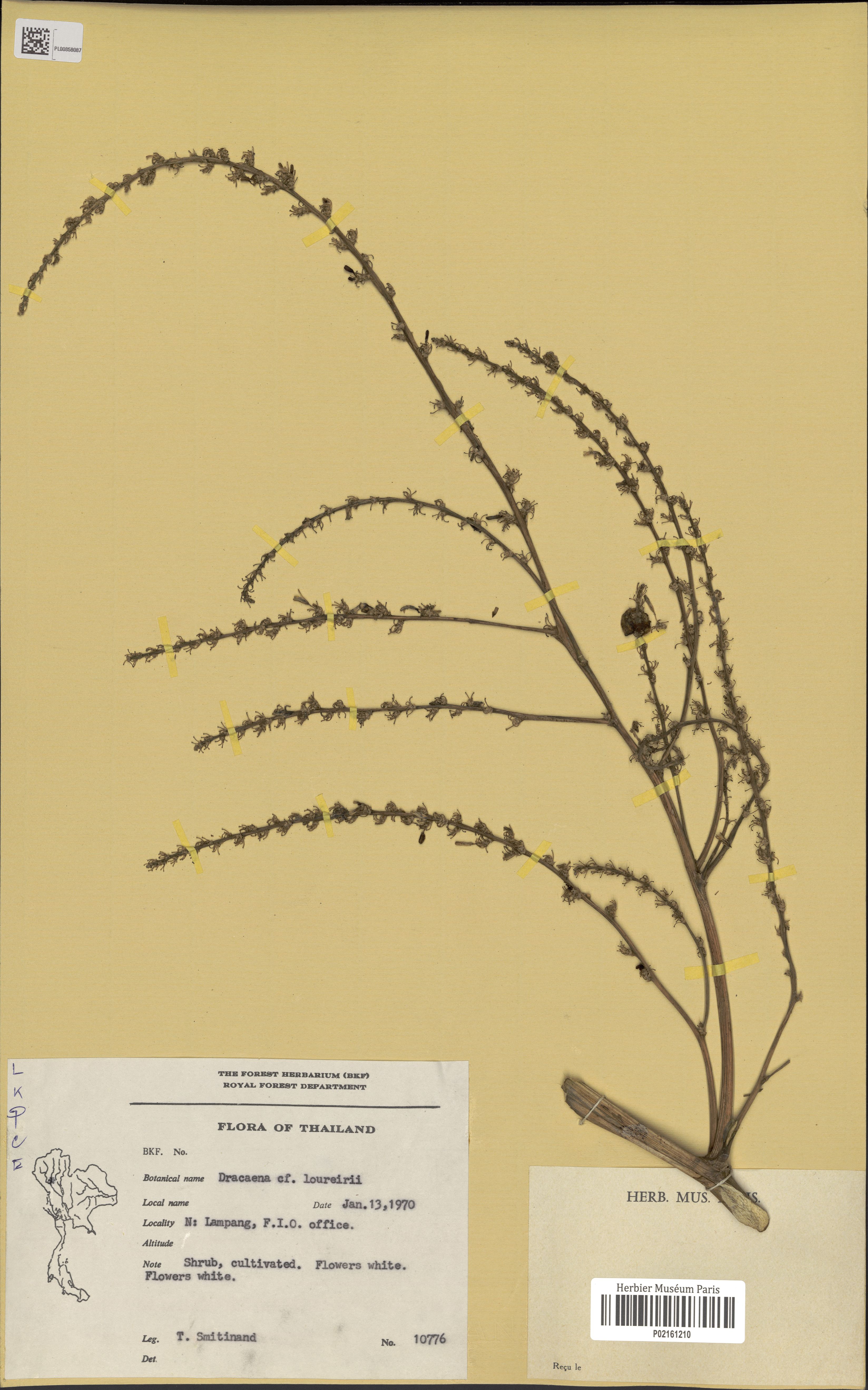
As a Dracaena, this plant grows as an evergreen tree with relatively few branches, its linear to lance-shaped leaves clustering toward the branch tips. Mature specimens can produce small greenish-white flowers, which may later give way to orange or red berries.
Source: RHS
Care recipe
The species record — the baseline every cultivar inherits unless it says otherwise.
Care notes are early — not yet verified
- Light
- ai:claude-opus-4-8
- Water
- ai:claude-opus-4-8 (range 10-21d)
- Humidity
- ai:claude-opus-4-8
- Soil
- ai:claude-fable-5
- Care
- ai:claude-fable-5
Bright, indirect
≈ every 21 days
Medium
16–30 °C
Gritty, fast-draining mix with sand and perlite
Cane cuttings rooted in a warm, moist medium
Light balanced feed monthly during the growing season
Slow
Very rarely flowers indoors
Toxic to cats & dogs
Saponins — vomiting (occasionally with blood), depression, anorexia, drooling. This is where toxicity lives: every cultivar of this species inherits it and none can override it.
Reference images
Every image credited. Licenses link to their deeds.
Sources: ai:claude-opus-4-8 · ai:claude-opus-4-8 (range 10-21d) · ai:claude-fable-5 · ASPCA
Kept true by its growers
Every fact here carries its source. Grow Dragon's Blood Tree yourself? What you’ve observed — how it drinks, how it holds its color, a name that’s off — and a clear photo of your plant are exactly what keep this page honest. Contributions are reviewed before anything changes.
Sign in to add what you know →