Species · genus Dieffenbachia · Araceae
Dumb Cane
Dieffenbachia seguine (Jacq.) Schott
Also known as: Dumbcane · Dumbplant · Mother-in-law-plant · Seguin Tuftroot · Tuftroot
Cultivars of D. seguine
The named forms growers keep — each with its own page, each honest about how much we know.
No named cultivars catalogued under D. seguine yet. When growers document a stable, named form, it earns its own page here.
Guide
The species-level account. Cultivar pages build on this and say where they differ.
A cane-like tropical evergreen
Dieffenbachia seguine is a variable tropical evergreen perennial grown for its glossy, patterned foliage carried on upright, cane-like stems. Left to its own devices it can climb to around three metres, though most indoor specimens stay far more modest. It belongs to the Araceae family, the same clan that gives us philodendrons and calla lilies.
Source: RHS
Caribbean and South American roots
This dumb cane traces back to the Caribbean and northern South America, with some accounts pointing to Brazil as its native ground. The genus name honours J.F. Dieffenbach, who oversaw the gardens of the royal palace of Schönbrunn in Vienna around 1830. In its native habitat the plant can reach six to ten feet, though containers keep it considerably smaller.
Source: Missouri Botanical Garden
Bright, humid, and steady
Give this plant bright, filtered light and high humidity, and pot it in a loam-based, peat-free compost. Water moderately through the growing season with a monthly balanced feed, then taper right back in winter, watering sparingly while offering full light. Daily misting helps, and standing the pot on a bed of wet pebbles is another way to keep humidity up.
Source: RHS
Stem cuttings and layering
Propagate by taking stem tip cuttings, or by cutting stem sections that each carry a growth bud and laying them flat on the compost surface at around 25°C. Air layering is another route to new plants, and root cuttings work too.
Source: RHS
Glossy, mottled leaves
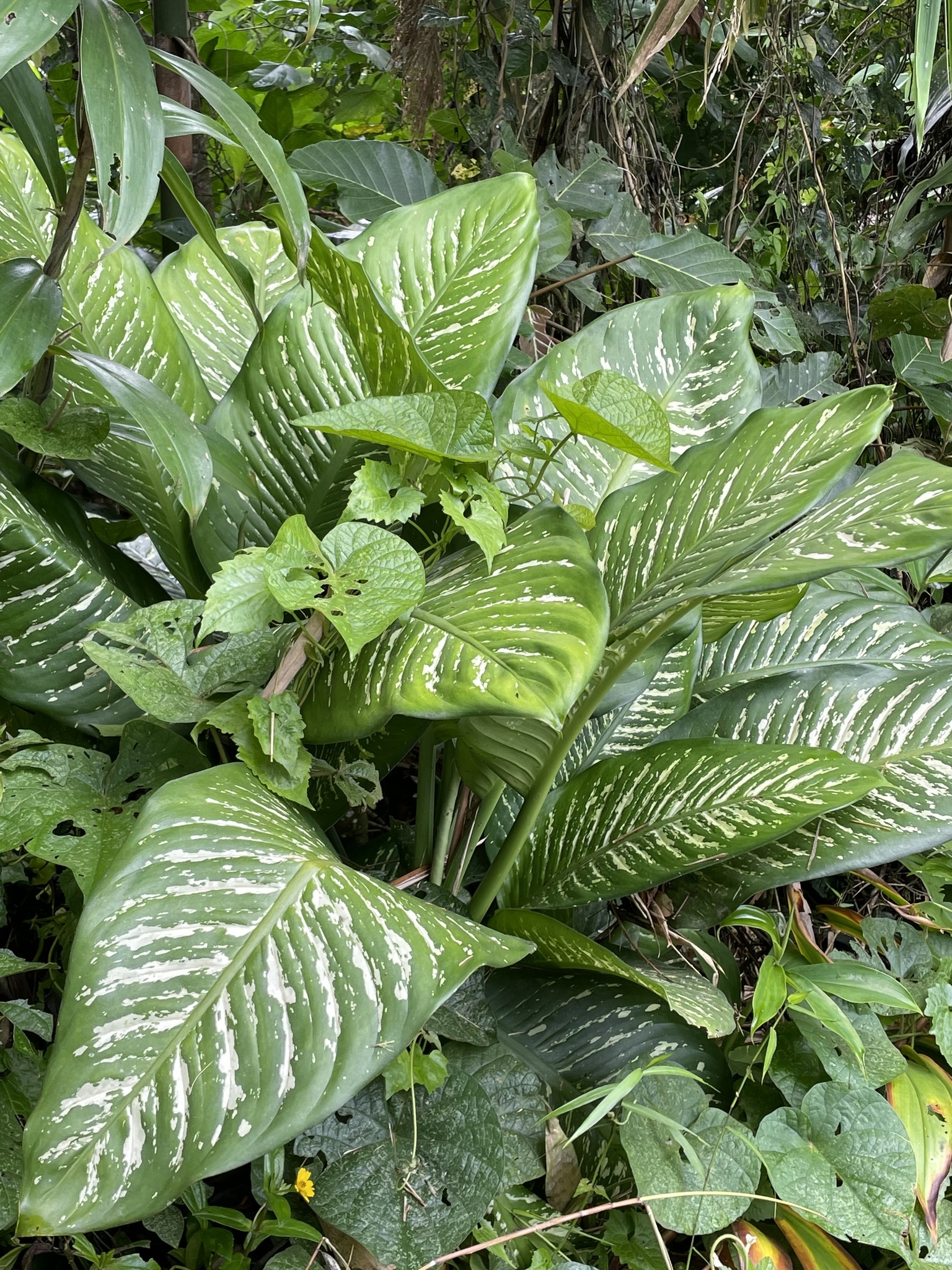
The species is notably variable, but typically shows broadly oval to oblong, glossy dark green leaves sparsely spotted with white. As lower leaves drop with age, the cane-like stem beneath becomes increasingly visible, giving the plant its upright, sculptural habit. Cultivars and hybrids widen the palette further, adding shades of yellow and green to the variegation.
Source: Missouri Botanical Garden
Watch for common houseplant pests
Aphids are the main concern the RHS flags, particularly on new growth. More broadly, keep an eye out for spider mites, scale, and mealybugs as well, since these are the usual suspects on dumb cane.
Source: Missouri Botanical Garden
Toxic sap, occasional rot
Fungal leaf spot, rots, and blight can turn up on this plant. More pressing is the sap itself, which is poisonous if ingested and irritating on skin contact, so gloves are worth wearing when handling it, and it should be kept well away from pets and small children.
Source: Missouri Botanical Garden
Care recipe
The species record — the baseline every cultivar inherits unless it says otherwise.
Care notes are early — not yet verified
- Light
- ai:claude-opus-4-8
- Water
- ai:claude-opus-4-8 (range 7-12d)
- Humidity
- ai:claude-opus-4-8
- Soil
- ai:claude-fable-5
- Care
- ai:claude-fable-5
Bright, indirect
≈ every 12 days
Medium
18–27 °C
Rich, moisture-retentive but draining potting mix
Stem sections laid in moist mix, or air layering
Balanced liquid feed monthly in the growing season
Moderate
Occasional spathe blooms on mature plants
Toxic to cats & dogs & humans
Araceae contain insoluble calcium oxalate crystals that irritate the mouth and throat if chewed. This is where toxicity lives: every cultivar of this species inherits it and none can override it.
Reference images
Every image credited. Licenses link to their deeds.
PrimarySources: ai:claude-opus-4-8 · ai:claude-opus-4-8 (range 7-12d) · ai:claude-fable-5 · ai:claude-opus-4-8 (family inference)
Kept true by its growers
Every fact here carries its source. Grow Dumb Cane yourself? What you’ve observed — how it drinks, how it holds its color, a name that’s off — and a clear photo of your plant are exactly what keep this page honest. Contributions are reviewed before anything changes.
Sign in to add what you know →