Species · genus Dendrobium · Orchidaceae
Noble Dendrobium
Dendrobium nobile Lindl.
Cultivars of D. nobile
The named forms growers keep — each with its own page, each honest about how much we know.
No named cultivars catalogued under D. nobile yet. When growers document a stable, named form, it earns its own page here.
Guide
The species-level account. Cultivar pages build on this and say where they differ.
A Noble Cane Orchid
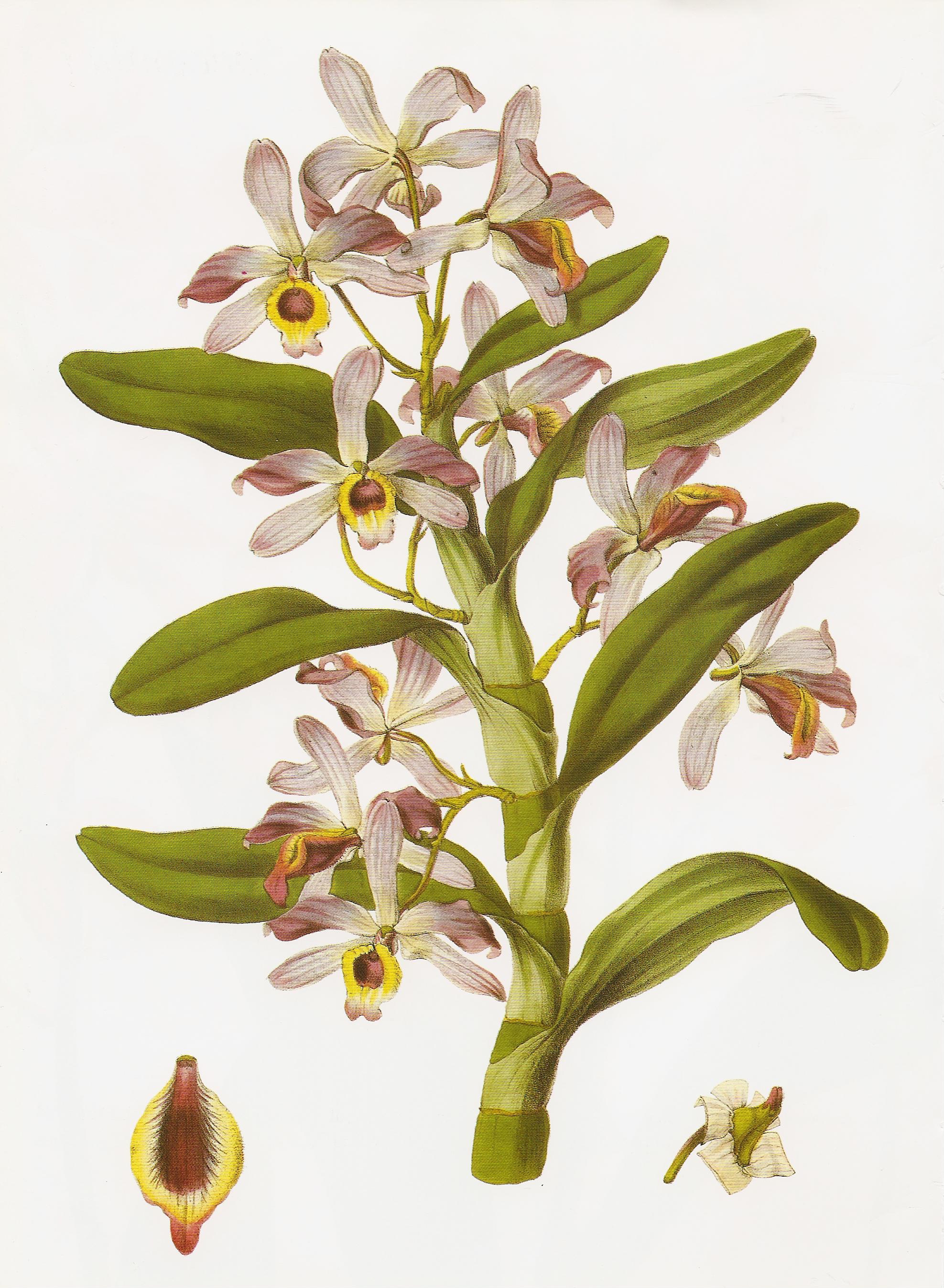
Dendrobium nobile, sometimes called the noble rock orchid, is an epiphytic orchid of the huge Dendrobium genus, grown for its clusters of fragrant blooms held along upright, cane-like stems. In cultivation it typically stays compact, reaching perhaps 30cm, with glossy oval leaves and trusses of rose-pink, maroon-lipped flowers appearing from winter into spring.
Source: RHS
From South and Southeast Asia
This species comes from South and Southeast Asia, where members of the genus grow as epiphytes and terrestrials, wedged into trees or rocky ground rather than rooted in soil. The wider Dendrobium genus is vast, counting well over a thousand species, and hails from Asia and the South Pacific, where it clings to trees in jungle conditions.
Source: Epic Gardening
A Seasonal Rhythm
Grow this orchid in an epiphytic bark-based mix, in partial shade with good ventilation, keeping day temperatures around 18-25°C and nights above 10°C through late spring and summer, watering freely and feeding with orchid fertiliser every third watering, and misting twice daily for humidity. From autumn to early spring, move it to a well-lit spot and keep it on the dry side, since this cool, drier rest is what encourages flowering to begin again the following spring.
Source: RHS
Division and Keikis
The most straightforward way to propagate is division once a plant has outgrown its pot, or by potting up keikis, the small plantlets that sometimes form on older canes, once their new roots reach a couple of centimetres. Seed propagation is possible only under sterile laboratory conditions and is not practical for home growers.
Source: RHS
Canes, Nodes, and Blooms
The plant carries elongated, stem-like pseudobulbs, or canes, set with linear to oval leaves, and it sends out short flowering stems from the upper nodes of mature canes, each bearing several blooms. Its growth habit can be columnar and upright or, if grown in a basket, more pendulous, and the flowers themselves are fragrant, roughly 5cm across, pale rose-pink with a distinctive maroon lip.
Source: RHS
Sap Feeders to Watch
This orchid can attract scale insects, aphids, mealybugs, and red spider mite, all of which feed on plant sap and tender new growth. Otherwise the species is generally free of disease.
Source: RHS
Light Touch Pruning
No routine pruning is needed beyond removing spent flowers, and canes should not be cut back unless fully shrivelled. Older canes can be removed once a plant carries at least three younger, thick, leaf-bearing ones, and because these orchids grow best with slightly restricted roots, avoid over-potting or disturbing them too often.
Source: RHS
Care recipe
The species record — the baseline every cultivar inherits unless it says otherwise.
Care notes are early — not yet verified
- Light
- ai:claude-opus-4-8
- Water
- ai:claude-opus-4-8 (range 5-10d)
- Humidity
- ai:claude-opus-4-8
- Soil
- ai:claude-fable-5
- Care
- ai:claude-fable-5
Bright, indirect
≈ every 10 days
High
10–28 °C
Medium bark mix in a snug pot
Keikis and cane division
Dilute orchid feed weekly while growing, none in winter
Moderate
Showy blooms along the canes after a cool, dry winter rest
Not yet documented
This is where toxicity lives — every cultivar of this species inherits it and none can override it.
Reference images
Every image credited. Licenses link to their deeds.
PrimarySources: ai:claude-opus-4-8 · ai:claude-opus-4-8 (range 5-10d) · ai:claude-fable-5
Kept true by its growers
Every fact here carries its source. Grow Noble Dendrobium yourself? What you’ve observed — how it drinks, how it holds its color, a name that’s off — and a clear photo of your plant are exactly what keep this page honest. Contributions are reviewed before anything changes.
Sign in to add what you know →