Species · genus Dendrobium · Orchidaceae
Hooded Orchid
Dendrobium aphyllum (Roxb.) C.E.C.Fisch.
Also known as: Leafless Dendrobium
Cultivars of D. aphyllum
The named forms growers keep — each with its own page, each honest about how much we know.
No named cultivars catalogued under D. aphyllum yet. When growers document a stable, named form, it earns its own page here.
Guide
The species-level account. Cultivar pages build on this and say where they differ.
A pendulous hooded orchid
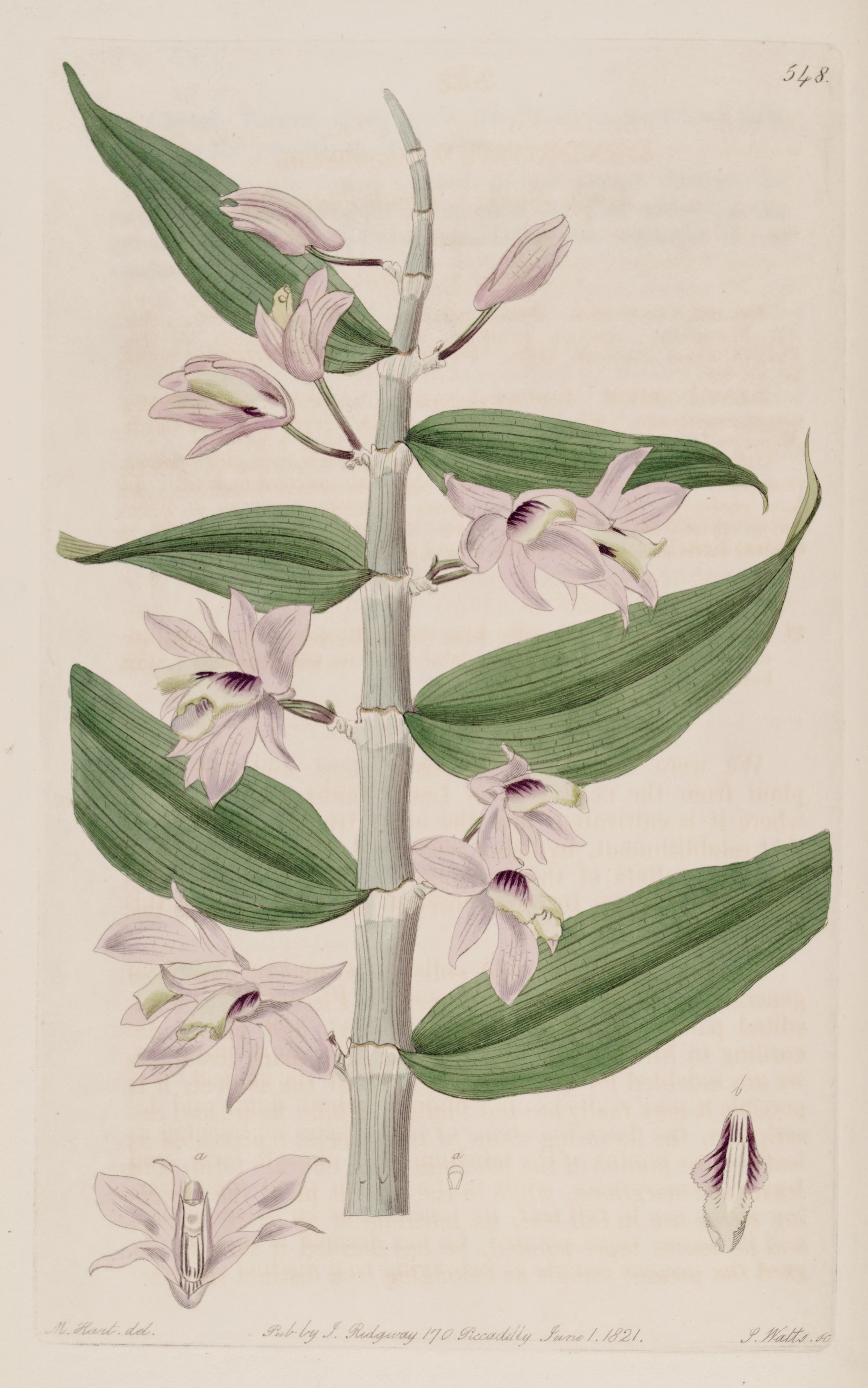
Dendrobium aphyllum, sometimes called the hooded orchid, is a large deciduous epiphytic orchid grown for its cascading cane-like stems and its brief but generous spring flush of fragrant flowers. It is a familiar sight in orchid collections and botanical gardens, valued for being both showy and forgiving of cultivation.
Source: RHS
A name two centuries in dispute
This orchid ranges from Nepal across southern and north-eastern India, Bhutan, Myanmar, China, Thailand, Laos, Cambodia and Vietnam to Peninsular Malaysia, growing as an epiphyte or lithophyte in forests and on limestone cliffs up to 1,600 metres. William Roxburgh first described it in 1795, but an inaccurate illustration muddled its identity for two hundred years, during which it was widely grown and known as D. pierardii. Kew botanist André Schuiteman eventually resolved the confusion, restoring D. aphyllum as the correct name for the plant long cultivated under that other name.
Source: Kew
A growing season, then a rest
Give this orchid bright, filtered light through the year, and during the warmer growing months water frequently and keep humidity high, feeding at the same time. As autumn arrives, ease off both watering and feeding from around October, letting the plant rest through winter until warmth returns and prompts new growth and flowering in spring.
Source: RHS
Division and keiki
Seed propagation only really works under laboratory conditions, so most growers rely on dividing mature plants once they outgrow their pot. Older canes sometimes throw sideshoots, or keiki, which can be removed and potted into sphagnum moss once their new roots reach at least 2cm long.
Source: RHS
Bare canes, fleeting flowers
The plant forms clustered, cane-like stems that hang or arch, reaching well over half a metre, each set with alternate glossy lance-shaped leaves that drop after a single growing season, leaving the stems bare. From these leafless nodes come short flowering stems bearing one to three blooms apiece, pale pink to pinkish violet with a rounded, hairy-edged lip, fragrant but short-lived, lasting only about a week.
Source: RHS
Watch for sap-suckers
This orchid can attract scale insects, aphids, mealybugs and red spider mite, so it is worth checking the canes and leaf undersides for these early on.
Source: RHS
Light-handed pruning
Little pruning is needed beyond removing spent flowers as they finish. Avoid cutting whole canes unless they have completely shrivelled, and when older canes are removed, leave at least three younger, thick, leaf-bearing canes in place. Because the plant grows best with its roots slightly restricted, avoid over-potting or disturbing them too often.
Source: RHS
Care recipe
The species record — the baseline every cultivar inherits unless it says otherwise.
Care notes are early — not yet verified
- Light
- ai:claude-opus-4-8
- Water
- ai:claude-opus-4-8 (range 4-9d)
- Humidity
- ai:claude-opus-4-8
- Soil
- ai:claude-fable-5
- Care
- ai:claude-fable-5
Bright, indirect
≈ every 9 days
High
15–30 °C
Bark mix or slab mount, fast-draining
Keikis along the canes, or division
Dilute orchid feed while growing, stop in winter
Moderate
Blooms on leafless canes after a dry winter rest
Not yet documented
This is where toxicity lives — every cultivar of this species inherits it and none can override it.
Reference images
Every image credited. Licenses link to their deeds.
Sources: ai:claude-opus-4-8 · ai:claude-opus-4-8 (range 4-9d) · ai:claude-fable-5
Kept true by its growers
Every fact here carries its source. Grow Hooded Orchid yourself? What you’ve observed — how it drinks, how it holds its color, a name that’s off — and a clear photo of your plant are exactly what keep this page honest. Contributions are reviewed before anything changes.
Sign in to add what you know →