Species · genus Curio · Asteraceae
Bluestraws
Curio talinoides (DC.) P.V.Heath
Also known as: Narrowleaf Chalksticks
Cultivars of C. talinoides
The named forms growers keep — each with its own page, each honest about how much we know.
No named cultivars catalogued under C. talinoides yet. When growers document a stable, named form, it earns its own page here.
Guide
The species-level account. Cultivar pages build on this and say where they differ.
A Blue-Grey Trailer
Curio talinoides, sometimes still sold under its older names Kleinia talinoides or Senecio talinoides, is a succulent in the daisy family grown mainly as an easy houseplant or conservatory subject. Its subspecies mandraliscae is the form most often seen, prized for its pale, waxy foliage.
Source: RHS
Cape Mountain Native
Curio as a genus comes from South Africa's Cape Province mountains, where these evergreen succulents grow with long, striated leaves and disc-shaped flowerheads that lack ray florets. The plant has passed through several names over time, having once been classified as Kleinia and Senecio before settling into Curio.
Source: RHS
Sun, Restraint, Ventilation
Give this plant full light and good airflow, in a mix of peat-free loam-based compost with leaf mould and grit for sharp drainage. Water moderately while it is actively growing, and feed monthly with a half-strength balanced liquid feed during that same period. As a succulent from South Africa's high ground, it tolerates dry indoor air and only asks for occasional watering, though it should be kept away from cold or hot drafts.
Source: RHS
Division Or Stem Sections
New plants are raised by division or by removing and rooting stem sections.
Source: RHS
Waxy Blue Foliage
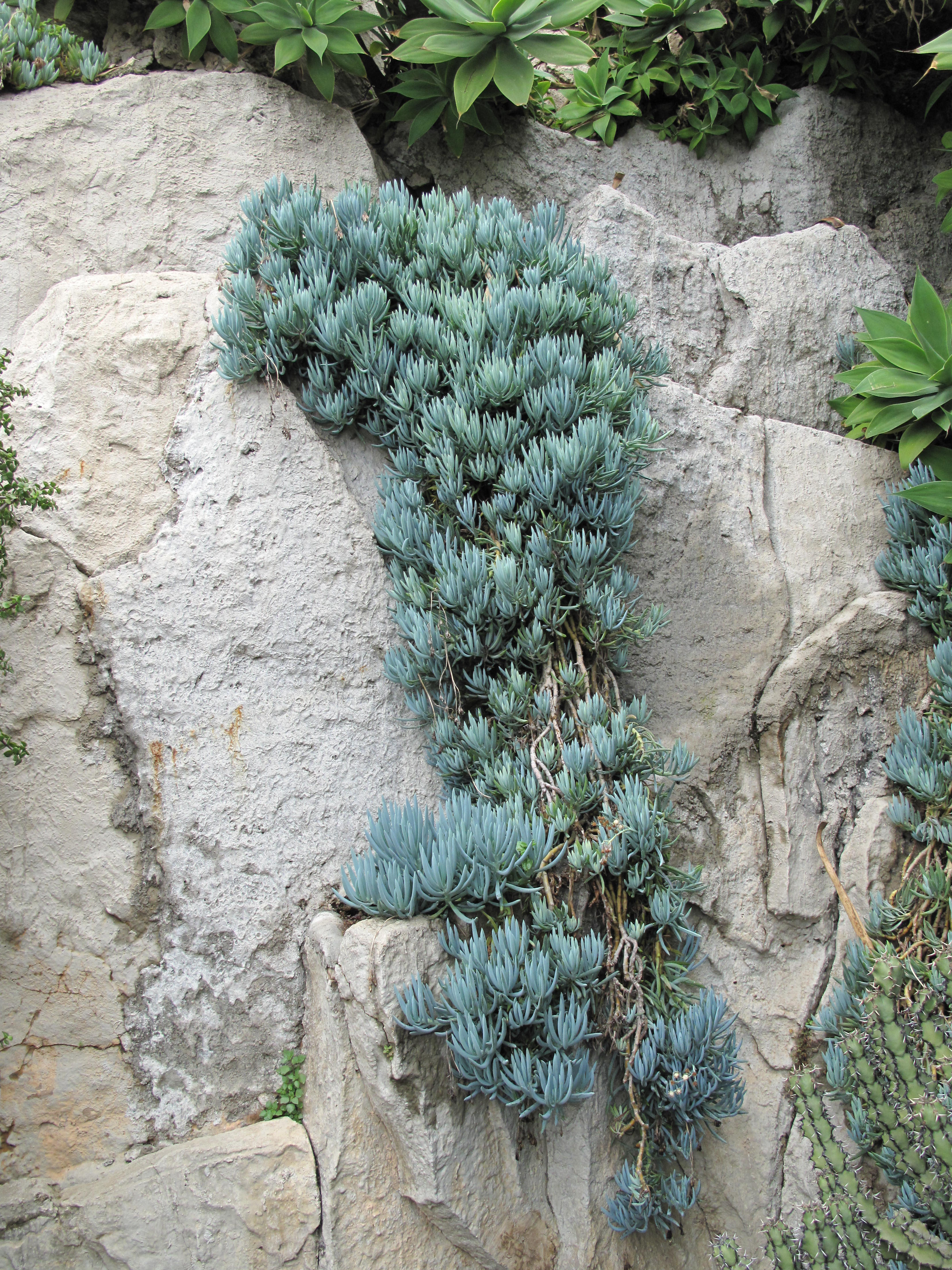
This is a spreading succulent that can reach around 45cm, with elongated, thick, fleshy leaves in a blue-grey shade and a waxy coating. Stems start upright and gradually sprawl into a dense mat. Flowering is rare, but when it happens the blooms are small, white, and inconspicuous, appearing at the stem tips in autumn or winter after a spell of dormancy.
Source: RHS
Watch For Sap Feeders
Aphids, glasshouse red spider mite, and glasshouse whitefly are the pests most likely to trouble this plant.
Source: RHS
Overwatering Brings Rot
The main disease risk here is stem rot, which sets in when the plant is watered too generously.
Source: RHS
Little Upkeep Needed
No pruning is required for this plant, keeping its upkeep straightforward.
Source: RHS
Care recipe
The species record — the baseline every cultivar inherits unless it says otherwise.
Care notes are early — not yet verified
- Light
- ai:claude-opus-4-8
- Water
- ai:claude-opus-4-8 (range 14-28d)
- Humidity
- ai:claude-opus-4-8
- Soil
- ai:claude-fable-5
- Care
- ai:claude-fable-5
Direct sun
≈ every 28 days
Low — average room
10–27 °C
Gritty, fast-draining cactus and succulent mix
Stem cuttings left to callus, then rooted in dry mix
Dilute succulent feed once or twice in spring and summer
Moderate
Small white to cream flowers, occasional indoors
Toxic to cats & dogs
String-of-pearls / string-of-bananas (succulent senecio) — stomach upset, vomiting, lethargy. This is where toxicity lives: every cultivar of this species inherits it and none can override it.
Reference images
Every image credited. Licenses link to their deeds.
PrimarySources: ai:claude-opus-4-8 · ai:claude-opus-4-8 (range 14-28d) · ai:claude-fable-5 · ASPCA
Kept true by its growers
Every fact here carries its source. Grow Bluestraws yourself? What you’ve observed — how it drinks, how it holds its color, a name that’s off — and a clear photo of your plant are exactly what keep this page honest. Contributions are reviewed before anything changes.
Sign in to add what you know →