Species · genus Curio · Asteraceae
Blue Chalkstick
Curio ficoides (L.) P.V.Heath
Also known as: Flat Chalkstick · Flatleaf Senecio
Cultivars of C. ficoides
The named forms growers keep — each with its own page, each honest about how much we know.
No named cultivars catalogued under C. ficoides yet. When growers document a stable, named form, it earns its own page here.
Guide
The species-level account. Cultivar pages build on this and say where they differ.
Meet Curio ficoides
Curio ficoides is a succulent perennial shrub, sometimes scrambling and sometimes more upright, grown for its fleshy blue to grey-green stems and leaves rather than its flowers. It belongs to the daisy family, and its old names, Senecio ficoides and Kleinia ficoides, still turn up on plant labels.
Source: RHS
A Cape mountain native
The genus Curio comes from the mountains of South Africa's Cape Province, where these evergreen succulents grow with their characteristic long, striated leaves. This particular species and its selection 'Mount Everest' both trace back to that Cape origin, brought into cultivation as houseplants and conservatory subjects.
Source: RHS
Sun, grit, and restraint
Give this plant full light with good ventilation, and pot it in a mix of two parts peat-free loam-based compost to one part each leaf mould and grit, in loam or sand that drains well. Water moderately only while it is actively growing, and feed monthly with a half-strength balanced liquid feed during that period. It tolerates a fairly narrow winter minimum, so treat it as a plant for a sheltered, south- or west-facing spot rather than an exposed one.
Source: RHS
Division or stem cuttings
Propagate by division, or by removing stem sections and rooting them.
Source: RHS
Chalky stems, rare flowers
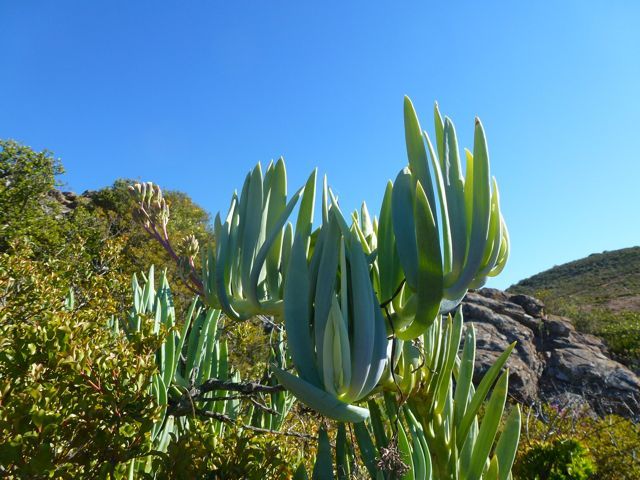
The species carries elongated, flattened, fleshy blue-grey leaves and stems on a plant that can reach up to a metre, with some forms scrambling and others upright. It flowers rarely, and when it does the blooms are small, white, and without ray florets, appearing at stem tips in autumn or winter after a spell of dormancy. The selection 'Mount Everest' is more uniformly columnar, with narrow fleshy green leaves given a waxy silvery bloom.
Source: RHS
Aphids, mites, whitefly
Watch for aphids, glasshouse red spider mite, and glasshouse whitefly, the common pests of this plant under glass or indoors.
Source: RHS
Overwatering causes stem rot
The main trouble to guard against is stem rot, which sets in if the plant is overwatered.
Source: RHS
Little upkeep needed
No pruning is required for this plant, which suits its slow, considered growth habit.
Source: RHS
Care recipe
The species record — the baseline every cultivar inherits unless it says otherwise.
Care notes are early — not yet verified
- Light
- ai:claude-opus-4-8
- Water
- ai:claude-opus-4-8 (range 14-28d)
- Humidity
- ai:claude-opus-4-8
- Soil
- ai:claude-fable-5
- Care
- ai:claude-fable-5
Direct sun
≈ every 28 days
Low — average room
10–27 °C
Gritty, fast-draining cactus and succulent mix
Stem cuttings left to callus, then rooted in dry mix
Dilute succulent feed once or twice in the growing season
Moderate
Small yellow daisy-like flowers, occasional indoors
Toxic to cats & dogs
String-of-pearls / string-of-bananas (succulent senecio) — stomach upset, vomiting, lethargy. This is where toxicity lives: every cultivar of this species inherits it and none can override it.
Reference images
Every image credited. Licenses link to their deeds.
PrimarySources: ai:claude-opus-4-8 · ai:claude-opus-4-8 (range 14-28d) · ai:claude-fable-5 · ASPCA
Kept true by its growers
Every fact here carries its source. Grow Blue Chalkstick yourself? What you’ve observed — how it drinks, how it holds its color, a name that’s off — and a clear photo of your plant are exactly what keep this page honest. Contributions are reviewed before anything changes.
Sign in to add what you know →