Species · genus Crossandra · Acanthaceae
Firecracker-flower
Crossandra infundibuliformis (L.) Nees
Also known as: Firecracker-plant
Cultivars of C. infundibuliformis
The named forms growers keep — each with its own page, each honest about how much we know.
No named cultivars catalogued under C. infundibuliformis yet. When growers document a stable, named form, it earns its own page here.
Guide
The species-level account. Cultivar pages build on this and say where they differ.
The Firecracker Flower
Crossandra infundibuliformis is an evergreen sub-shrub grown for its dense, cone-like spikes of salver-shaped flowers set against glossy, lance-shaped leaves. It is treated variously as a garden shrub, annual bedding plant, or bright flowering houseplant, and the flowers appear over a long stretch of the growing season.
Source: RHS
A Range Across Continents
This species is native to southern India and Sri Lanka, though as a garden plant it has also become common across subtropical central Africa, from Angola to Somalia, as well as further afield in Bangladesh. It grows naturally in dry tropical conditions, which explains its comfort with heat.
Source: Epic Gardening
Warmth, Light, and Steady Moisture
Give this plant as much light as you can indoors, ideally a sunny window or bright artificial light, while outdoors it wants full sun to partial shade and shelter from the hottest direct rays. Keep the soil consistently moist without letting it turn soggy, easing off through winter, and feed with a general-purpose fertilizer during active growth. It is not frost-tolerant and prefers temperatures kept above roughly 55°F (13°C).
Source: Epic Gardening
From Cuttings or Seed
Crossandra can be propagated either from stem cuttings or from seed. A cutting is best taken as a fresh spring stem tip cut just below a leaf node, dipped in water and rooting hormone, and given bottom warmth to root. Seed can be started indoors at any time by sprinkling it over a warm, consistently moist germination medium.
Source: Epic Gardening
Blooms and Bursting Pods
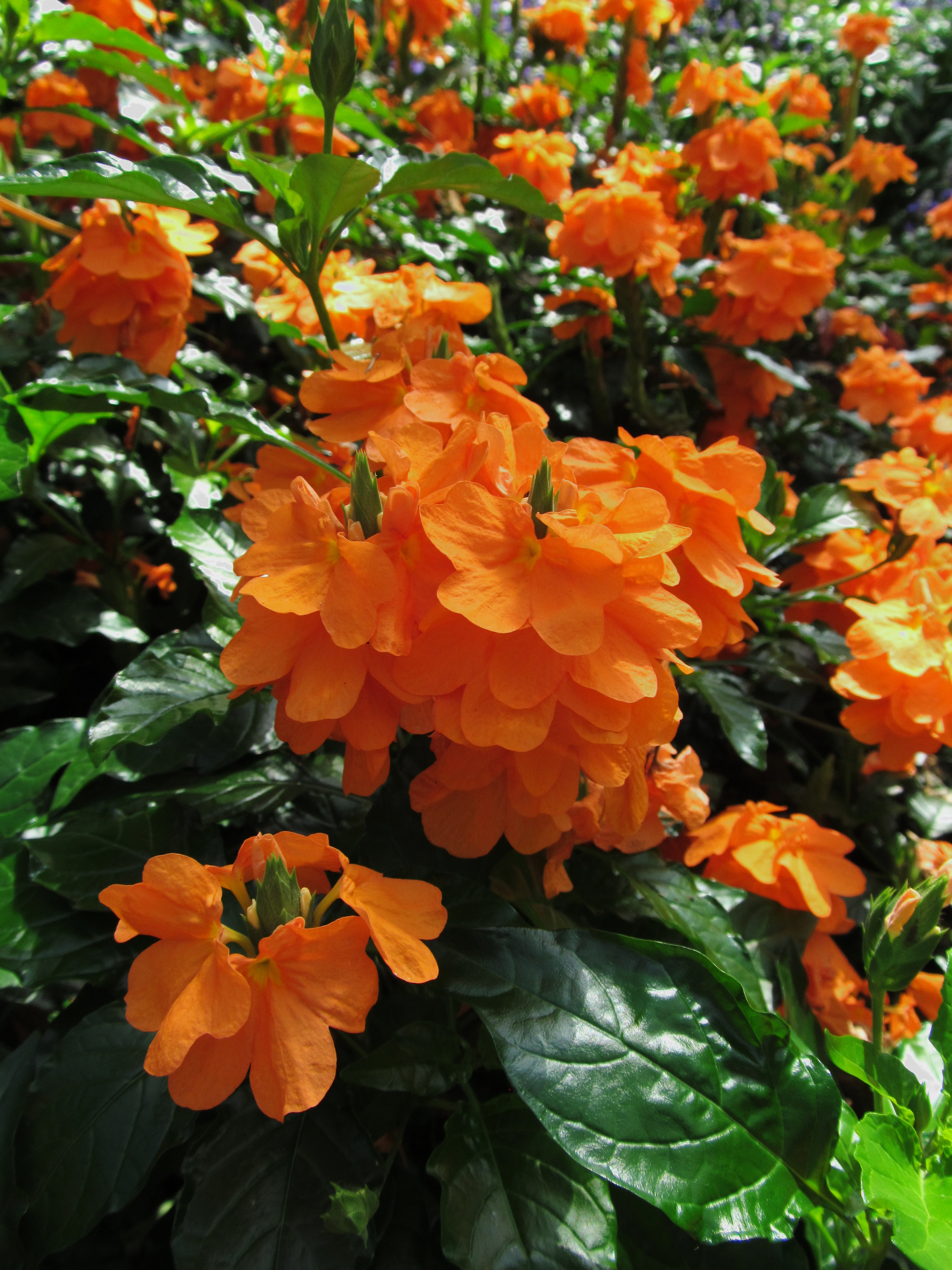
Each flower is built from five overlapping, unevenly fan-shaped petals fused into a slender tube, most often in salmon or apricot tones though cultivars extend to yellow, red, and pink. The glossy, teardrop-shaped leaves can reach up to five inches long on plants that top out around two to three feet indoors. Its common name actually refers not to the flowers but to the seed pods, which pop open on humid days and scatter their seed.
Source: Epic Gardening
Occasional Sap Suckers
Pest trouble is not common on this plant, but when it appears it tends to be aphids, whiteflies, mealybugs, or spider mites, all of which pierce leaves or stems to feed on sap. Aphids and whiteflies can usually be knocked back with a strong spray of water followed by neem oil or insecticidal soap if needed, while small mealybug infestations can be dabbed away with rubbing alcohol.
Source: Epic Gardening
Cold, Sun, and Dry Air
Temperatures below about 55°F (13°C) cause leaf discoloration and, if prolonged, dieback, since this plant has no frost tolerance. Too much harsh direct sun can scorch the leaves, while insufficient water or low humidity shows up as dry, browning leaf edges. Overall the plant is notably resistant to disease, so most trouble traces back to temperature, light, or moisture rather than pathogens.
Source: Epic Gardening
Pinching and Pruning
Pinch out young growing points to encourage a bushier habit, and prune in spring just before active growth resumes to promote new, healthy stems. Deadhead spent flower spikes to keep the plant blooming, and if the popping seed pods are unwelcome indoors, cut spikes back before seed fully forms.
Source: Epic Gardening
Care recipe
The species record — the baseline every cultivar inherits unless it says otherwise.
Care notes are early — not yet verified
- Light
- ai:claude-opus-4-8
- Water
- ai:claude-opus-4-8 (range 5-10d)
- Humidity
- ai:claude-opus-4-8
- Soil
- ai:claude-fable-5
- Care
- ai:claude-fable-5
Bright, indirect
≈ every 10 days
Medium
16–27 °C
Rich, well-draining potting mix with organic matter
Stem tip cuttings rooted in warm, humid conditions
Balanced liquid feed every 2 weeks in the growing season
Moderate
Bright orange fan-shaped blooms, frequent in warmth and light
Not yet documented
This is where toxicity lives — every cultivar of this species inherits it and none can override it.
Reference images
Every image credited. Licenses link to their deeds.
PrimarySources: ai:claude-opus-4-8 · ai:claude-opus-4-8 (range 5-10d) · ai:claude-fable-5
Kept true by its growers
Every fact here carries its source. Grow Firecracker-flower yourself? What you’ve observed — how it drinks, how it holds its color, a name that’s off — and a clear photo of your plant are exactly what keep this page honest. Contributions are reviewed before anything changes.
Sign in to add what you know →