Species · genus Crassula · Crassulaceae
Calico Kitten
Crassula pellucida L.
Also known as: Variegated Trailing Jade · Trailing Crassula
Cultivars of C. pellucida
The named forms growers keep — each with its own page, each honest about how much we know.
No named cultivars catalogued under C. pellucida yet. When growers document a stable, named form, it earns its own page here.
Guide
The species-level account. Cultivar pages build on this and say where they differ.
Calico Kitten Crassula
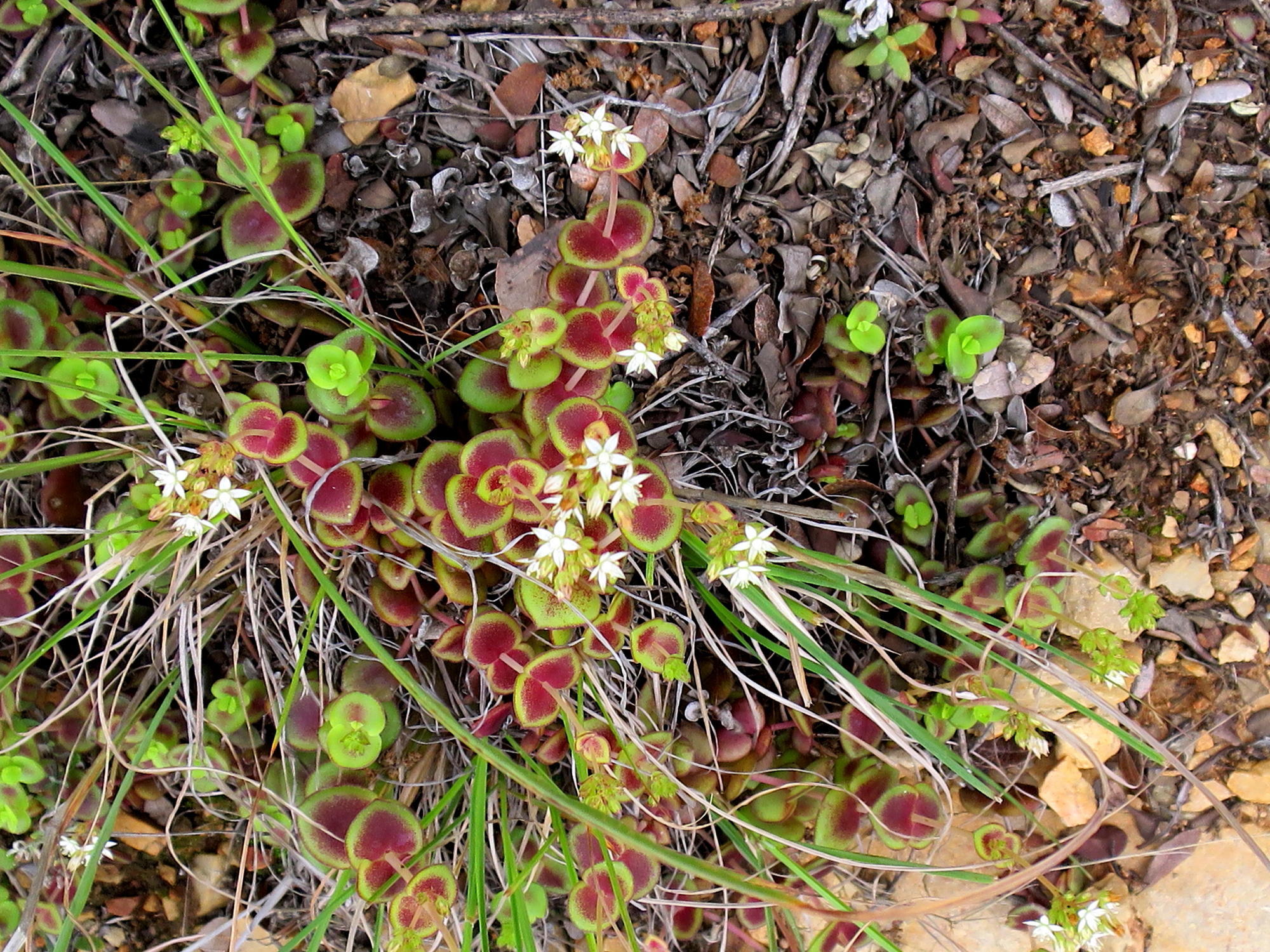
Crassula pellucida subsp. marginalis, sold as calico kitten, is a small trailing succulent in the Crassulaceae family. It stays low, generally under 10cm tall, and spreads via brittle stems set with fleshy, patterned leaves, with tiny starry white flowers appearing in summer.
Source: RHS
Light Water And Feed
Grown under glass or indoors, this crassula wants full sun to bright, filtered light and a standard cactus compost that drains freely. From spring to autumn water moderately, taking care not to wet the leaves, and feed monthly to every two or three weeks with a balanced liquid fertiliser; through winter, water only sparingly. Soil pH is flexible, tolerating acid, alkaline, or neutral conditions, and the plant is happiest in a sheltered spot.
Source: RHS
Stem And Leaf Cuttings
Calico kitten propagates readily from stem or leaf cuttings, with cuttings best taken in spring or early summer.
Source: RHS
Colour Forms And Habit
The species itself carries grey-green leaves edged in red on trailing stems. Selections vary the palette considerably: the form rubra shows purplish-pink, red-edged heart-shaped leaves with a hint of yellow or green, giving it a cascading, weeping habit, while the Variegata cultivar mixes cream streaks and pink flushes into grey-green foliage on a scrambling, low-growing frame.
Source: RHS
Mealybugs And Others
Mealybugs are the pest most often flagged for this crassula, and some forms are also noted as susceptible to vine weevil and aphids. Disease is generally not a concern for this plant.
Source: RHS
Little Pruning Needed
No pruning is required to keep this trailing succulent in good order, and it reaches maturity over roughly two to five years while staying compact, making it a low-maintenance choice for pots, hanging baskets, or a conservatory shelf.
Source: RHS
Care recipe
The species record — the baseline every cultivar inherits unless it says otherwise.
Care notes are early — not yet verified
- Light
- ai:claude-opus-4-8
- Water
- ai:claude-opus-4-8 (range 10-21d)
- Humidity
- ai:claude-opus-4-8
- Soil
- ai:claude-fable-5
- Care
- ai:claude-fable-5
Bright, indirect
≈ every 21 days
Low — average room
10–27 °C
Gritty, fast-draining cactus and succulent mix
Stem cuttings root readily where they touch soil
Dilute succulent feed once or twice in the growing season
Fast
Small white to pale-pink flowers; foliage reddens in bright light
Not yet documented
This is where toxicity lives — every cultivar of this species inherits it and none can override it.
Reference images
Every image credited. Licenses link to their deeds.
PrimarySources: ai:claude-opus-4-8 · ai:claude-opus-4-8 (range 10-21d) · ai:claude-fable-5
Kept true by its growers
Every fact here carries its source. Grow Calico Kitten yourself? What you’ve observed — how it drinks, how it holds its color, a name that’s off — and a clear photo of your plant are exactly what keep this page honest. Contributions are reviewed before anything changes.
Sign in to add what you know →