Species · genus Crassula · Crassulaceae
Jade Plant
Crassula arborescens (Mill.) Willd.
Also known as: Silver Dollar Plant · Silver-dollar Stonecrop · Tree Crassula · Tree Stonecrop
Cultivars of C. arborescens
The named forms growers keep — each with its own page, each honest about how much we know.
No named cultivars catalogued under C. arborescens yet. When growers document a stable, named form, it earns its own page here.
Guide
The species-level account. Cultivar pages build on this and say where they differ.
The Silver Dollar Plant
Crassula arborescens, known as silver dollar, is a shrub-like succulent grown both as a houseplant and a conservatory subject. It carries the common thread of the jade family: stout branching stems and thick, fleshy leaves that hold water against dry spells.
Source: RHS
A Cape Succulent
This crassula's home ground is the Cape region of South Africa, part of a genus that runs from succulent annuals to evergreen shrubs, all built around fleshy leaves and small starry flowers. The wavy-leaved form, subsp. undulatifolia, comes from the same stock, distinguished chiefly by its rippled foliage.
Source: RHS
Sun, Then Restraint
Give it full light and a pot of cactus compost, then water moderately through the growing season with a monthly feed of balanced liquid fertiliser. Cut water right back in winter, when the plant's growth slows and its tolerance for a soggy root ball drops with it.
Source: RHS
Seed or Cuttings
Seed can be sown at 15°C in early spring, or the plant increased by stem or leaf cuttings taken in spring and summer.
Source: RHS
Grey Leaves, Red Edges
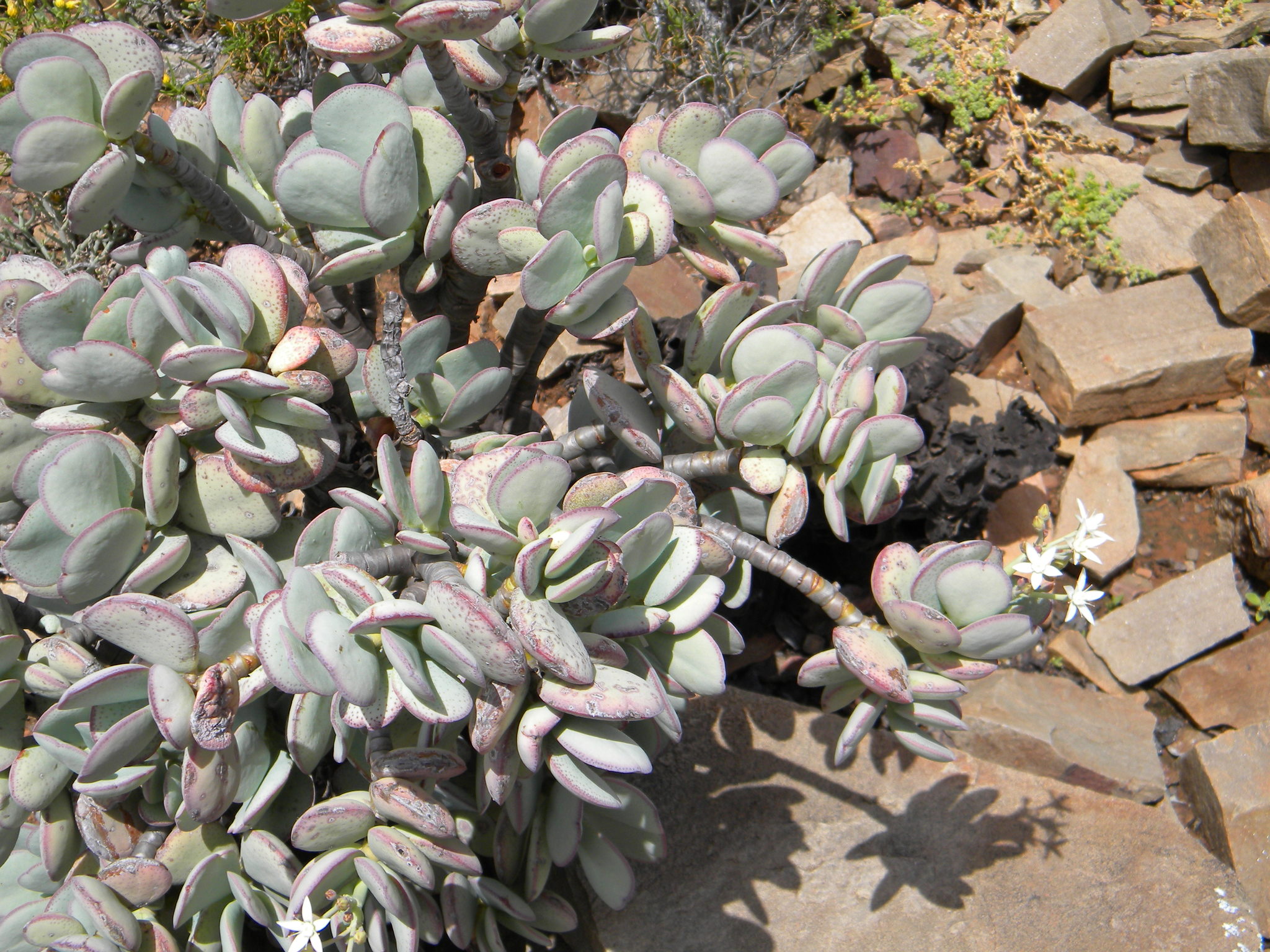
Left to its own devices it becomes a shrub to a metre or more, with stout branched stems and grey-green leaves often edged and spotted in red. From autumn into winter it can send up star-shaped pink flowers, though on a plant kept in a pot these are seldom seen. The subspecies undulatifolia carries the same red-margined colouring but on leaves that wave and ripple, staying smaller at around 60cm.
Source: RHS
Mealybugs and Company
Mealybugs, vine weevil, and aphids are the pests most likely to trouble this crassula. Beyond that watch list, it is generally free of disease.
Source: RHS
Little Fuss Required
No pruning is needed, which suits its standing as a low-maintenance houseplant. Left in a pot of cactus compost in a sunny, sheltered spot, it can take five to ten years to reach full maturity, with the wavy-leaved form settling in rather sooner, at two to five years.
Source: RHS
Care recipe
The species record — the baseline every cultivar inherits unless it says otherwise.
Care notes are early — not yet verified
- Light
- ai:claude-opus-4-8
- Water
- ai:claude-opus-4-8 (range 14-28d)
- Humidity
- ai:claude-opus-4-8
- Soil
- ai:claude-fable-5
- Care
- ai:claude-fable-5
Direct sun
≈ every 28 days
Low — average room
10–27 °C
Gritty, fast-draining cactus and succulent mix
Stem or leaf cuttings left to callus, then rooted
Dilute succulent feed once or twice in the growing season
Slow
Rarely flowers indoors; white to pink clusters when mature
Toxic to cats & dogs
Silver jade — same ASPCA jade-plant listing (vomiting, incoordination). This is where toxicity lives: every cultivar of this species inherits it and none can override it.
Reference images
Every image credited. Licenses link to their deeds.
PrimarySources: ai:claude-opus-4-8 · ai:claude-opus-4-8 (range 14-28d) · ai:claude-fable-5 · ASPCA
Kept true by its growers
Every fact here carries its source. Grow Jade Plant yourself? What you’ve observed — how it drinks, how it holds its color, a name that’s off — and a clear photo of your plant are exactly what keep this page honest. Contributions are reviewed before anything changes.
Sign in to add what you know →