Species · genus Cotyledon · Crassulaceae
Pig's Ear
Cotyledon orbiculata L.
Also known as: Pig's Ears · Cotyledon · Pig Ears · Pigs Ears · Round-leafed Navel-wort
Cultivars of C. orbiculata
The named forms growers keep — each with its own page, each honest about how much we know.
No named cultivars catalogued under C. orbiculata yet. When growers document a stable, named form, it earns its own page here.
Guide
The species-level account. Cultivar pages build on this and say where they differ.
Pig's Ear Succulent
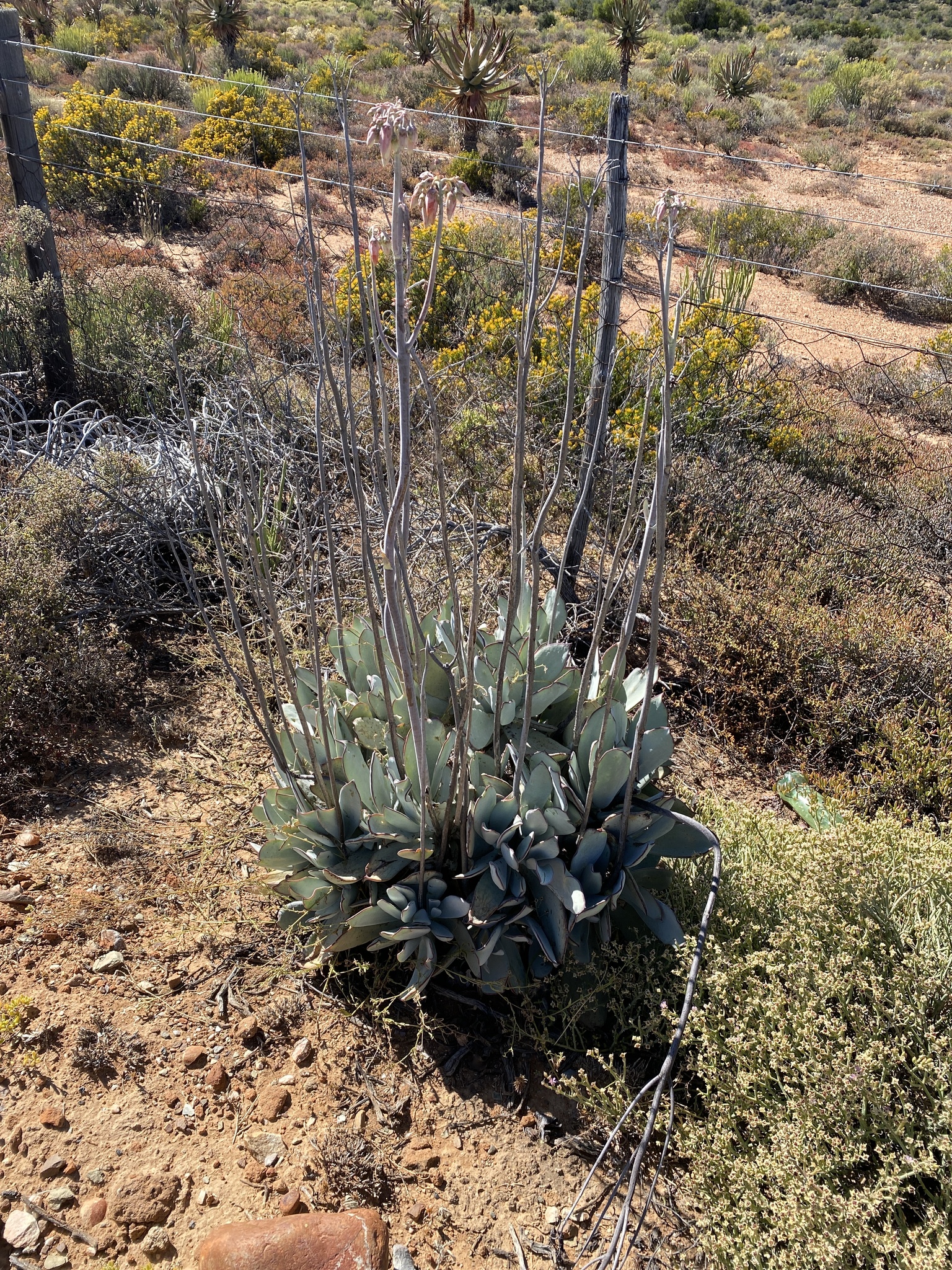
Cotyledon orbiculata, commonly called round-leafed navel-wort or pig's ear, is an evergreen succulent shrub in the Crassulaceae family. It builds a bushy, upright form and can reach around a metre tall, with the variety oblonga, known as silver crown, staying somewhat lower and more spreading.
Source: RHS
A South African Native
This plant hails from South Africa, part of a genus of succulent perennials and shrubs bearing simple, opposite leaves and nodding bell-shaped flowers in red, orange, or yellow. In UK conditions it is rated H1C, meaning it can only take a spell outdoors in summer and needs glasshouse protection otherwise.
Source: RHS
Sun, Grit, and Restraint
Give this plant full light and a standard cactus compost with sharp drainage, ideally loam or sand based. Water freely while it is actively growing, then taper back to just moist, and keep it nearly dry through winter. A dilute, low-nitrogen feed fortnightly through late spring and summer is enough, and low humidity suits it far better than a damp corner; standing it outside for the summer months does it good.
Source: RHS
Seed or Cuttings
Propagation is straightforward here, done either by seed or from stem cuttings.
Source: RHS
Waxy Leaves, Nodding Bells
The leaves are the main draw here, fleshy and grey-green, coated in a powdery wax, and often edged in deep red. On the species proper these are oval, while the oblonga variety carries them more wedge-shaped to oblong-linear. Both forms send up tall flower stems, to about 70cm, carrying clusters of pendulous, bell-shaped flowers in shades of orange-red to pinkish-orange, appearing in late summer and autumn.
Source: RHS
Mealybug and Weevil Watch
Keep an eye out for mealybugs, vine weevil, and aphids, the usual suspects on this genus. Disease is otherwise rarely a concern.
Source: RHS
Little Pruning Needed
No pruning is required for this plant, which keeps its maintenance simple. It suits a spot as a houseplant, on a patio in a container, or in a conservatory or greenhouse, and works well for a low-maintenance planting scheme.
Source: RHS
Care recipe
The species record — the baseline every cultivar inherits unless it says otherwise.
Care notes are early — not yet verified
- Light
- ai:claude-opus-4-8
- Water
- ai:claude-opus-4-8 (range 14-28d)
- Humidity
- ai:claude-opus-4-8
- Soil
- ai:claude-fable-5
- Care
- ai:claude-fable-5
Direct sun
≈ every 28 days
Low — average room
10–27 °C
Gritty, fast-draining cactus and succulent mix
Leaf or stem cuttings left to callus, then rooted
Dilute succulent feed once or twice in the growing season
Slow
Orange bell-shaped flowers on tall stalks in summer
Toxic to cats & dogs & humans
Crassulaceae genus Cotyledon contains bufadienolide cardiac glycosides, which are toxic to animals and humans. This is where toxicity lives: every cultivar of this species inherits it and none can override it.
Reference images
Every image credited. Licenses link to their deeds.
PrimarySources: ai:claude-opus-4-8 · ai:claude-opus-4-8 (range 14-28d) · ai:claude-fable-5 · ai:claude-opus-4-8 (family inference)
Kept true by its growers
Every fact here carries its source. Grow Pig's Ear yourself? What you’ve observed — how it drinks, how it holds its color, a name that’s off — and a clear photo of your plant are exactly what keep this page honest. Contributions are reviewed before anything changes.
Sign in to add what you know →