Species · genus Codiaeum · Euphorbiaceae
Garden Croton
Codiaeum variegatum (L.) Rumph. ex A.Juss.
Cultivars of C. variegatum
The named forms growers keep — each with its own page, each honest about how much we know.
No named cultivars catalogued under C. variegatum yet. When growers document a stable, named form, it earns its own page here.
Guide
The species-level account. Cultivar pages build on this and say where they differ.
A colourful tropical shrub
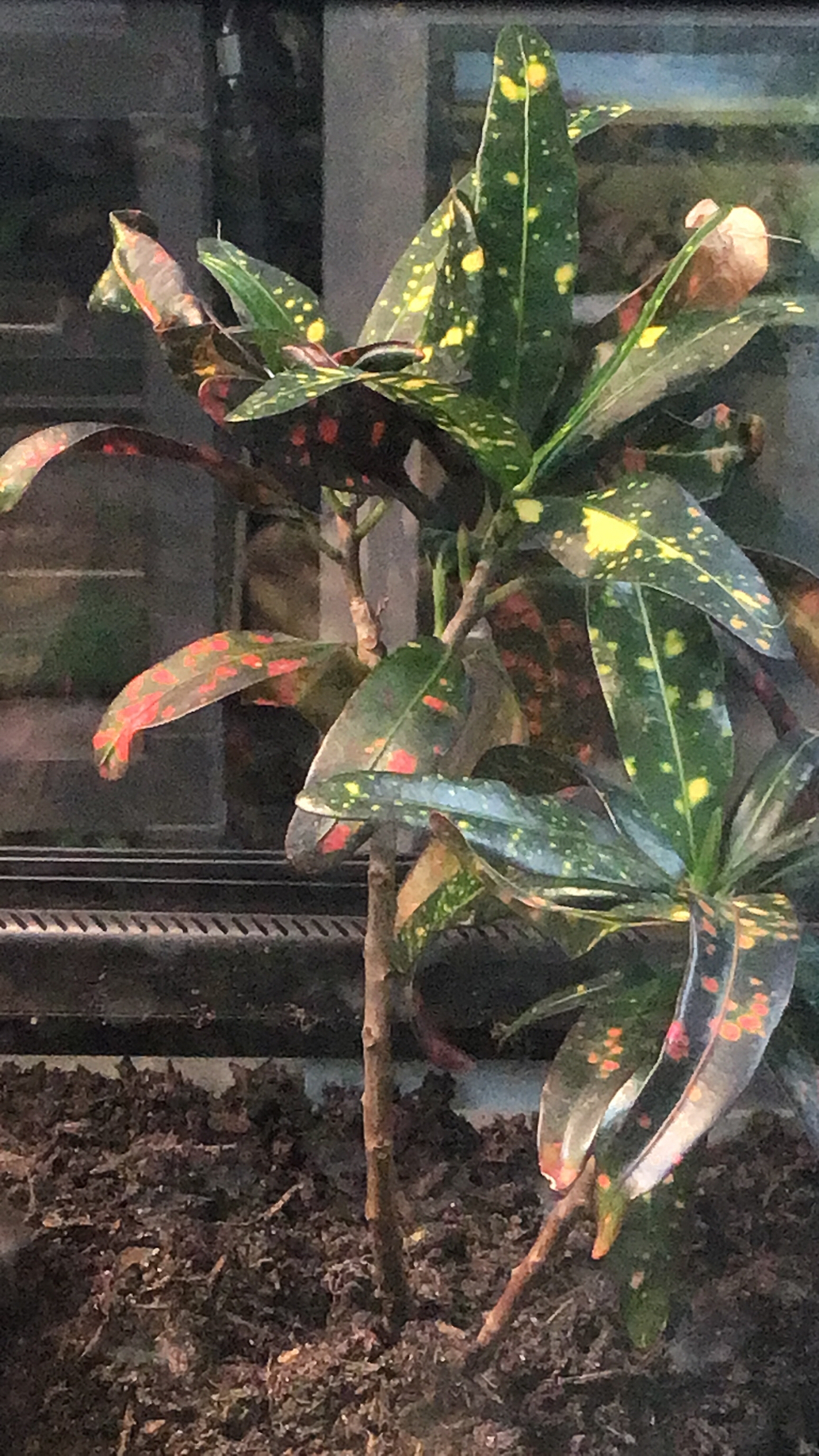
Croton, botanically Codiaeum variegatum, is a tropical evergreen shrub grown indoors chiefly for its thick, leathery leaves splashed and veined in red, pink, orange, yellow and green. It belongs to the euphorbia family, and its foliage rather than any flower is the draw for houseplant keepers.
Source: RHS
From tropical forest floors
Crotons originate in tropical regions of Malaysia, Indonesia and Australia, where they grow as evergreen shrubs. In the wild they are understorey plants, living on the floors of tropical forests in Southeast Asia, which explains their liking for warmth and shelter from harsh direct sun. Many cultivars have since been selected for particular leaf shapes, textures and colour patterns.
Source: Epic Gardening
Warmth, light and moisture
Crotons ask for bright but indirect light, since too little dulls the leaf colour and too much strong summer sun through glass can scorch it. They need consistent warmth, roughly 18–35°C, never dropping below 15°C, along with high humidity best supplied by a tray of damp pebbles or a steamy bathroom. Water once the top of the compost has dried out, ideally with rainwater or filtered water at room temperature, easing off in winter, and feed during the growing season with an acidic, potassium-rich fertiliser in early and late spring rather than through autumn and winter.
Source: RHS
Rooting stem cuttings
The usual method is softwood or stem cuttings taken in early summer, ideally a segment with at least three sets of leaves, stripped down to a few top leaves and rooted in water or in a rooting-hormone-dipped mix of vermiculite, sand and peat moss under a humid cover. Air layering is also possible, wounding a stem, packing it with damp sphagnum moss under plastic until roots form, then severing and potting the new plant. Root division at outgrown pots is possible too, though crotons dislike disturbance and may sulk with wilting or leaf loss afterwards.
Source: Epic Gardening
Leaves in every hue
The defining feature of a croton is its bold, leathery foliage, which can reach up to 30cm long and appears in combinations of red, pink, burgundy, orange, yellow and green. Colour may form contrasting splashes and blotches, or follow the leaf veins, depending on the cultivar, and plants range from a compact 30cm up to 90cm or more indoors. Croton flowers do occur, with separate male and female blooms on the same plant, but they are unremarkable next to the foliage.
Source: RHS
Watch for mites and scale
Spider mites are the most common indoor pest, leaving leaves speckled with yellow and eventually causing leaf drop; wiping the foliage with a moist cloth and keeping humidity up helps discourage them. Mealybugs can also appear and cause leaf drop, dealt with by dabbing small colonies with alcohol or using neem oil or insecticidal soap on larger ones. Outdoors, croton scale, thrips (which particularly trouble Petra crotons) and the croton caterpillar are additional risks, generally managed with neem oil, water sprays, or Bt for caterpillars.
Source: Epic Gardening
Leaf drop and root rot
Leaf drop is the most frequent complaint, usually traced to compost or air that has gone too dry, a cold draught, or temperatures held below 15°C for too long. Root rot follows waterlogged compost, whether from overwatering, a pot left standing in water, or a mix that drains poorly, and can kill the plant if left unchecked. Foliage that stays plain green rather than colouring up generally signals insufficient light, while greyish scorched patches point to too much direct summer sun.
Source: RHS
Pruning, potting and poison caution
Crotons can stay in their original pot for a year or two, moving up to a slightly larger container in spring once roots crowd it, using a light, fast-draining, peat-free ericaceous compost, and repotting every few years thereafter. If a plant turns leggy, prune it in spring just above a leaf joint to encourage bushier side growth. The milky sap is an irritant to skin and eyes and all parts of the plant are poisonous, so gloves are worth wearing when pruning, and plants are best kept out of reach of children and pets.
Source: RHS
Care recipe
The species record — the baseline every cultivar inherits unless it says otherwise.
Care notes are early — not yet verified
- Light
- ai:claude-opus-4-8
- Water
- ai:claude-opus-4-8 (range 5-10d)
- Humidity
- ai:claude-opus-4-8
- Soil
- ai:claude-fable-5
- Care
- ai:claude-fable-5
Bright, indirect
≈ every 10 days
High
16–27 °C
Rich, well-draining potting mix
Stem cuttings with rooting hormone, or air layering
Balanced liquid feed monthly in the growing season
Moderate
Insignificant racemes — grown entirely for the foliage
Toxic to cats & dogs & humans
Euphorbiaceae produce an irritant milky latex that can cause skin and mucous-membrane irritation and digestive upset if ingested. This is where toxicity lives: every cultivar of this species inherits it and none can override it.
Reference images
Every image credited. Licenses link to their deeds.
PrimarySources: ai:claude-opus-4-8 · ai:claude-opus-4-8 (range 5-10d) · ai:claude-fable-5 · ai:claude-opus-4-8 (family inference)
Kept true by its growers
Every fact here carries its source. Grow Garden Croton yourself? What you’ve observed — how it drinks, how it holds its color, a name that’s off — and a clear photo of your plant are exactly what keep this page honest. Contributions are reviewed before anything changes.
Sign in to add what you know →