Species · genus Ceropegia · Apocynaceae
String of Hearts
Ceropegia woodii Schltr.
Also known as: Hearts Entangled · Rosary Vine
Cultivars of C. woodii
The named forms growers keep — each with its own page, each honest about how much we know.
No named cultivars catalogued under C. woodii yet. When growers document a stable, named form, it earns its own page here.
Guide
The species-level account. Cultivar pages build on this and say where they differ.
A Trailing Succulent Charmer
String of Hearts is a trailing succulent grown for its long, thin vines strung with small, heart-shaped leaves. It goes by many names in cultivation, including rosary vine, sweetheart vine, chain of hearts, and hearts on a string, and is usually sold as Ceropegia woodii even though its accepted name places it as a subspecies of Ceropegia linearis.
Source: Epic Gardening
From South Africa to Kew
This plant is native to Southern Africa, with the RHS placing its natural range from Zimbabwe down to South Africa. Its rise to houseplant fame traces back to a specimen collected in the South African mountains by botanist John Medley Wood, curator of the Durban Botanic Gardens, who sent it to Kew where it was described in Curtis's Botanical Magazine in 1900. The species name honors Wood, while the genus name comes from Greek words for waxy and fountain, a nod to its curious blooms.
Source: Epic Gardening
Bright Light, Dry Soil
This succulent wants bright indirect light, tolerating some direct sun outside the hottest afternoon hours, though too little light causes stretched, leggy growth. Water sparingly, letting the soil dry out fully between waterings, roughly once a month or less in cooler seasons, since the leaves and tubers store moisture and are prone to rot if kept wet. It prefers warm, dry conditions around 80°F and lower humidity near 40 percent, and only needs feeding occasionally with a diluted succulent fertilizer, ideally in spring to support flowering.
Source: Epic Gardening
Cuttings, Tubers, or Seed
The RHS recommends propagating by seed sown at 19-24°C in early spring, from stem bulbils, or by taking 10-15cm stem cuttings in early summer and rooting them in cactus compost kept moist at 22-25°C. Epic Gardening adds that cuttings can also simply be rooted in water before moving to soil, and that the small aerial tubers along the vine can be pinned into soil to root before being separated into new plants.
Source: RHS
Hearts on a String
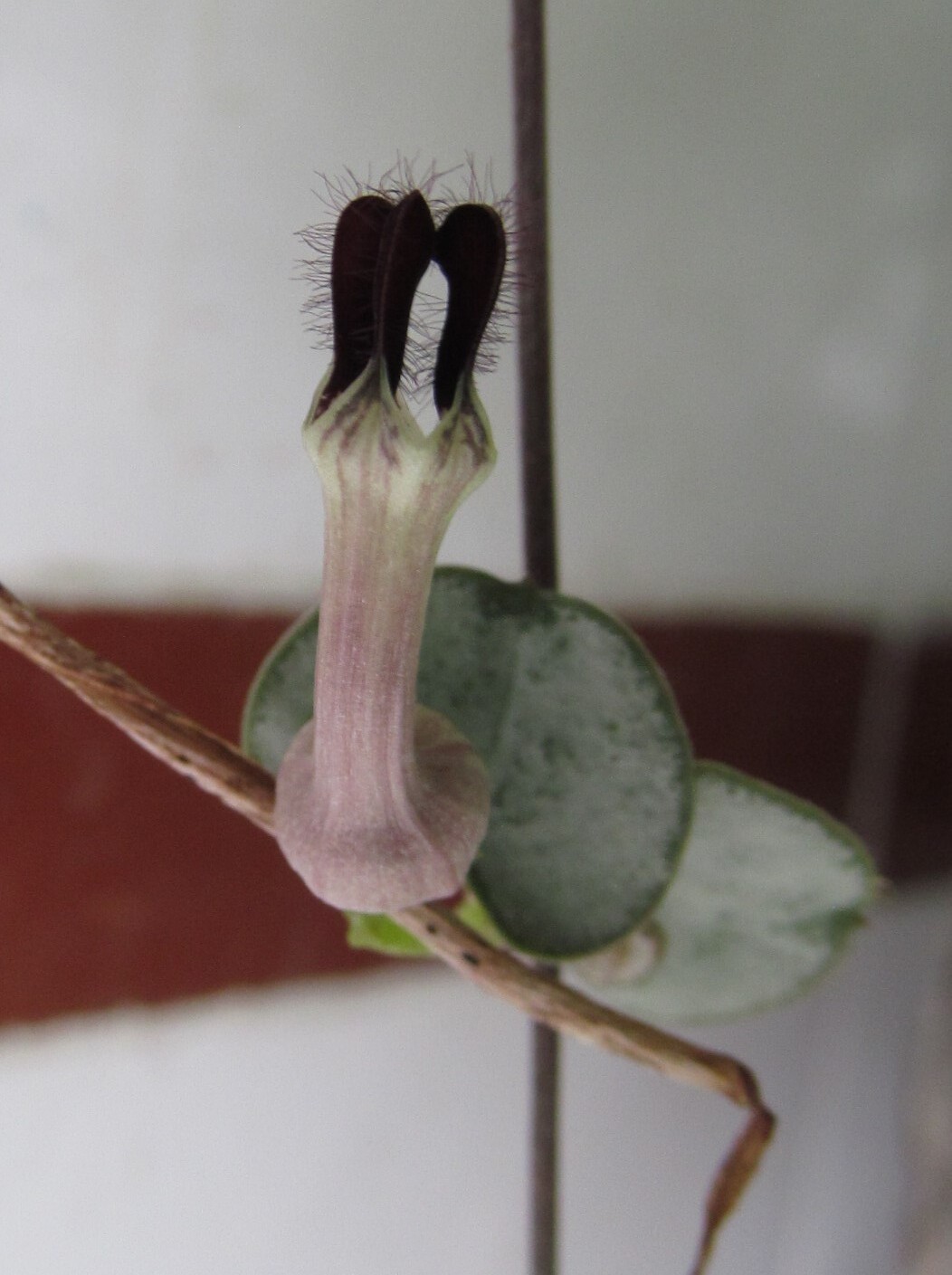
The RHS describes it as an evergreen tuberous perennial with trailing stems reaching a metre or more, carrying small, heart-shaped leaves patterned in grey with purple undersides, and lantern-shaped pink and purple tubular flowers about 2cm long. Epic Gardening notes the leaves are semi-succulent, storing water in a plump but flattened form, and that the mottled green-and-silver coloring is sometimes joined by pink variegation in some plants. Small tuber-like bumps, called aerial tubers, also form along the vines as the plant spreads.
Source: RHS
Watch for Sap Feeders
The RHS lists mealybugs, aphids, and scale insects as the pests this plant is vulnerable to.
Source: RHS
Rot, Drop, and Stretch
Leaf drop is usually a stress response, most often triggered by cold temperature swings or by overwatering, which leaves vines and leaves mushy as they succumb to rot. The RHS likewise notes the plant is vulnerable to basal rot if kept too wet over winter. Leggy vines with wide gaps between leaves signal too little light, while tangled, unruly growth is simply a sign the vines need regular detangling and trimming.
Source: Epic Gardening
Confined Pots, Occasional Repot
This plant is happiest a little pot-bound, since confinement encourages denser growth and can even trigger flowering, but it should still be repotted roughly every three years or once roots emerge from the drainage holes. The RHS notes it needs no routine pruning, though Epic Gardening suggests trimming unbalanced or overly long vines during the growing season, taking no more than a third of the plant at once, and saving the cuttings for propagation.
Source: Epic Gardening
Care recipe
The species record — the baseline every cultivar inherits unless it says otherwise.
Care notes are early — not yet verified
- Light
- ai:claude-opus-4-8
- Water
- ai:claude-opus-4-8 (range 10-21d)
- Humidity
- ai:claude-opus-4-8
- Soil
- ai:claude-fable-5
- Care
- ai:claude-fable-5
Bright, indirect
≈ every 21 days
Low — average room
13–27 °C
Free-draining succulent mix with extra grit
Root the aerial tubers or trailing stem cuttings
Weak succulent feed monthly in spring and summer
Moderate
Curious lantern-shaped flowers appear readily
Toxic to cats & dogs & humans
Apocynaceae family is associated with cardiac glycosides and milky latex that can be irritant or toxic. This is where toxicity lives: every cultivar of this species inherits it and none can override it.
Reference images
Every image credited. Licenses link to their deeds.
Sources: ai:claude-opus-4-8 · ai:claude-opus-4-8 (range 10-21d) · ai:claude-fable-5 · ai:claude-opus-4-8 (family inference)
Kept true by its growers
Every fact here carries its source. Grow String of Hearts yourself? What you’ve observed — how it drinks, how it holds its color, a name that’s off — and a clear photo of your plant are exactly what keep this page honest. Contributions are reviewed before anything changes.
Sign in to add what you know →