Species · genus Ceropegia · Apocynaceae
Carrion-Flower
Orbea variegata (L.) Haw.
Also known as: Starfish-cactus · Starfishplant · Toad-cactus · Toadplant
Cultivars of O. variegata
The named forms growers keep — each with its own page, each honest about how much we know.
No named cultivars catalogued under O. variegata yet. When growers document a stable, named form, it earns its own page here.
Guide
The species-level account. Cultivar pages build on this and say where they differ.
A Starfish in Miniature
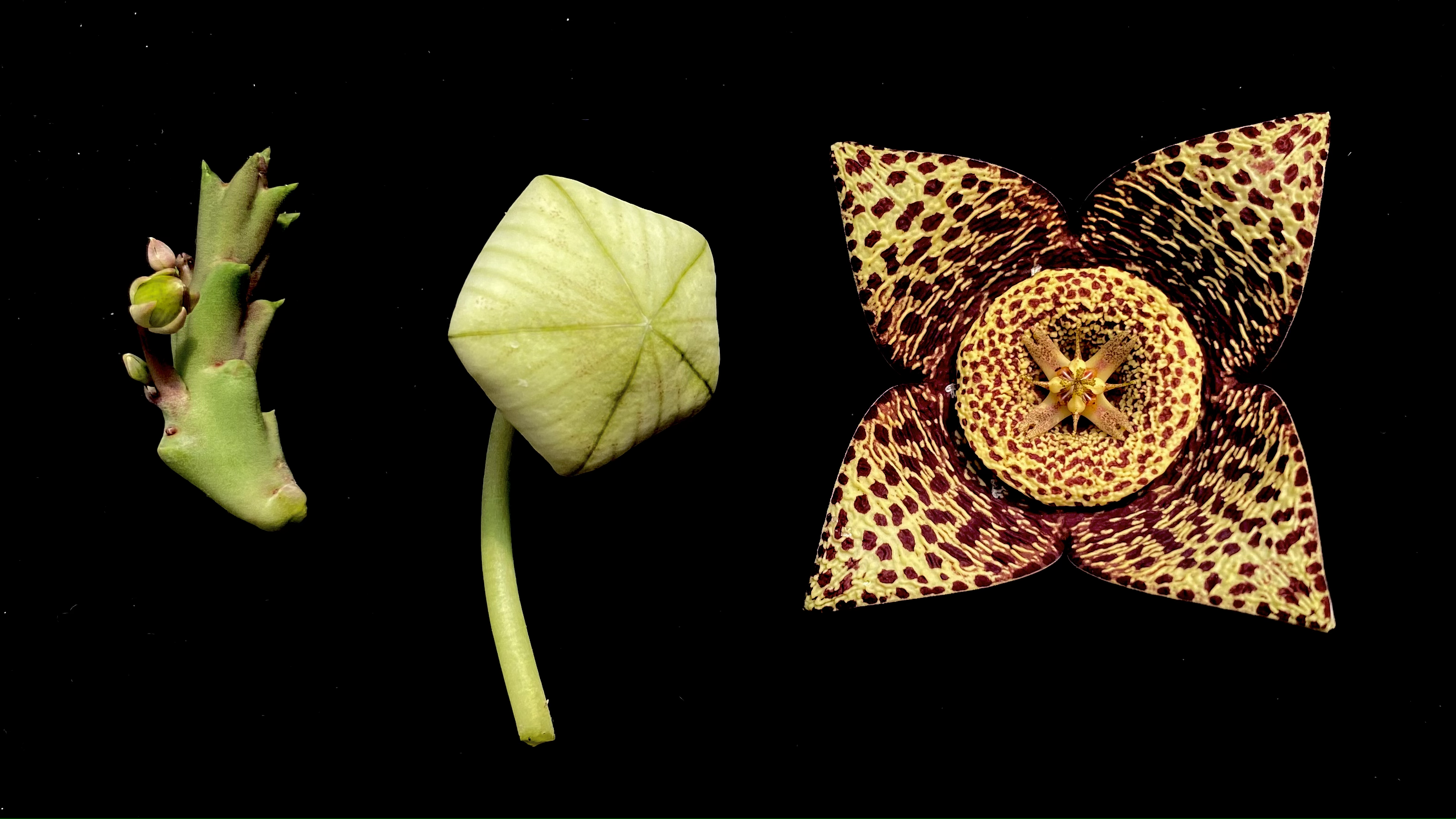
Orbea variegata, known as the star flower or starfish cactus, is a low-growing succulent perennial that looks cactus-like but carries no true leaves at all. Its charm lies not in foliage but in a run of star-shaped blooms marked with deep reddish-purple, spotted across a pale ground.
Source: RHS
A Cape Native
This plant's natural range lies in South Africa, around the Cape. It belongs to the genus Orbea, a group of leafless, clump-forming succulents from the same region, all sharing fleshy toothed stems and flowers built to lure rather than to please the nose.
Source: RHS
Bright Light, Dry Feet
Grow this one under glass in a standard cactus compost, set in bright but filtered light with low humidity around it. While it is actively growing, water moderately and feed every two or three weeks with a balanced liquid feed, then let it rest almost dry over winter, offering only the occasional sparing drink to stop the stems wrinkling.
Source: RHS
By Seed or Stem
New plants can be raised from seed sown at 19 to 24°C in early spring, or more simply from cuttings of stem sections taken after flowering.
Source: RHS
Star-Spotted Blooms
The stems stand erect and angled, reaching only up to about 10cm in height, forming a low clump rather than a tall specimen. From these emerge up to five star-shaped flowers at a time, each 5 to 8cm across, whitish but heavily spotted with a deep reddish-purple that gives the plant its common name.
Source: RHS
Watch for Mealybugs
The main pest concern here is mealybugs, worth checking for in the folds and angles of the stems.
Source: RHS
Little Fuss Needed
This is a low-maintenance plant that needs no pruning, and it is generally free of disease. It suits patio and container growing, and given time to maturity of around five to ten years, it asks for patience more than intervention.
Source: RHS
Care recipe
The species record — the baseline every cultivar inherits unless it says otherwise.
Care notes are early — not yet verified
- Light
- ai:claude-opus-4-8
- Water
- ai:claude-opus-4-8 (range 14-28d)
- Humidity
- ai:claude-opus-4-8
- Soil
- ai:claude-fable-5
- Care
- ai:claude-fable-5
Bright, indirect
≈ every 28 days
Low — average room
10–30 °C
Very gritty succulent mix with excellent drainage
Root a callused stem cutting in dry, sandy mix
Weak succulent feed once or twice in the growing season
Moderate
Striking star-shaped, foul-scented flowers in late summer
Toxic to cats & dogs & humans
Apocynaceae frequently contain cardiac glycosides and irritant latex; treat as potentially harmful if ingested. This is where toxicity lives: every cultivar of this species inherits it and none can override it.
Reference images
Every image credited. Licenses link to their deeds.
PrimarySources: ai:claude-opus-4-8 · ai:claude-opus-4-8 (range 14-28d) · ai:claude-fable-5 · ai:claude-opus-4-8 (family inference)
Kept true by its growers
Every fact here carries its source. Grow Carrion-Flower yourself? What you’ve observed — how it drinks, how it holds its color, a name that’s off — and a clear photo of your plant are exactly what keep this page honest. Contributions are reviewed before anything changes.
Sign in to add what you know →