Species · genus Caladium · Araceae
Heart Of Jesus
Caladium bicolor (Aiton) Vent.
Also known as: Angel Wings · Artist's Pallet · Caladium · Elephant's-ear · Fancy-leaf Caladium
Cultivars of C. bicolor
The named forms growers keep — each with its own page, each honest about how much we know.
No named cultivars catalogued under C. bicolor yet. When growers document a stable, named form, it earns its own page here.
Guide
The species-level account. Cultivar pages build on this and say where they differ.
A Foliage-First Aroid
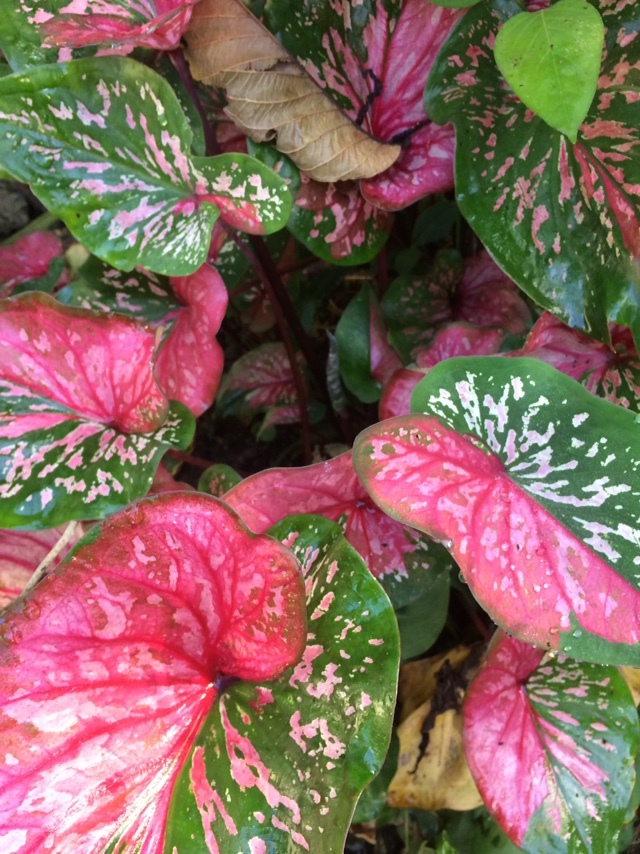
Caladium bicolor, often called angel wings, is an arum family plant grown almost entirely for its bold, patterned leaves rather than its flowers, which stay hidden or barely appear at all. It grows from a tuber into clumps a foot or two tall, with arrowhead-shaped leaves splashed in green, pink, red, and white.
Source: Missouri Botanical Garden
From Rainforest Floor to Parlor
This plant traces back to Brazil and other parts of northern South America, with some populations native to Central America, where it grows as a true understory species along riverbanks, in clearings, and beneath the forest canopy. It has since naturalized in India, Africa, and various tropical islands. Its cultivated history began with hybridizing in France in the late 1700s, and by 1867 a variety called 'Triomphe de l'Exposition' was the star of the great French Exposition. Later, breeders in Tampa, Florida, developed many of the colorful varieties still grown today.
Source: Epic Gardening
Shade, Moisture, Warmth
This plant wants part shade to full shade, or filtered light, in moist, fertile, humusy, acidic soil, and it does well even in fairly deep shade, but direct sun will scorch the leaves. Keep the soil consistently moist, especially through dry summer stretches, without letting it stay soggy, and feed regularly during active growth. It is most content in hot, humid conditions with nighttime temperatures that don't dip much below 60°F.
Source: Missouri Botanical Garden
Dividing the Tubers
Propagation is done by dividing the tubers, ideally in spring before new growth starts, using a clean, sharp knife and making sure each section carries at least one eye. Cut pieces should be left to dry and scab over for about a week before planting, which helps prevent rot. Larger divisions tend to establish and leaf out faster than smaller ones.
Source: Epic Gardening
Leaves Take the Stage
The heart- or arrow-shaped leaves can run six to eight inches long, colored in shades of pink, red, green, or white with contrasting veins and edges, sometimes with a ruffled margin and a nearly translucent, parchment-like texture. Flowers do occur but are inconspicuous aroid spathes and are not the plant's draw. Growth habit varies from compact, low mounds to taller, more upright clumps depending on the cultivar.
Source: Epic Gardening
Mostly Left Alone
Caladium bicolor has no serious insect or disease problems as a rule, though its rather fragile leaves are easily torn by wind or hail, and slugs and snails will chew holes in the foliage given the chance.
Source: Missouri Botanical Garden
Reading the Leaves
Yellowing or browning foliage is almost always tied to water: too little causes drooping followed by yellowing and eventual dry, brown leaves, while too much invites root rot, showing up as pale, yellowing, or soft and mushy leaves. Leaf drop is most often the result of too much direct sunlight rather than anything else, so a shadier spot usually solves it. Fungal diseases such as Fusarium and Pythium favor the same moist, shaded conditions this plant likes, so good drainage is the best safeguard.
Source: Epic Gardening
Seasonal Rhythm and Tidying
In warm zones the tubers can stay in the ground year-round, but where winters are cold they need to be dug up after foliage dies back in fall, dried, and stored somewhere that doesn't drop below 45°F, much as one would treat tuberous begonias. Container-grown plants can simply be brought indoors and stored in their pots. Through the growing season, just remove dead or damaged leaves as they appear to keep fungal issues from spreading, and cut back the dead growth once the plant goes fully dormant.
Source: Missouri Botanical Garden
Care recipe
The species record — the baseline every cultivar inherits unless it says otherwise.
Care notes are early — not yet verified
- Light
- ai:claude-opus-4-8
- Water
- ai:claude-opus-4-8 (range 5-10d)
- Humidity
- ai:claude-opus-4-8
- Soil
- ai:claude-fable-5
- Care
- ai:claude-fable-5
Bright, indirect
≈ every 10 days
High
18–29 °C
Rich, moisture-retentive mix with peat/coir and perlite
Divide dormant tubers
Balanced feed every 2 weeks while in leaf
Fast
Grown for vivid leaves; tubers go dormant and rest in winter
Toxic to cats & dogs & humans
Araceae contain insoluble calcium oxalate crystals, which cause oral and digestive irritation if chewed or ingested. This is where toxicity lives: every cultivar of this species inherits it and none can override it.
Reference images
Every image credited. Licenses link to their deeds.
Sources: ai:claude-opus-4-8 · ai:claude-opus-4-8 (range 5-10d) · ai:claude-fable-5 · ai:claude-opus-4-8 (family inference)
Kept true by its growers
Every fact here carries its source. Grow Heart Of Jesus yourself? What you’ve observed — how it drinks, how it holds its color, a name that’s off — and a clear photo of your plant are exactly what keep this page honest. Contributions are reviewed before anything changes.
Sign in to add what you know →