Species · genus Bisnaga · Cactaceae
Glaucous Barrel Cactus
Ferocactus glaucescens (DC.) Britton & Rose
Cultivars of F. glaucescens
The named forms growers keep — each with its own page, each honest about how much we know.
No named cultivars catalogued under F. glaucescens yet. When growers document a stable, named form, it earns its own page here.
Guide
The species-level account. Cultivar pages build on this and say where they differ.
The Glaucous Barrel Cactus
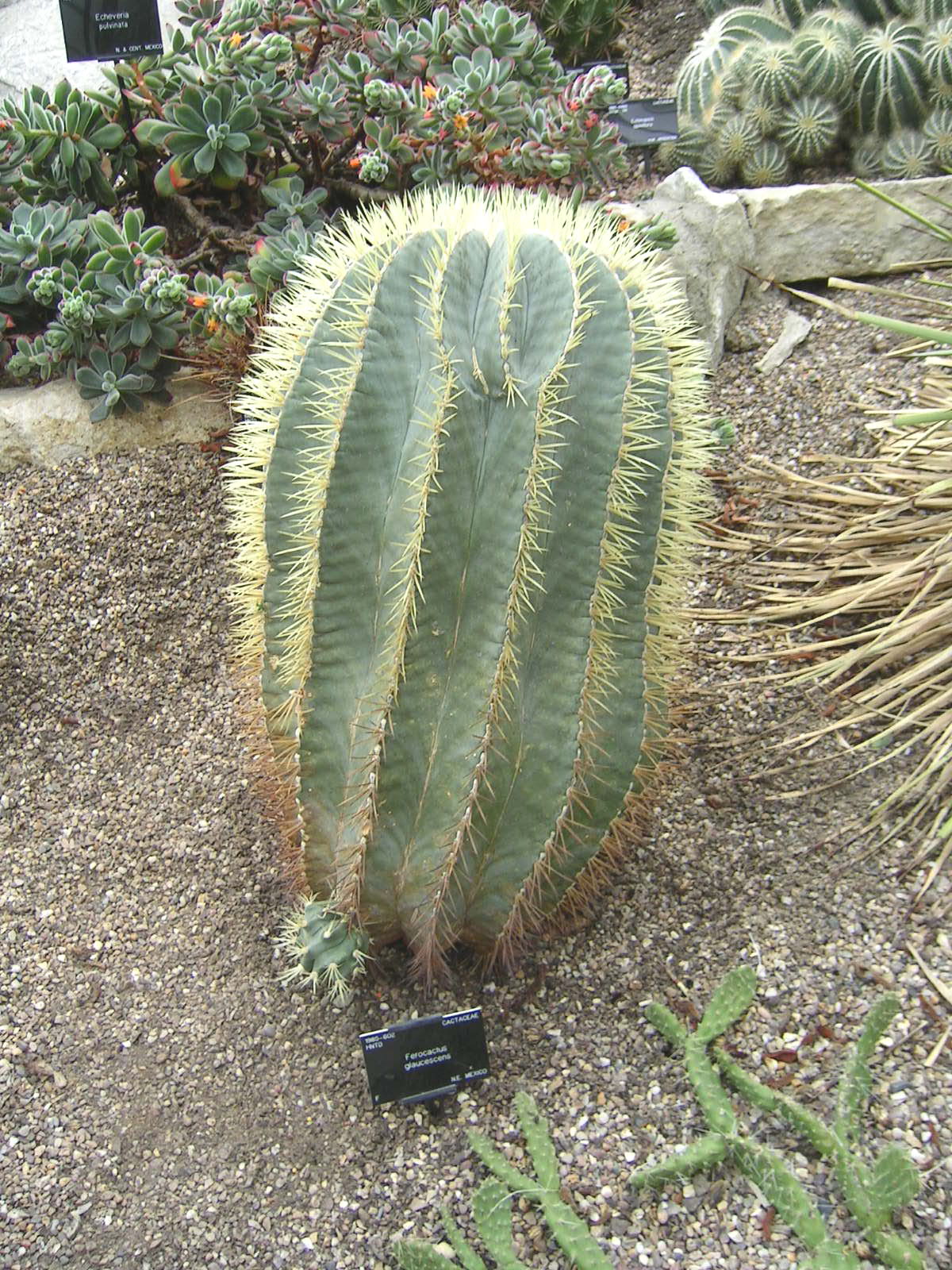
Ferocactus glaucescens, known as the glaucous barrel cactus, is a globose to cylindric cactus with a grey-green stem that can reach up to 60cm and sometimes clusters into groups. It carries yellow spines to 2.5cm long and produces funnel-shaped yellow flowers of 3-4cm across, and it has earned the RHS Award of Garden Merit.
Source: RHS
Native to Eastern Mexico
This species comes from northeastern Mexico, extending along the Gulf as far as Veracruz, where it grows in desert and dry shrubland. It was first described as Echinocactus glaucescens before being placed in Ferocactus by Britton and Rose in 1922, and it carries over a dozen synonyms accumulated across its taxonomic history.
Source: Kew
A Sun-Loving, Sparing Routine
Grow this cactus under glass in standard cactus compost, in bright but filtered light, with low humidity. Water moderately while it is in active growth and feed every two to three weeks with a balanced liquid feed, but keep the plant almost dry through winter. In UK conditions it wants full sun, a sheltered spot, and free-draining loam or sandy soil.
Source: RHS
Grown From Seed
Propagation is by seed, sown at 10-20°C in early spring.
Source: RHS
Ribs, Spines and Flowers
The genus is marked by spherical to columnar stems with prominent ribs bearing spiny areoles, sometimes hooked, and funnel-shaped flowers appearing in summer. In this species the ribbed grey-green stem clusters over time, and its yellow spines and yellow blooms are distinctive against the glaucous body.
Source: RHS
Watch for Mealybugs
This cactus may be susceptible to mealybugs, though it is otherwise generally disease-free.
Source: RHS
Little Fuss Required
No pruning is required for this plant, and it suits low-maintenance patio or container growing. It reaches maturity slowly, typically taking ten to twenty years, and stays compact throughout, with a maximum height and spread of 0.1 to 0.5 metres.
Source: RHS
Care recipe
The species record — the baseline every cultivar inherits unless it says otherwise.
Care notes are early — not yet verified
- Light
- ai:claude-opus-4-8
- Water
- ai:claude-opus-4-8 (range 14-28d)
- Humidity
- ai:claude-opus-4-8
- Soil
- ai:claude-fable-5
- Care
- ai:claude-fable-5
Direct sun
≈ every 28 days
Low — average room
7–32 °C
Very gritty, fast-draining cactus mix
Seed, or offsets from clustering plants
Dilute cactus feed once in early summer
Slow
Pale yellow blooms atop the ribs; possible on mature plants
Not yet documented
This is where toxicity lives — every cultivar of this species inherits it and none can override it.
Reference images
Every image credited. Licenses link to their deeds.
PrimarySources: ai:claude-opus-4-8 · ai:claude-opus-4-8 (range 14-28d) · ai:claude-fable-5
Kept true by its growers
Every fact here carries its source. Grow Glaucous Barrel Cactus yourself? What you’ve observed — how it drinks, how it holds its color, a name that’s off — and a clear photo of your plant are exactly what keep this page honest. Contributions are reviewed before anything changes.
Sign in to add what you know →