Species · genus Begonia · Begoniaceae
Painted-leaf Begonia
Begonia rex Putz.
Also known as: King Begonia · Rex Begonias
Cultivars of B. rex
The named forms growers keep — each with its own page, each honest about how much we know.
No named cultivars catalogued under B. rex yet. When growers document a stable, named form, it earns its own page here.
Guide
The species-level account. Cultivar pages build on this and say where they differ.
A Foliage Showpiece
Rex begonia is grown not for flowers but for its bold, colorful leaves, which range through purple, pink, red, silver, and black depending on variety. It stays relatively short, which suits it well to desks, tabletops, and terrariums where its patterned foliage can stand out against plainer neighbors.
Source: Costa Farms
A Rhizome from Asia
Begonia rex-cultorum refers to a whole group of cultivated begonias bred from the wild species Begonia rex, which grows naturally in rocky, forested valleys and slopes of northeastern India, southern China, and Vietnam. The genus itself is named for Michael Begon, a onetime governor of French Canada. Growers have hybridized the wild species widely, producing the huge range of leaf colors, textures, and sizes seen in cultivation today.
Source: Missouri Botanical Garden
Light, Water, Rest
Give rex begonia medium to bright, filtered light, keeping it out of hot direct sun, and let the potting mix approach dryness at the surface before watering again, since it tolerates being slightly underwatered far better than sitting wet. It does not demand the intense humidity many other exotics want, but dry winter air can brown the leaf tips, so it helps to raise humidity in that season. Feed lightly, as little as once or twice a year for steady growth or more often with a general houseplant fertilizer if faster growth is wanted, and expect many cultivars to slow down or shed leaves into a winter rest, watering sparingly until new growth resumes in spring.
Source: Costa Farms
Leaf and Rhizome Cuttings
Rex begonia is commonly propagated from leaf cuttings taken in May or June: a newly matured leaf is cut through its major veins at intervals, laid top-side up on sandy cutting compost, pegged down so the cuts touch the mix, and kept warm and humid in a propagator until plantlets form at the cut points and can be potted on. Rhizomatous types like this one can also be divided in spring, provided each piece carries at least one growing point.
Source: RHS
Leaves Built for Looking
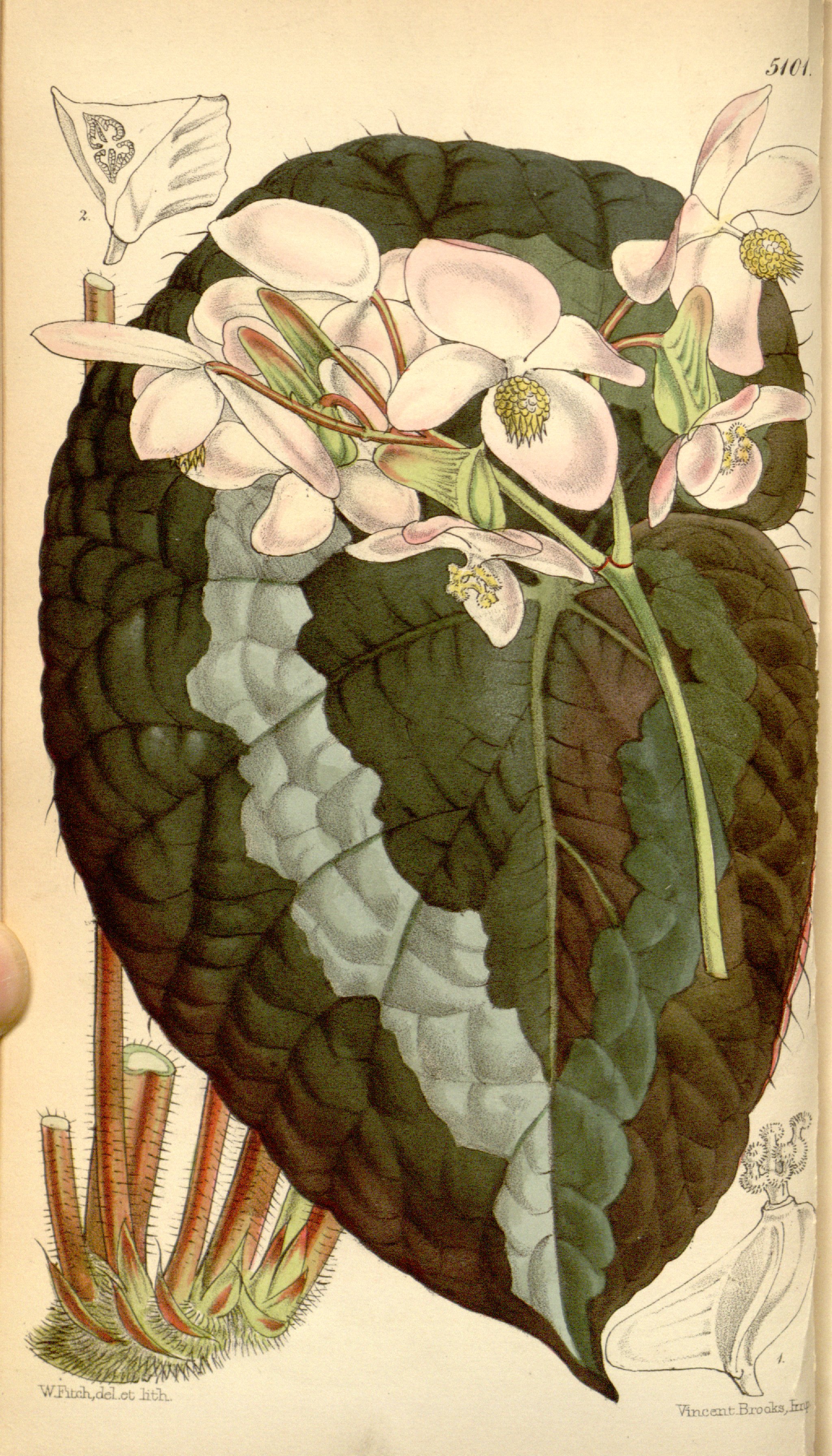
In its unbred form, this begonia carries large, sparsely hairy leaves with prominent veins, reaching up to a foot long, dark green at the center and margin with a silvery zone between, and red on the underside. Cultivated rex varieties riff on this pattern endlessly: Tornado shows splashes of silver, bronze, and purple on dark green, Red Kiss carries a metallic-red ring over purple-black foliage, and stronger light tends to intensify the coloration in many varieties. Flowers, when they appear, are small and pink and considered secondary to the foliage display.
Source: Costa Farms
Watch for Mealybugs and Mildew
Rex begonias are prone to mildew and botrytis fungal infections, which are best kept at bay by removing dead leaves promptly and ensuring good air circulation rather than relying solely on fungicide. Mealybugs can also turn up, and the same routine of keeping the plant well groomed and free of surface debris helps prevent both insects and disease.
Source: Missouri Botanical Garden
Reading the Leaves
Brown leaf edges usually point to low humidity or too much heat, while rotten leaves and leaf drop tend to trace back to excess humidity, overwatering, or too little light. Yellowing leaves can result from low light or from watering that swings too far wet or too dry, and most plants brought to advice desks turn out to have been either overwatered or kept in air that was too dry.
Source: RHS
Care recipe
The species record — the baseline every cultivar inherits unless it says otherwise.
Care notes are early — not yet verified
- Light
- ai:claude-opus-4-8
- Water
- ai:claude-opus-4-8 (range 5-10d)
- Humidity
- ai:claude-opus-4-8
- Soil
- ai:claude-fable-5
- Care
- ai:claude-fable-5
Bright, indirect
≈ every 10 days
High
16–26 °C
Light, fast-draining mix of peat/coir with perlite
Leaf cuttings pinned to moist medium
Half-strength balanced feed every 2-4 weeks in growth
Moderate
Grown for foliage; flowers are small and best pinched off
Toxic to cats & dogs
Soluble calcium oxalates — mouth irritation, vomiting; tubers most toxic. This is where toxicity lives: every cultivar of this species inherits it and none can override it.
Reference images
Every image credited. Licenses link to their deeds.
PrimarySources: ai:claude-opus-4-8 · ai:claude-opus-4-8 (range 5-10d) · ai:claude-fable-5 · ASPCA
Kept true by its growers
Every fact here carries its source. Grow Painted-leaf Begonia yourself? What you’ve observed — how it drinks, how it holds its color, a name that’s off — and a clear photo of your plant are exactly what keep this page honest. Contributions are reviewed before anything changes.
Sign in to add what you know →