Species · genus Begonia · Begoniaceae
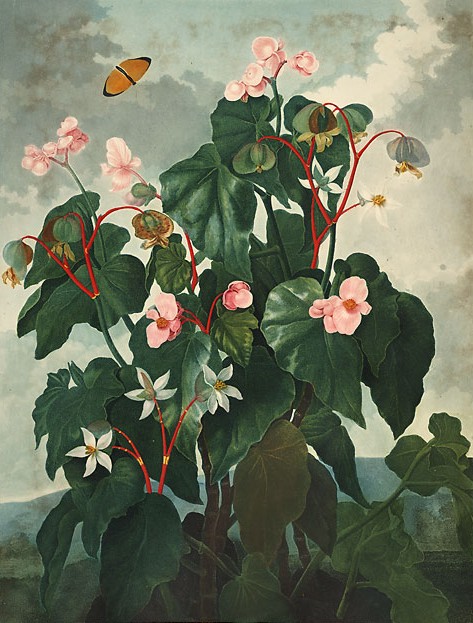
Begonia obliqua
Begonia obliqua L.
Cultivars of B. obliqua
The named forms growers keep — each with its own page, each honest about how much we know.
No named cultivars catalogued under B. obliqua yet. When growers document a stable, named form, it earns its own page here.
Guide
The species-level account. Cultivar pages build on this and say where they differ.
The oblique-leaved begonia
Begonia obliqua is a species in the large and varied Begonia genus, formally described by Linnaeus and known in cultivation as the oblique-leaved begonia. Like its relatives, it belongs to a genus of annuals, evergreen or deciduous perennials and shrubs, most with fibrous, tuberous or rhizomatous roots and characteristically asymmetrical leaves.
Source: RHS
A Lesser Antilles native
This species is native to the Leeward and Windward Islands of the Lesser Antilles, where it grows as an epiphyte within the wet tropical biome. It carries a long list of historic synonyms, among them Begonia odorata and Begonia macrophylla, a sign of how often it has been renamed and reclassified since its first description in 1753.
Source: Kew
Light, water, and feeding rhythm
Grown indoors as a fibrous-rooted begonia, it prefers bright filtered light rather than direct sun, which can scorch the foliage. The compost should be kept moist but well-drained, never left to dry out completely nor left waterlogged, and humidity is best maintained by standing the pot on a gravel tray rather than misting, since damp, over-humid air invites mildew. Established plants benefit from a high-potassium feed from May to September, and a winter minimum of around 13°C (55°F) is advised.
Source: RHS
Seed, cuttings, or division
Fibrous-rooted begonias can be raised from seed sown on the surface of compost in February or March at 21–25°C, pricked out once the first true leaf appears. Stem cuttings of about 7–10cm can be taken in April and rooted with gentle bottom heat, while rhizomatous types are best increased by division in spring, ensuring each piece carries at least one growing point.
Source: RHS
Asymmetry and pattern
As a member of the Begonia genus, this plant shares the family trait of markedly asymmetrical, often strikingly patterned leaves. Flowers are typically small, borne in clusters that carry both male and female blooms together.
Source: RHS
Watch for common pests
Aphids and red spider mite are worth watching for on begonias grown indoors, alongside powdery mildew, which tends to take hold in damp, poorly ventilated conditions.
Source: RHS
Reading the leaves
Brown leaf edges usually point to low humidity or too high a temperature, while rotten leaves or leaf drop tend to follow excess humidity, overwatering, or too little light. Yellowing leaves can result from low light or from watering that is either too heavy or too sparing, and bud drop is often traced back to dry air or underwatering.
Source: RHS
Care recipe
The species record — the baseline every cultivar inherits unless it says otherwise.
Care notes are early — not yet verified
- Light
- ai:claude-opus-4-8
- Water
- ai:claude-opus-4-8 (range 5-10d)
- Humidity
- ai:claude-opus-4-8
- Soil
- ai:claude-fable-5
- Care
- ai:claude-fable-5
Bright, indirect
≈ every 10 days
Medium
16–26 °C
Airy, moisture-retentive mix with coir and perlite
Stem cuttings rooted in moist medium
Light balanced feed every 3-4 weeks in the growing season
Moderate
Produces modest white blooms under good conditions
Toxic to cats & dogs
Soluble calcium oxalates — mouth irritation, vomiting; tubers most toxic. This is where toxicity lives: every cultivar of this species inherits it and none can override it.
Reference images
Every image credited. Licenses link to their deeds.
Sources: ai:claude-opus-4-8 · ai:claude-opus-4-8 (range 5-10d) · ai:claude-fable-5 · ASPCA
Kept true by its growers
Every fact here carries its source. Grow Begonia obliqua yourself? What you’ve observed — how it drinks, how it holds its color, a name that’s off — and a clear photo of your plant are exactly what keep this page honest. Contributions are reviewed before anything changes.
Sign in to add what you know →