Species · genus Begonia · Begoniaceae
Clubed Begonia
Begonia cucullata Willd.
Also known as: Wax Begonia · Clubbed Begonia
Cultivars of B. cucullata
The named forms growers keep — each with its own page, each honest about how much we know.
No named cultivars catalogued under B. cucullata yet. When growers document a stable, named form, it earns its own page here.
Guide
The species-level account. Cultivar pages build on this and say where they differ.
A tender wax begonia
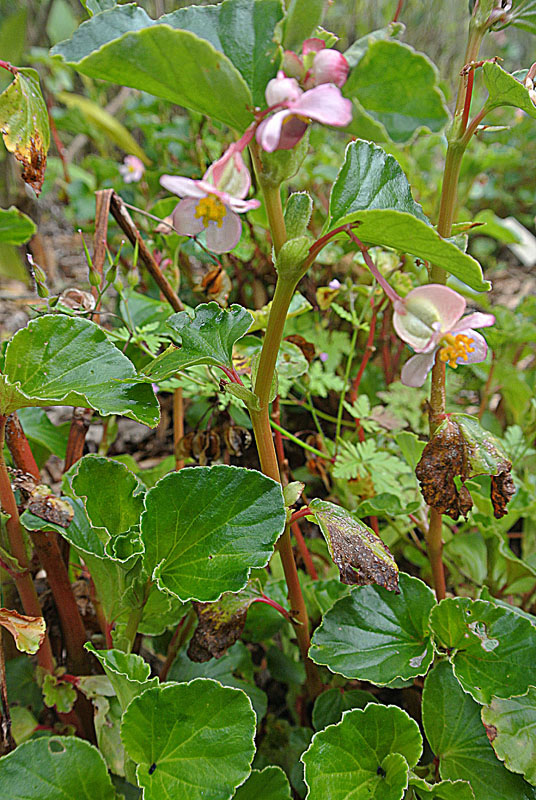
Begonia cucullata var. arenosicola is a tender evergreen perennial with succulent stems, growing to around 40cm high. Its glossy, oval to broadly elliptic leaves have toothed, often wavy edges, and in summer it carries small clusters of white flowers touched with pink.
Source: RHS
South American roots
The wider species Begonia cucullata is native to a swath of South America running from Bolivia through Brazil into northeastern Argentina, growing there as a subshrub or shrub in wet tropical habitats. It has since spread well beyond that range, becoming established in places as far apart as Florida, Hawaii, Korea, and several Indian Ocean islands. Within this species, this particular variety is one of several recognised botanical varieties.
Source: Kew
Light, soil, shelter
This begonia does best in partial shade, particularly an east, north or west-facing spot that is sheltered rather than exposed. It wants fertile, well-drained soil, either loam or sand, on the acid to neutral side, and appreciates dappled or afternoon shade even though it will tolerate most positions. It is only reliably hardy outdoors in a UK summer, so it is generally grown as bedding or in containers that can be brought indoors for winter.
Source: RHS
Seed or cuttings
Increase this plant by seed, by root cuttings, or by leaf cuttings taken in spring or summer, ideally set in a propagating case kept in partial shade.
Source: RHS
Succulent stems, toothed leaves
The plant has a bushy, evergreen habit built on succulent stems, with rounded, toothed and sometimes wavy-edged foliage. Its size stays modest, reaching only 0.1 to 0.5 metres in both height and spread at maturity.
Source: RHS
Watch for common pests
It can attract caterpillars, mealybugs, mites, thrips, vine weevil, and aphids, so it is worth checking leaves and stems regularly for early signs of any of these.
Source: RHS
Grey mould and rot
The main troubles to watch for are grey mould, powdery mildew, and stem rot, all of which tend to take hold in damp, poorly ventilated conditions.
Source: RHS
No pruning needed
This begonia asks for no pruning. As bedding or in a movable container, it is best planted out once the last frosts have passed and brought under cover again as temperatures drop.
Source: RHS
Care recipe
The species record — the baseline every cultivar inherits unless it says otherwise.
Care notes are early — not yet verified
- Light
- ai:claude-opus-4-8
- Water
- ai:claude-opus-4-8 (range 5-10d)
- Humidity
- ai:claude-opus-4-8
- Soil
- ai:claude-fable-5
- Care
- ai:claude-fable-5
Bright, indirect
≈ every 10 days
Medium
13–27 °C
Rich, well-draining potting mix
Stem cuttings rooted in water or soil
Balanced liquid feed every two weeks in growth
Fast
Free-flowering white to pink blooms much of the year
Toxic to cats & dogs
Soluble calcium oxalates — mouth irritation, vomiting; tubers most toxic. This is where toxicity lives: every cultivar of this species inherits it and none can override it.
Reference images
Every image credited. Licenses link to their deeds.
Sources: ai:claude-opus-4-8 · ai:claude-opus-4-8 (range 5-10d) · ai:claude-fable-5 · ASPCA
Kept true by its growers
Every fact here carries its source. Grow Clubed Begonia yourself? What you’ve observed — how it drinks, how it holds its color, a name that’s off — and a clear photo of your plant are exactly what keep this page honest. Contributions are reviewed before anything changes.
Sign in to add what you know →