Species · genus Begonia · Begoniaceae
Bolivian Begonia
Begonia boliviensis A.DC.
Also known as: Tuberous Begonia
Cultivars of B. boliviensis
The named forms growers keep — each with its own page, each honest about how much we know.
No named cultivars catalogued under B. boliviensis yet. When growers document a stable, named form, it earns its own page here.
Guide
The species-level account. Cultivar pages build on this and say where they differ.
A trailing Bolivian begonia
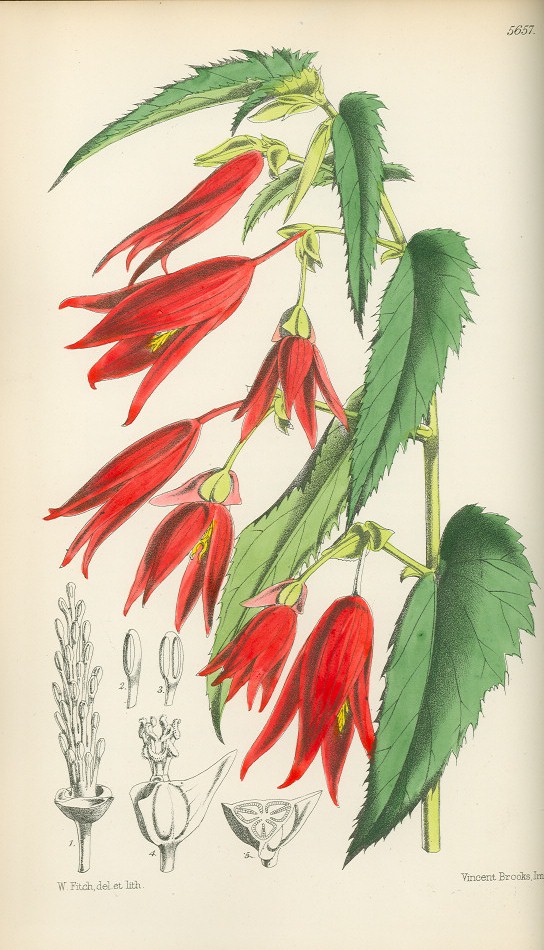
Begonia boliviensis is a tuberous, trailing perennial grown for its arching stems and cascades of drooping, single scarlet-orange flowers through summer and autumn. It reaches a modest height and spread of around 60cm, making it a natural choice for pots and hanging baskets rather than borders.
Source: RHS
From the Andes
This begonia's natural range lies in Argentina and Bolivia, and its name records that Bolivian origin. The 'Firecracker' selection is a further refinement of the species, bred for its slender orange flowers held in pendant clusters.
Source: RHS
Light, moisture, and a warm start
Grow this begonia in full sun or partial shade, in loam or sandy soil kept moist but well-drained, at a neutral pH. Tubers are best started indoors in spring in light, free-draining compost, with 'Firecracker' preferring 16-18°C to get going, and plants can then move outdoors or into pots and baskets once frost has passed. It suits a sheltered spot and is only reliably hardy outdoors in a UK summer, so containers under glass or moved indoors for winter suit it best.
Source: RHS
Cuttings, or seed
The species is propagated from basal or stem-tip softwood cuttings taken in spring or summer. 'Firecracker' can additionally be raised from seed, basal cuttings, or stem cuttings taken from sideshoots.
Source: RHS
Angel wings and trailing stems
The species carries glossy, oval, pointed leaves in the classic angel-wing shape on arching, pendulous, succulent stems. 'Firecracker' shows pointed, toothed leaves to about 13cm long, and produces slender orange flowers to 5cm long in pendant clusters through the summer months.
Source: RHS
A broad watch list
This begonia may draw caterpillars, mealy bugs, mites, glasshouse thrips, vine weevil, and aphids. None of these are unique to it, but they are worth checking for on the undersides of those glossy leaves.
Source: RHS
Rot and mildew risks
The plant can be susceptible to grey mould, powdery mildew, stem rot, and rhizome rot. These issues tend to trace back to excess moisture or poor air movement around the succulent stems and tubers.
Source: RHS
Dormancy and tidying
As the species dies back for winter, remove the old stems and foliage, then dry off the tubers and store them frost-free until spring. 'Firecracker' by contrast needs no pruning, though its tubers should still be lifted in autumn before the first frosts and dried off for the season.
Source: RHS
Care recipe
The species record — the baseline every cultivar inherits unless it says otherwise.
Care notes are early — not yet verified
- Light
- ai:claude-opus-4-8
- Water
- ai:claude-opus-4-8 (range 5-10d)
- Humidity
- ai:claude-opus-4-8
- Soil
- ai:claude-fable-5
- Care
- ai:claude-fable-5
Bright, indirect
≈ every 10 days
Medium
13–27 °C
Light, well-draining peat-based potting mix
Tubers or stem cuttings
Balanced liquid feed every two weeks while in growth
Fast
Abundant pendulous flowers through summer
Toxic to cats & dogs
Soluble calcium oxalates — mouth irritation, vomiting; tubers most toxic. This is where toxicity lives: every cultivar of this species inherits it and none can override it.
Reference images
Every image credited. Licenses link to their deeds.
PrimarySources: ai:claude-opus-4-8 · ai:claude-opus-4-8 (range 5-10d) · ai:claude-fable-5 · ASPCA
Kept true by its growers
Every fact here carries its source. Grow Bolivian Begonia yourself? What you’ve observed — how it drinks, how it holds its color, a name that’s off — and a clear photo of your plant are exactly what keep this page honest. Contributions are reviewed before anything changes.
Sign in to add what you know →