Species · genus Astrophytum · Cactaceae
Bishop's-cap
Astrophytum myriostigma Lem.
Also known as: Bishop's-cap Cactus · Bishop's-hat · Bishop's-hood · Bishop's-miter Cactus
Cultivars of A. myriostigma
The named forms growers keep — each with its own page, each honest about how much we know.
No named cultivars catalogued under A. myriostigma yet. When growers document a stable, named form, it earns its own page here.
Guide
The species-level account. Cultivar pages build on this and say where they differ.
The Bishop's Mitre Cactus
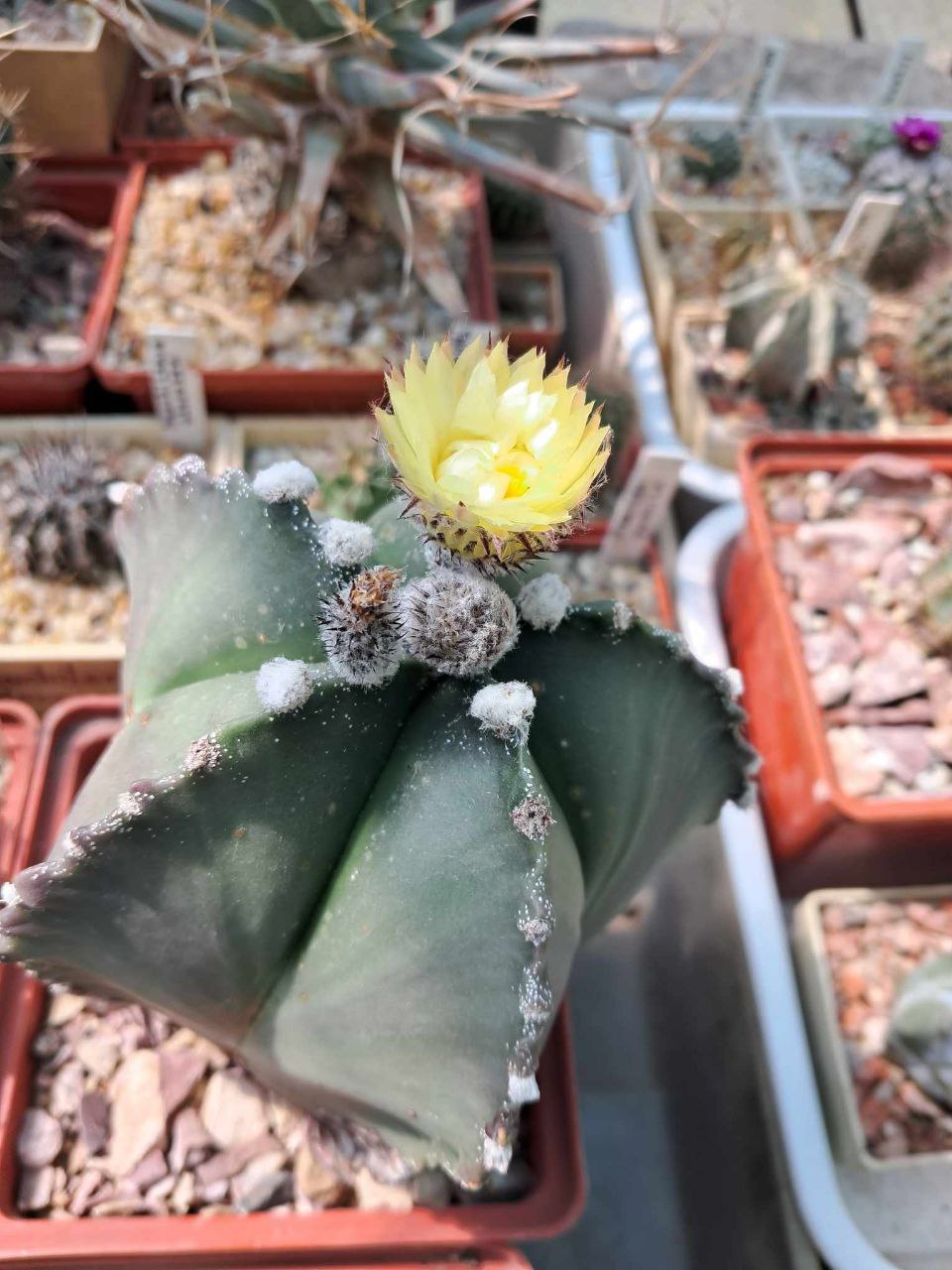
Astrophytum myriostigma is a spineless cactus that forms a rounded to shortly columnar body, divided into a handful of broad, ribbed sections. Its common names, bishop's cap or bishop's mitre, nod to its resemblance to the pointed hat worn by bishops.
Source: Missouri Botanical Garden
Highlands of Northeastern Mexico
This species is native to the rocky, lime-rich soils of the northern and central Mexican uplands, growing at elevations between roughly 2500 and 5000 feet. Kew confirms its native range as northeastern Mexico, where it grows in desert and dry shrubland habitats.
Source: Kew
Sun, Grit, and Restraint
Give this cactus full sun and a sharply draining, alkaline mix, whether that means cactus compost with limestone chippings under glass or poor, gritty soil outdoors in warmer climates. Water lightly through the growing season but hold off entirely once the plant is dormant. It tolerates dry and shallow, rocky soils without complaint and asks little beyond good light and a dry rest.
Source: RHS
Grown From Seed
Propagation is by seed, sown in early spring at around 21°C (70°F).
Source: RHS
Star-Shaped, Woolly Ribs
The genus name draws on the Greek for star and plant, a reference to its low, star-like form, while myriostigma nods to the many small woolly scales scattered across its ribs. Typically five ribs form the body, though four is possible and up to eight can occur, narrowing to an acute point and giving the plant its grey-green, felted look. With age the rib count tends to climb. Come summer, funnel-shaped flowers open, creamy white to pale yellow and fragrant, roughly 2 inches long and equally wide.
Source: Missouri Botanical Garden
Mealybugs and Scale
Mealybugs and scale are the main pests to watch for, and they are easy to miss on this plant since they can blend into its woolly, felted scales. Regular close inspection of the ribs is worthwhile for that reason.
Source: Missouri Botanical Garden
Root Rot From Wet Soil
Root rot is the chief problem, and it traces back to soils kept too moist. Otherwise this is a plant with few complaints, generally described as disease-free.
Source: Missouri Botanical Garden
No Pruning Needed
This cactus asks for no pruning at all. Suited to patio and container growing, it is a low-maintenance plant overall, needing little beyond its seasonal water rhythm.
Source: RHS
Care recipe
The species record — the baseline every cultivar inherits unless it says otherwise.
Care notes are early — not yet verified
- Light
- ai:claude-opus-4-8
- Water
- ai:claude-opus-4-8 (range 14-30d)
- Humidity
- ai:claude-opus-4-8
- Soil
- ai:claude-fable-5
- Care
- ai:claude-fable-5
Direct sun
≈ every 30 days
Low — average room
10–32 °C
Fast-draining gritty cactus mix with extra pumice
Grown from seed; offsets are rare
Dilute low-nitrogen cactus feed monthly in spring and summer
Slow
Yellow flowers on mature plants in strong light
Not yet documented
This is where toxicity lives — every cultivar of this species inherits it and none can override it.
Reference images
Every image credited. Licenses link to their deeds.
PrimarySources: ai:claude-opus-4-8 · ai:claude-opus-4-8 (range 14-30d) · ai:claude-fable-5
Kept true by its growers
Every fact here carries its source. Grow Bishop's-cap yourself? What you’ve observed — how it drinks, how it holds its color, a name that’s off — and a clear photo of your plant are exactly what keep this page honest. Contributions are reviewed before anything changes.
Sign in to add what you know →