Species · genus Asplenium · Aspleniaceae
Maidenhair Spleenwort
Asplenium trichomanes L.
Cultivars of A. trichomanes
The named forms growers keep — each with its own page, each honest about how much we know.
No named cultivars catalogued under A. trichomanes yet. When growers document a stable, named form, it earns its own page here.
Guide
The species-level account. Cultivar pages build on this and say where they differ.
A small, hardy fern
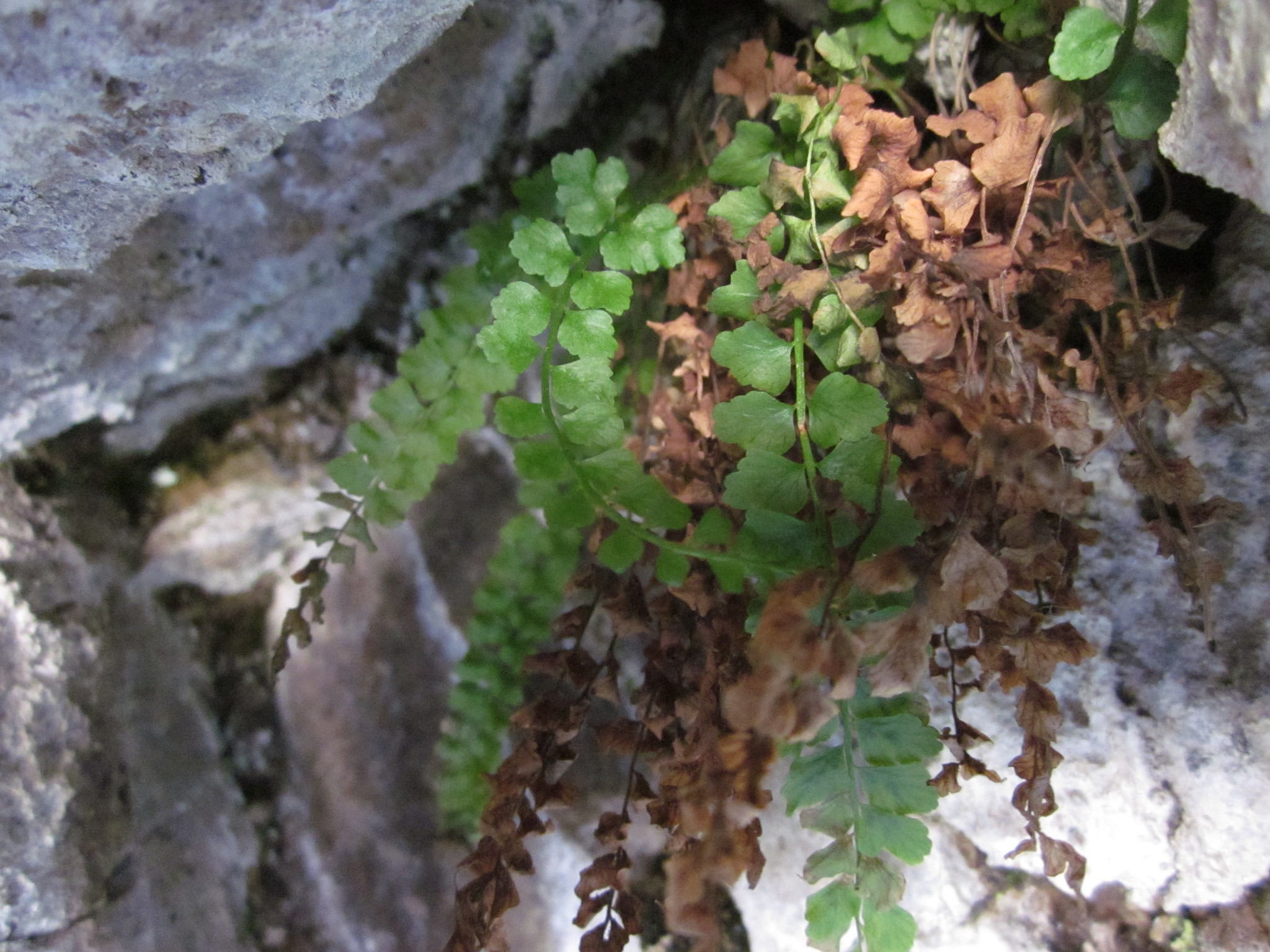
Maidenhair spleenwort is a compact evergreen fern, growing to only about 15cm tall, with a neat rosette of dark green, pinnate fronds carried on blackish stems. It is at home tucked into a dry wall or shaded corner rather than dominating a border.
Source: RHS
Widespread native fern
This is a genuinely wide-ranging species, native across the temperate and subtropical Northern Hemisphere and even reaching the Hawaiian Islands. It is one of the ferns native to Britain and Ireland, and it grows as a perennial, often rooting into rock as a lithophyte rather than only in soil.
Source: Kew
Shade, moisture, shelter
Give this fern full or partial shade and a sheltered spot, whether facing north, east or west. It wants humus-rich soil that stays moist but drains well, with some added grit, and it is equally content in chalk, clay, loam or sand as long as the pH sits neutral to alkaline.
Source: RHS
Division or spores
Increase plants by division, or raise new ones from spores sown as soon as they are ripe, kept at around 15°C.
Source: RHS
Rosette of dark fronds
The fronds are pinnate, dark green, and made up of small, rounded or oblong segments set along blackish stalks, arising from creeping rhizomes in a tufted, clump-forming habit. A related selection, the Incisum Group, carries the same small-segmented look but with more deeply cut, incised leaflets.
Source: RHS
Largely trouble-free
Grown outdoors, this fern is generally free of pests and disease, which is one of its quieter virtues.
Source: RHS
Minimal pruning needed
There is little upkeep beyond removing dead or damaged fronds as they appear; otherwise the plant is left to its own tufted growth.
Source: RHS
Care recipe
The species record — the baseline every cultivar inherits unless it says otherwise.
Care notes are early — not yet verified
- Light
- ai:claude-opus-4-8
- Water
- ai:claude-opus-4-8 (range 5-10d)
- Humidity
- ai:claude-opus-4-8
- Soil
- ai:claude-fable-5
- Care
- ai:claude-fable-5
Medium light
≈ every 10 days
High
5–21 °C
Gritty, well-draining mix with limestone; keep evenly moist
Spores; division of small clumps
Very dilute feed sparingly in spring and summer
Slow
Never flowers — a fern, reproduces by spores
Not yet documented
This is where toxicity lives — every cultivar of this species inherits it and none can override it.
Reference images
Every image credited. Licenses link to their deeds.
PrimarySources: ai:claude-opus-4-8 · ai:claude-opus-4-8 (range 5-10d) · ai:claude-fable-5
Kept true by its growers
Every fact here carries its source. Grow Maidenhair Spleenwort yourself? What you’ve observed — how it drinks, how it holds its color, a name that’s off — and a clear photo of your plant are exactly what keep this page honest. Contributions are reviewed before anything changes.
Sign in to add what you know →